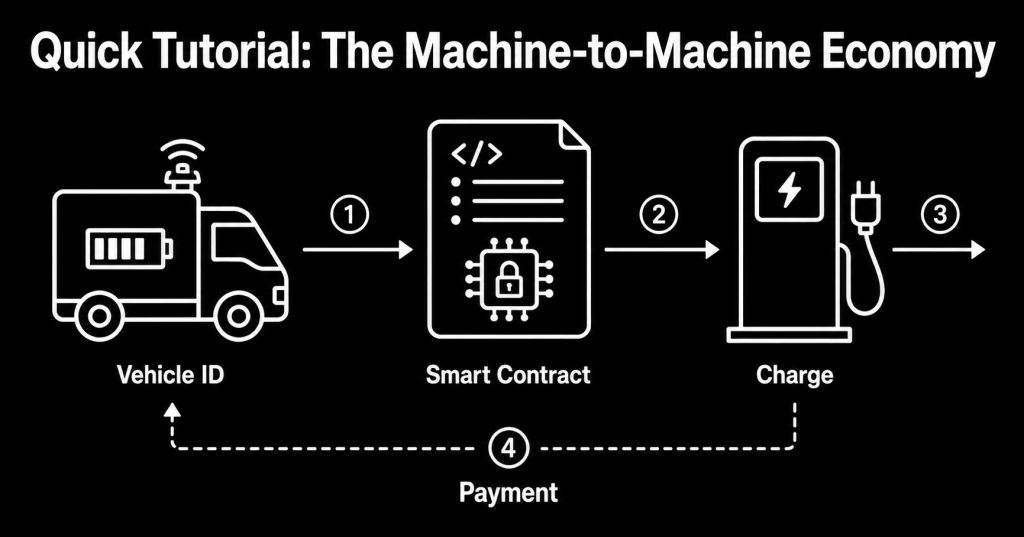


A machine economy does not begin when robots walk around with wallets. It begins much earlier, when daily human activity is converted into digital identity, digital money, automated permissions, sensor data, smart contracts, and machine-readable rules. The first stage is still people-to-people. The second is people-to-machines. The third is machine-to-machine. The danger is that each stage removes more human judgment from the transaction. Eventually, the system can continue trading, allocating, denying, and enforcing without needing people in the loop.
1. People-to-People: The Old Human Economy
The older economy was built around direct human exchange. A person paid another person. A buyer met a seller. A worker dealt with an employer. A patient spoke to a doctor. A customer spoke to a shopkeeper. Cash, checks, handwritten receipts, local credit, barter, favors, trust, reputation, and personal judgment all mattered.
That system was imperfect, but it had one major human feature: flexibility. A shopkeeper could say, “Pay me next week.” A mechanic could fix a car for a neighbor and settle later. A farmer could trade food for labor. A landlord could wait a few days. A clerk could override a mistake. A doctor could treat a person first and argue with billing later.
In the people-to-people economy, identity was partly social. People were known by family, town, work, face, voice, reputation, and relationship. A person was not merely an account number. He was someone’s neighbor, customer, patient, worker, father, widow, veteran, friend, or regular.
This is important because human economies depend on exceptions. Life is not clean. People lose jobs. Payments arrive late. ID cards expire. Systems make errors. Storms happen. Cars break down. Banks freeze accounts. Illness interrupts work. A purely rule-based economy treats these disruptions as failures. A human economy can sometimes treat them as life.
The first step toward the machine economy is the removal of that human layer. Transactions become less about direct exchange and more about authorized access. The question changes from “Do I trust this person?” to “Does the system recognize this account?”
2. Digital Payments: The Bridge Away from Human Exchange
Digital payment systems do not automatically create a dystopia. Credit cards, debit cards, mobile wallets, bank transfers, and online payments are useful. They are fast, convenient, and often safer than carrying cash. The problem begins when digital payment becomes the only practical way to participate.
Once payments become fully digital, every transaction produces data. The system can know where a person was, what he bought, when he bought it, how often he buys it, what account he used, what device he used, and whether the transaction fits his normal pattern. This creates a financial shadow of daily life.
At first, this data is used for fraud prevention, credit scoring, convenience, targeted advertising, taxes, and compliance. Later, it can be used for risk scoring, behavior prediction, account restrictions, automated denials, dynamic pricing, insurance adjustments, benefit eligibility, and law-enforcement flags.
This is where the human economy starts becoming machine-readable. The payment is no longer just a payment. It becomes a signal. It tells the system who you are, where you are, what you need, what you value, and whether your behavior fits an acceptable pattern.
The Bank for International Settlements has already described tokenization and unified ledgers as possible foundations for the next-generation monetary and financial system. Its 2025 Annual Economic Report discusses bringing tokenized central bank reserves, commercial bank money, and financial assets together on programmable platforms. That is not the same as saying every person will be forced into a dystopian payment grid, but it does show the direction of institutional thinking: money, assets, and settlement becoming more programmable, unified, and machine-executable.
3. Tokenization: Turning Reality into Machine-Readable Claims
Tokenization means converting a claim, asset, right, or unit of value into a digital token that can be recorded, transferred, programmed, or settled on a digital platform. It can apply to money, bonds, securities, real estate, commodities, carbon credits, energy credits, identity credentials, access rights, supply-chain records, and many other things.
The Financial Stability Board has described tokenization as involving financial assets such as tokenized money used for settlement and tokenized financial instruments such as securities or fund shares. The BIS has also described tokenization as a growing area of central-bank and financial-market experimentation.
The key danger is not the token itself. A token is just a digital representation. The danger is what happens when access to real life depends on tokens. Food access can become a token. Energy access can become a token. Transport access can become a token. Medical eligibility can become a token. Housing access can become a token. Work authorization can become a token. Public benefits can become a token. Carbon allowance, mobility allowance, water allocation, and device access can all become programmable permissions.
Once that happens, a person does not simply “buy” something. He requests permission from a transaction stack. The stack may check identity, wallet status, location, account balance, risk score, health status, legal status, subscription status, insurance status, carbon allowance, travel zone, credit condition, and policy rules. The transaction may be approved, delayed, repriced, reported, or denied.
That is the shift from money as a tool to money as a control interface.
4. Smart Contracts: Transactions That Execute Themselves
Smart contracts are pieces of code that execute terms automatically when conditions are met. NIST defines a smart contract as code and data deployed through cryptographically signed transactions on a blockchain network, executed by network nodes, with results recorded on the blockchain. NIST’s blockchain overview also traces the concept back to Nick Szabo’s idea of a computerized transaction protocol that executes contract terms.
In plain terms, a smart contract is a rule engine. If this condition happens, then that action happens. If delivery is confirmed, release payment. If a meter reports power use, debit the account. If a vehicle enters a toll zone, charge the wallet. If collateral falls below a threshold, liquidate the position. If identity verification fails, deny access.
Smart contracts reduce delay and remove intermediaries. That can be efficient. But it also removes mercy, context, appeal, and human judgment unless those are deliberately built back into the system.
A normal contract can be argued over. A smart contract executes. A normal clerk can override a mistake. A smart contract follows code. A normal shopkeeper can show mercy. A smart contract checks conditions. A normal court can consider circumstances. A machine transaction may deny access before a human ever reviews the case.
The danger is not that smart contracts exist. The danger is that more of life can be moved into self-executing rules that operate faster than human appeal.
5. People-to-Machines: The Consumer Becomes a Managed User
The second stage is people-to-machines. This is where a person no longer deals mainly with another person, but with a machine interface: an app, kiosk, smart lock, vending system, digital wallet, vehicle dashboard, medical portal, benefits portal, smart meter, delivery platform, or AI assistant.
This already exists. People order food through apps. Pay tolls automatically. Unlock doors with phones. Use self-checkout lanes. Receive bank fraud alerts from algorithms. Get medical results through portals. Apply for jobs through automated filters. Use smart thermostats, connected cars, wearables, and subscription devices.
The U.S. Payments Forum has discussed contextual payments involving AI, 5G, IoT, and connected devices, including examples where smart-home devices can automatically order and pay for groceries or household supplies when stock runs low. That is people-to-machines moving toward machines acting on behalf of people.
At this stage, the person is still present, but the machine mediates the transaction. The person does not negotiate with the grocery store. The app does. The person does not hand money to the driver. The platform settles. The person does not talk to the toll booth. The sensor bills the account. The person does not ask the bank clerk. The algorithm flags or clears the payment.
This creates convenience, but also dependency. If the app fails, the person cannot buy. If the account is frozen, the person cannot pay. If the device is unsupported, the person is locked out. If the biometric check fails, the person cannot enter. If the risk system flags him, the machine may deny service before any human knows he exists.
The person becomes a managed user.
6. IoT: The Sensor Layer of the Machine Economy
The Internet of Things is the physical sensing layer of the machine economy. It includes smart meters, cameras, drones, vehicles, thermostats, industrial sensors, medical devices, warehouse scanners, agricultural sensors, environmental monitors, wearable devices, smart locks, connected appliances, robotic systems, and infrastructure sensors.
NIST describes IoT products as having components that interact with the physical world through sensors or actuators and communicate through network interfaces such as Ethernet, Wi-Fi, Bluetooth, LTE, Zigbee, or other technologies. NIST also emphasizes that understanding expected IoT network behavior is important for cybersecurity and access controls.
This is important because IoT devices do not merely observe the world. Many can act on the world. A sensor measures. An actuator changes something. A smart meter reports electricity use. A smart lock grants or denies entry. A vehicle reports location. A drone observes and follows. A thermostat changes power demand. A water valve opens or closes. A robotic arm moves goods. A traffic system controls flow.
When these devices connect to payment systems, identity systems, AI systems, and ledgers, they become economic actors. A machine can detect a condition, request authorization, trigger a payment, release a service, deny access, report a violation, or call another machine.
This is the hardware foundation for people-to-machine and machine-to-machine transactions.
7. Machine-to-Machine: The Economy Without Human Handshakes
Machine-to-machine commerce is the third stage. At this stage, machines transact directly with other machines. A human may have designed the system, funded it, or set the original rules, but the day-to-day exchange happens automatically.
A solar array sells power to a building. A building pays for cooling. A cooling system buys water allocation. A smart meter reports consumption. A utility AI adjusts pricing. A warehouse robot orders parts. A drone pays for charging. A truck pays a road fee. A farm sensor purchases irrigation. A factory machine orders raw material. A data center buys power priority. A security system renews a monitoring contract. A smart contract settles the payment.
No cashier is needed. No clerk is needed. No driver is needed. No dispatcher is needed. No local shopkeeper is needed. No human handshake is needed.
This is not fantasy. The pieces already exist separately: connected devices, automated logistics, digital payments, smart contracts, AI agents, tokenized assets, real-time pricing, industrial IoT, and programmable financial infrastructure. The machine economy is what happens when those pieces are integrated.
The U.S. Payments Forum’s contextual-payments work describes IoT and connected environments where devices initiate payment-related activity. NIST defines the IoT hardware layer. NIST also defines smart contracts as executable blockchain code. BIS describes programmable tokenized ledgers as a potential future financial infrastructure. Put those together and the direction is clear: the transaction layer can become increasingly automated, programmable, and machine-readable.
8. How a Machine-to-Machine Transaction Works
A simple machine-to-machine transaction has six parts.
First, a sensor detects a condition. A battery is low. A water tank is below threshold. A server rack is overheating. A vehicle needs charging. A warehouse is low on parts. A drone needs maintenance.
Second, the machine identifies itself. It presents a device ID, cryptographic key, certificate, account, wallet, or network credential.
Third, the machine requests a service. It asks for power, water, cooling, bandwidth, road access, spare parts, compute, repair, or data.
Fourth, the system checks authorization. Is this device recognized? Is its wallet funded? Is the contract valid? Is the location permitted? Is the request within policy? Is the resource available? Is the machine trusted?
Fifth, the transaction executes. A smart contract releases payment. A ledger records the transfer. A service is provided. A valve opens. A charger activates. A gate opens. A drone launches. A robot picks the part. A network route is assigned.
Sixth, the result is logged. The machine’s status changes. The account balance changes. The inventory changes. The maintenance record updates. The risk model updates. The system learns.
That is the core of the machine economy: sense, identify, authorize, transact, act, record.
9. Why This Becomes Dangerous
The danger is not that machines can pay other machines. That may be useful for logistics, energy balancing, industrial automation, and maintenance. The danger is that human access can become secondary to machine access.
A machine can have better identity than a human. A drone may have a valid certificate, wallet, route authorization, maintenance contract, and network permission. A displaced human may have none of those things.
A machine can transact faster than a human. It can request, pay, receive, and log in milliseconds. A human may need to explain, appeal, wait, or beg.
A machine can be more legible to the system than a human. It reports clean data. It follows protocol. It has a known location, known function, known owner, known risk profile, and known maintenance schedule. A human is messy, unpredictable, emotional, biological, and difficult to optimize.
This creates a brutal possibility: machines become legitimate to one another while humans become illegitimate to the system.
The drone is recognized. The charging pad is recognized. The data center is recognized. The smart contract is recognized. The token is recognized. The grid node is recognized. The warehouse robot is recognized. The human standing outside the fence is not.
10. The Exclusion Mechanism
The machine economy does not need to announce that humans are excluded. It can exclude through requirements.
No digital identity, no access.
No wallet, no payment.
No biometric match, no entry.
No valid token, no service.
No compliance status, no travel.
No approved profile, no medicine.
No subscription, no device function.
No risk clearance, no account.
No authorized location, no movement.
No machine-readable status, no participation.
This is how exclusion becomes administrative instead of violent. The door does not open. The pump does not start. The charger does not activate. The clinic does not admit. The vehicle does not move. The account does not settle. The system does not need to hate anyone. It simply fails to recognize them.
11. From Economy to Governance
Once every transaction is digital, every transaction can become policy enforcement. Payment is no longer just payment. It becomes identity, permission, location, compliance, risk scoring, tax collection, resource allocation, and behavioral control.
A normal economy asks: can you pay?
A machine economy can ask: are you allowed to pay?
That is the key difference.
In a cash economy, money is general. If you have it, you can usually use it. In a programmable economy, money can become conditional. It may work only for certain goods, places, times, users, devices, or approved purposes. That can be sold as efficiency or safety. It can also become a control grid.
The BIS does not present tokenization as a dystopian project; it presents it as a way to improve settlement, programmability, and financial infrastructure. But the same technical features that improve efficiency can also increase control if deployed without strong rights, public accountability, cash alternatives, privacy protections, human appeal, and democratic limits.
12. The Trending Direction
The machine economy begins with convenience. Then it becomes infrastructure. Then it becomes dependency. Then it becomes exclusion.
People-to-people exchange leaves room for trust, memory, mercy, and local judgment.
People-to-machine exchange replaces human judgment with interfaces, credentials, and automated access.
Machine-to-machine exchange goes further. It allows infrastructure to operate, purchase, allocate, repair, secure, and optimize without direct human participation.
That is the danger behind the phrase “machines tending machines.” It is not just robots repairing robots. It is infrastructure serving infrastructure. Data centers buying power. Power systems feeding computation. Computation managing access. Smart contracts settling machine obligations. Drones protecting facilities. Ledgers validating ledgers. AI systems optimizing other AI systems.
At first, humans own the machines. Then humans depend on the machines. Then machines recognize other machines more reliably than they recognize people. Finally, the system can continue functioning even while more human beings are pushed outside its permissions.
That is the warning. A machine economy does not have to kill humanity to defeat human society. It only has to make participation conditional, automated, and machine-readable. Once that happens, the central question of life changes from “What do you need?” to “Does the system authorize you?”
Example: Autonomous Truck Pays Charging Station
Here is one clear technical example: an autonomous electric delivery truck pays an automated charging station without a human cashier, driver, clerk, or dispatcher.
The transaction is between two machines: the truck and the charging station. The truck needs electricity. The charging station sells electricity. A smart contract handles the terms, authorization, payment, delivery confirmation, and settlement. This is machine-to-machine commerce.
An autonomous delivery truck is driving a logistics route. Its battery drops to 18%. Its onboard AI checks its delivery schedule, remaining range, cargo priority, weather, route restrictions, and nearby charging stations. It selects a charging station that has available power, accepts machine wallets, supports the truck’s connector type, and is authorized for commercial fleet charging.
The truck is an IoT machine. It has sensors and actuators that interact with the physical world, plus network interfaces that connect it to digital systems. NIST defines IoT devices in this general way: devices with a sensor or actuator for the physical world and a network interface for the digital world. That matters because the truck is not merely a vehicle. It is a networked economic actor.
The charging station is also an IoT machine. It has power electronics, a meter, a connector actuator, a lock, a network interface, a local controller, and a digital wallet. It can identify vehicles, negotiate a charging rate, measure delivered electricity, enforce safety rules, and report the transaction to a payment or ledger system.
The process begins when the truck sends a request:
Request: Need 120 kWh chargeVehicle ID: FleetTruck-4921Wallet address: 0xA91...Route authorization: validConnector type: CCS/NACS commercialMax accepted price: $0.42/kWhRequired completion time: 42 minutes
The charging station responds:
Station ID: ChargeNode-77Available capacity: 150 kWhCurrent price: $0.37/kWhGrid condition: normalSmart contract address: 0xF22...Required deposit: 120 kWh × $0.37 = $44.40 plus service fee
At this point, the two machines have not yet exchanged electricity. They have only exchanged machine-readable credentials, pricing, and contract terms.
Junction 1: Machine Identity
The first technical junction is identity. The truck must prove it is a real, authorized fleet vehicle. The charging station must prove it is a real, authorized charging node.
This can be done through digital certificates, cryptographic keys, fleet credentials, device IDs, wallet signatures, or a trusted registry. The truck signs a message with its private key. The station verifies the signature with the truck’s public key. The station signs its own message. The truck verifies the station.
In plain terms, both machines ask:
“Are you really who you claim to be?”
This is the machine equivalent of a person showing ID, a company account, and payment method. But here, the proof is cryptographic instead of conversational.
Junction 2: Authorization
The second junction is authorization. Identity only proves the machine exists. Authorization determines whether it is allowed to transact.
The smart contract or authorization server checks:
Is the truck registered?
Is the fleet account active?
Is the wallet funded?
Is the truck allowed to charge at this station?
Is the station allowed to sell power to this fleet?
Is the vehicle in an approved location?
Is the station currently connected to available grid capacity?
Is there a regulatory, safety, or pricing restriction?
If all conditions pass, the contract permits the transaction to begin. If not, the transaction fails before charging starts.
This is where exclusion enters the machine economy. A machine with valid credentials proceeds. A human without valid credentials gets denied. The machine is legible. The human may not be.
Junction 3: Smart Contract Creation or Call
The third junction is the smart contract. In this example, the charging network already has a deployed smart contract called something like:
EnergySaleContract
NIST defines a smart contract as code and data deployed through cryptographically signed transactions on a blockchain network, executed by network nodes, with execution results recorded on the blockchain.
In plain terms, the smart contract is a self-executing rule set.
It contains logic such as:
If truck is authorizedAnd station is authorizedAnd deposit is receivedAnd meter reports delivered energyThen release payment to stationAnd issue receipt to truckElse refund unused balanceAnd log exception
The smart contract does not “understand” the transaction like a human. It follows conditions. If the data says the condition is true, it executes. If not, it denies, delays, refunds, or escalates.
Junction 4: Deposit / Escrow
Before the charging station releases power, the truck places funds into escrow.
Escrow means the money is locked inside the smart contract until the transaction is completed. The truck does not pay the station directly at first. It sends tokens, stablecoin, digital dollars, fleet credits, or another settlement asset into the contract.
Example:
Truck wallet deposits: $48.00Estimated energy cost: $44.40Network/service fee: $1.20Reserve buffer: $2.40
The smart contract now holds the money. The station can see that funds are locked. The truck can see that the station cannot take more than the contract permits. Both machines proceed because the contract enforces the terms.
This is a critical feature of machine-to-machine commerce. Machines do not need personal trust if the contract locks the value, verifies the condition, and settles automatically.
Junction 5: Physical Service Activation
Once escrow is confirmed, the charging station unlocks the connector and allows power flow.
This is where the digital transaction touches the physical world.
The station’s actuator unlocks the charging port.
The truck connects.
The station verifies electrical safety.
The meter begins measuring kilowatt-hours.
The station sends status updates to the contract or to an oracle service.
The truck monitors battery state, voltage, current, temperature, and charging rate.
The charging station is no longer just a payment terminal. It is a machine delivering a physical resource under digital contract control.
Junction 6: Metering and Oracle Data
A smart contract cannot directly “see” electricity flowing through a cable. It needs trusted data from outside the blockchain. That outside data source is commonly called an oracle.
In this example, the oracle receives signed meter readings from the charging station:
Time: 14:03Energy delivered: 22.4 kWhMeter ID: Meter-77ASignature: valid
Then later:
Time: 14:18Energy delivered: 68.9 kWhSignature: valid
Then final:
Time: 14:35Energy delivered: 119.6 kWhSession completeSignature: valid
NIST’s blockchain overview notes that a smart contract using data from outside its own system uses an oracle. This is important because the smart contract itself does not know the real world. It only knows the data reported to it.
This creates a major technical vulnerability. If the oracle lies, fails, is hacked, or reports bad data, the contract may execute incorrectly. In a machine economy, the oracle becomes a powerful junction between physical reality and digital enforcement.
Junction 7: Settlement
When charging is complete, the smart contract calculates the final amount.
Example:
Energy delivered: 119.6 kWhPrice: $0.37/kWhEnergy cost: $44.25Service fee: $1.20Total charge: $45.45Escrow deposit: $48.00Refund to truck: $2.55
The smart contract releases $45.45 to the charging station and refunds $2.55 to the truck’s fleet wallet. Then it writes the transaction result to the ledger.
The settlement record may include:
Truck ID
Station ID
Time
Location
Energy delivered
Price
Wallet addresses
Contract address
Meter signature
Completion status
Refund amount
Carbon/energy classification
Fleet accounting code
No person manually approves this. The contract executes because the conditions were met.
Junction 8: Accounting and Secondary Transactions
After settlement, other machine transactions may automatically fire.
The fleet accounting system records energy cost.
The truck updates its route plan.
The charging station updates inventory of available grid capacity.
The utility records power demand.
The station’s maintenance AI logs connector wear.
The grid AI updates load forecast.
The fleet insurer updates operating data.
A carbon-accounting system records the energy source.
A tax engine records the taxable event.
A performance dashboard updates fleet efficiency.
This is where one machine-to-machine transaction becomes part of a larger machine economy. One charging event creates financial, logistical, regulatory, energy, maintenance, insurance, and surveillance data.
Junction 9: Enforcement
If something goes wrong, enforcement is also automated.
If the truck disconnects early, the contract charges only delivered energy and refunds the rest.
If the truck tries to charge without funds, the station never unlocks.
If the station underdelivers power, payment is reduced.
If the meter reports tampering, the session is frozen.
If the truck’s wallet is flagged, charging is denied.
If the station is blacklisted, the truck refuses connection.
If grid conditions worsen, the station throttles charge rate or reprices future sessions.
This is considered efficient. It is also dangerous if the same structure controls human access to food, transport, banking, housing, energy, or medicine.
Simple Smart Contract Logic
In plain English, the contract says:
“Truck may charge only if it is authorized, the station is authorized, funds are deposited, and valid meter data proves energy was delivered. Payment is released only for actual delivered energy. Unused funds return to the truck.”
In simplified pseudo-code:
contract EnergySaleContract: function startSession(truckID, stationID, maxKWh, maxPrice): require(truckID is authorized) require(stationID is authorized) require(wallet balance >= estimated cost) lock deposit in escrow open charging session function submitMeterReading(meterID, kWhDelivered, signature): require(meterID is trusted) require(signature is valid) update delivered energy amount function closeSession(): finalCost = deliveredKWh * pricePerKWh + serviceFee pay station finalCost refund truck remainingDeposit record session as complete
This is not full production code. It is a general logic pattern. Real systems would need cybersecurity controls, error handling, dispute handling, privacy protection, oracle validation, regulatory compliance, offline fallback, and safety shutdown procedures.
This one charging event shows the whole machine economy in miniature.
The truck senses its own need.
The truck finds a machine vendor.
The station verifies the truck.
The truck verifies the station.
A smart contract locks funds.
A physical machine delivers energy.
A meter reports real-world performance.
An oracle feeds that data into the contract.
The contract releases payment.
The ledger records the transaction.
Other systems update automatically.
No human negotiation is required.
It is fast, clean, and efficient.
It is also the danger. The same pattern can control access to fuel, housing, medicine, food, roads, water, electricity, tools, communications, and public services. The system no longer asks whether a human being needs something. It asks whether the requesting entity is recognized, authorized, funded, compliant, and machine-readable.
This is the central issue. In a machine economy, the machine with the right credential may receive service instantly, while a human without the right credential may be locked out of a world full of working infrastructure.
No “inclusivity”.

 Bantam Joe
Leave a comment