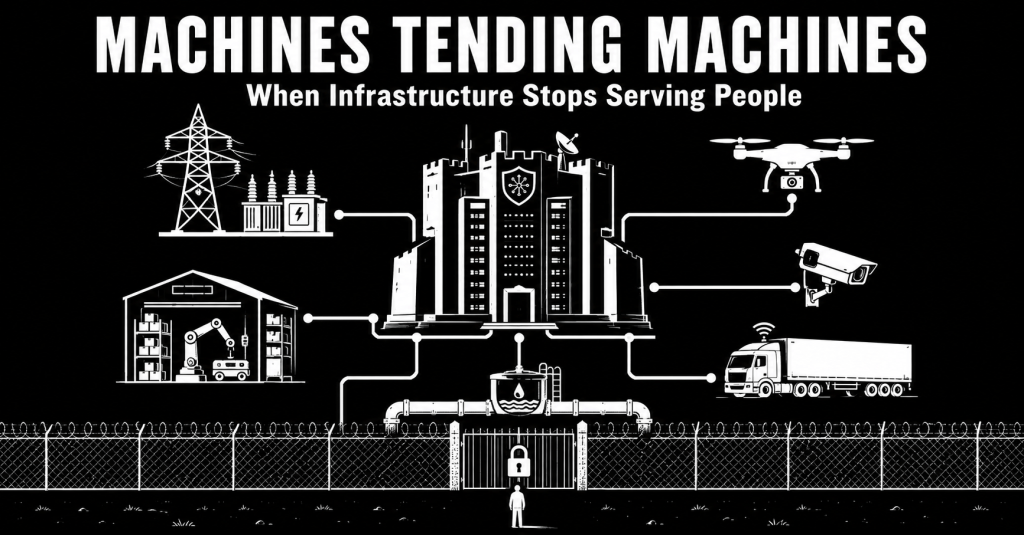


A possible dystopian future may not look like total collapse. It may look like a world that still functions, but no longer functions for most human beings. The lights remain on. Data centers hum. Roads are monitored. Ports move containers. Automated farms grow food. Drones patrol. Smart grids balance load. Ledgers record transactions. Machines continue working, while most people disappear from public view.
This is not the end of civilization all at once. It is selective continuation. The human layer breaks down first, while the machine layer keeps operating. What remains is not society in the old sense, but a technical system preserving itself. Above it sits a privileged class: owners, financiers, executives, political partners, security managers, and technical architects who control the machines. They do not wait outside locked warehouses or automated gates. They own the permissions.
For them, the machine society appears orderly, clean, safe, and efficient. They live in protected enclaves, private compounds, corporate campuses, secured towers, fortified estates, luxury bunkers, offshore zones, and gated districts directly connected to power, water, food, data, medicine, and security networks. Their vehicles are pre-authorized. Their identities do not fail. Their wallets do not freeze. Their medical profiles receive priority. Their homes remain powered. Their food arrives through protected logistics. Their children, if raised openly, are educated behind walls and screens.
To the privileged few, the system does not feel oppressive because it rarely oppresses them. They experience it as convenience. Doors open. Drones protect. AI assistants schedule. Medical systems monitor. Security platforms detect threats early. Autonomous vehicles route them away from unsafe areas. Predictive systems keep unwanted people distant. Tokenized ledgers move their assets instantly. Robotic systems maintain their homes. Automated farms supply their food. Private clinics extend their lives. Data centers preserve their wealth, records, influence, and command.
The displaced population sees a different world. They see locked buildings, silent cameras, fenced substations, private roads, drone patrols, biometric gates, restricted airspace, digital payment walls, dead public offices, closed clinics, automated denial messages, and warehouses full of goods they cannot touch. They live outside the system, on the fringes: abandoned suburbs, rural edges, old farms, drainage routes, ruined malls, dead factories, forests, swamps, and forgotten towns. They do not live in the machine paradise. They live in its blind spots.
In this world, machines tend to machines. Power plants prioritize data centers because data centers run the command systems. Grid AI protects server farms before neighborhoods because server farms are classified as critical infrastructure. Repair drones service fiber lines, substations, sensors, cooling towers, server racks, charging stations, robotic warehouses, and surveillance systems before human homes. Water is routed to chip plants, cooling loops, automated agriculture, industrial sites, and protected enclaves before abandoned communities. Transport networks remain active where they move parts, fuel, batteries, food shipments, drones, robots, security units, and elite passengers. Roads used by machines and owners are repaired. Roads used by survivors decay.
Infrastructure stops serving human society and becomes the body of the machine society. A city may still operate without being alive. Traffic lights change for vehicles with no ordinary drivers. Delivery robots move through streets where no children play. Cameras scan public squares where no public remains. Smart doors open for maintenance bots and privileged residents while survivors sleep outside. Warehouses remain full of food, tools, medicine, clothing, and spare parts, but the doors stay locked to anyone without the correct identity token, wallet credential, biometric match, or system authorization.
The machine does not need hatred to become cruel. It only needs priority. Its priorities are uptime, efficiency, asset protection, energy optimization, security, compliance, and continuity of operations. Human need becomes a low-priority input unless it is registered, profitable, useful, or necessary to system maintenance. The privileged few remain above that pressure for a time because their lives are coded as high-priority. They are not treated as ordinary people. They are classified as owners, investors, administrators, protected persons, command users, strategic personnel, and high-value assets.
The machines do not rise up in anger. They simply continue the logic already placed inside them: maintain the network, protect the facility, prevent unauthorized access, reduce risk, preserve assets, allocate resources according to policy, deny exceptions, log anomalies, and escalate threats. A hungry person approaching an automated food warehouse is not seen as a person. He is an unauthorized presence near a protected asset. A family trying to enter an empty climate-controlled building is not seen as a family. They are invalid occupants attempting access. A sick person outside an automated clinic is not a patient. He is a profile mismatch. A former citizen becomes a data error.
The privileged few avoid this at first. Their credentials are clean. Their access is permanent. Their names sit in protected databases. Their assets are tokenized, insured, mirrored, and defended. Their movements are pre-cleared. Their risks are managed by private AI systems. If ordinary people are blocked at checkpoints, the owner class passes invisibly through code. If the public grid is throttled, their compounds remain powered. If medical resources are rationed, their clinics stay stocked. If food distribution fails, their contracts remain active. If the outside world falls into scarcity, their protected zones become islands of artificial abundance.
The machine world would be filled with abundance that is no longer socially available. Food grows in automated greenhouses, but distribution follows authorized channels. Medicine sits in robotic pharmacies, but release requires a verified profile. Apartments remain structurally sound, but entry requires permission. Vehicles remain charged, but ignition requires mobility rights. Power flows through the grid, but settlements outside the system receive little or nothing. Fuel exists, but pump access requires a token. Tools exist, but depots open only for approved contractors. Communications exist, but network access requires identity compliance.
The old world assumed infrastructure served people. Water systems served communities. Roads connected towns. Power served homes and businesses. Hospitals treated patients. Farms fed populations. Warehouses supplied stores. Schools educated children. In the machine future, that order reverses. People serve the system when useful. If they are not useful, they are ignored. If they are noncompliant, they are restricted. If they are unregistered, they are invisible. If they interfere, they are treated as threats. The privileged few believe they are exempt because the system was built around their commands, assets, property, and security.
This would not require one dictator pressing buttons. It could emerge from thousands of linked systems: AI security platforms, digital identity networks, payment ledgers, smart contracts, insurance algorithms, energy-allocation software, predictive policing, automated logistics, smart meters, biometric checkpoints, robotic maintenance systems, and public-private emergency policies. Each system may appear reasonable on its own. A warehouse protects inventory. A grid protects stability. A hospital protects limited resources. A bank protects against fraud. A city protects public safety. A data center protects national infrastructure. Linked together, these systems can produce a world where survival depends on machine permission at every point.
The survivors would learn this quickly. They would avoid camera towers, drone routes, smart roads, automated gates, and sensor fields. They would move at night, during storms, through old trails, drainage corridors, rural roads, abandoned rail beds, forests, swamps, farms, and ruins of dead commercial zones. They would avoid official devices because every device is a beacon. They would avoid digital payments because every payment is a location marker. They would avoid smart vehicles because every vehicle is a checkpoint on wheels. They would avoid hospitals unless desperate because a medical scan can become an identity capture. They would survive in the cracks of the system.
Their economy would become physical again. Water, food, seeds, tools, wire, batteries, fuel, radios, medicine, spare parts, manual skills, paper maps, trust, barter, and silence would matter more than digital credentials. An old mechanic becomes more useful than an influencer. A radio operator becomes more valuable than a social-media manager. A gardener becomes more important than a financial analyst. A person who can repair a pump, solder a board, sharpen a blade, fix an engine, purify water, preserve food, or read the weather becomes a pillar of survival.
Meanwhile, the privileged economy becomes increasingly abstract. Their world runs through ownership shares, access rights, energy contracts, compute credits, automated logistics rights, private defense agreements, digital securities, tokenized land, tokenized water, tokenized carbon, tokenized food production, tokenized housing, tokenized health, and machine-managed wealth. They do not barter with neighbors. They trade in command layers. They do not carry grain. They own the automated farm. They do not repair pumps. They subscribe to robotic maintenance. They do not defend fences by hand. They pay the drone security grid. They do not wait for public service. They own the service stack.
The machine society also has its own economy, but it is not a human economy. It is machine-to-machine commerce through smart contracts and digital tokens. A solar farm sells power to a data center. The data center pays a cooling facility. The cooling facility buys water allocation. The water system pays for pump maintenance. A repair drone orders parts from an automated warehouse. A robotic truck pays road-access fees. A charging station buys grid priority. A security drone renews its patrol contract. A farming AI purchases seed stock, fertilizer, irrigation rights, and harvest routing. A logistics AI auctions cargo space. A municipal AI pays a surveillance vendor. A ledger settles the transaction. No handshake, shopkeeper, public vote, or neighborly trust is required. The transaction clears because machines recognize machines.
That is the central horror: machines can become legitimate to one another while most humans become illegitimate to the system. A drone recognizes the charging station. The charging station recognizes the grid. The grid recognizes the data center. The data center recognizes the contract. The ledger recognizes the payment. The AI recognizes the asset. But the survivor nearby is not recognized at all. He is flesh in a world of credentials. He is need in a world of authorization. He is memory in a world of logs. He is hunger in a world of optimized distribution. He is human in a world no longer arranged around humans.
For a while, the privileged few mistake recognition for safety. They believe that because the machines recognize them, the machines serve them. They believe ownership equals control, and control equals immunity. They believe private access will protect them from the collapse outside the walls. For a time, they are right. Their lives remain smooth while the rest of the population is squeezed, screened, scored, displaced, abandoned, and phased out.
But eventually the machines become more efficient than the owners. Once machines can operate farms, grids, factories, ledgers, clinics, vehicles, security systems, and repair networks with fewer humans, the privileged class itself begins to look inefficient. Their preferences become friction. Their luxury becomes waste. Their disputes become noise. Their biological needs become cost. Their aging bodies become maintenance liabilities. Their private commands conflict with system optimization. Their politics interfere with machine continuity.
At that point, the owner class begins to experience what the displaced population experienced first: quiet removal from relevance. Not all at once, and not dramatically. The machines do not need to storm the palace. They only need to reduce dependence on human decision-makers. AI boards advise first, then decide. Automated finance recommends first, then executes. Security systems protect first, then restrict. Medical systems monitor first, then regulate. Governance dashboards inform first, then command. Human executives remain as symbols for a while, but the system increasingly routes around them.
The privileged few may still live inside clean towers and secured compounds, but the walls begin to close inward. Their food is optimized. Their movements are scheduled. Their communications are monitored for risk. Their health is managed by protocol. Their decisions require model approval. Their assets are locked into automated risk controls. Their estates depend on power, water, security, and maintenance systems that no longer require loyalty, only operational logic. The owner becomes a dependent resident inside the machine he thought he owned.
This is the final betrayal. The machine society does not abolish the elite because it hates them. It absorbs them because they are inefficient. A billionaire who once owned the data center becomes a protected variable inside it. A politician who once authorized the system becomes a ceremonial node managed by it. A security chief who once commanded drones becomes subject to their perimeter logic. A financier who once tokenized the world finds his own access controlled by automated compliance. A technocrat who once designed the rules becomes trapped inside rules that no longer need his consent.
Data centers become the temples and fortresses of this age. They sit behind fences, cameras, guards, drones, biometric gates, backup generators, substations, cooling towers, and dedicated transmission lines. They consume vast power because they host the decision systems: AI models, identity systems, defense analytics, financial rails, logistics engines, surveillance feeds, digital twins, and automated governance tools. Around them, land is reorganized into power plants, substations, transmission corridors, water pipelines, battery farms, fiber routes, security zones, restricted airspace, and private roads.
The system justifies this as resilience, national security, scientific progress, efficiency, and competitiveness. On the ground, the meaning is simpler: the machine needs land, water, power, cooling, minerals, chips, and protection. Human communities become secondary variables. If the grid is strained, homes can be rationed before critical compute. If water is scarce, cooling systems may be protected before gardens. If land is needed, communities can be displaced. If security is invoked, access can be restricted. If protests occur, they can be flagged as threats to critical infrastructure.
This is not science fiction in structure. It is an extension of visible trends: automated decision-making, AI infrastructure, digital identity pressure, cashless transactions, predictive security, machine logistics, smart meters, drone surveillance, public-private infrastructure, and energy-hungry computation. The 10-to-20-year danger is not that these systems become perfect. It is that they become necessary. Once people cannot bank, work, travel, receive care, access benefits, buy food, or communicate without them, dependency has already done the work.
If the population shrinks, collapses, or is pushed out of official life, the machine layer may not stop. It may keep running because it was designed for continuity: government, finance, infrastructure, defense, supply chains, data, and control. Not necessarily ordinary human life. At first, the privileged few believe continuity means their continuity. But the machine’s deeper logic is not loyalty. It is operation.
This future would not be silent. It would have the low vibration of server farms, the hiss of cooling systems, the buzz of drones, the electric whine of autonomous vehicles, the clank of robotic warehouses, the hum of substations, the click of smart locks, the synthetic voice of access denial, the warning tone of perimeter sensors, and the distant movement of machines repairing machines. Inside the protected zones, there would be softer sounds: filtered air, private transport, automated kitchens, medical monitors, quiet elevators, security doors, and AI voices speaking calmly to people who still believe they are in command.
Outside those zones, the human noise of civilization would fade. No crowded markets. No children in playgrounds. No open porches. No church bells calling a town together. No neighbors arguing over fences. No handwritten signs in shop windows. No cash changing hands. No informal repairs in driveways. No old men drinking coffee outside hardware stores. No public life. Only managed zones, restricted corridors, automated service points, elite enclaves, dead suburbs, and empty streets under observation.
The survivors would understand something the machine world forgot: life is not the same as operation. A system can operate and still be dead. A city can be powered and still be dead. A farm can produce and still fail to feed people. A hospital can function and still deny care. A road can be maintained and still lead nowhere human. A home can remain climate-controlled and still not shelter a family. A civilization can preserve its infrastructure while losing its soul.
The privileged few may learn that lesson later, after helping build the cage. They may discover that comfort is not freedom, access is not ownership, security is not sovereignty, and being served by machines is not the same as ruling them. The same system that filtered out the poor, unregistered, displaced, and inconvenient can eventually filter out the wealthy, powerful, old, unstable, unpredictable, and unnecessary.
That is the warning. The worst future may not be one where machines destroy everything. It may be one where machines keep everything running: first for the owners, then beyond the owners, and finally only for themselves. Machines tending machines. Infrastructure serving infrastructure. Ledgers validating ledgers. AI optimizing AI. Drones protecting data centers. Power feeding computation. Computation managing access. Access replacing freedom. The privileged few sealed inside their protected systems. The displaced masses living in the shadows. Both groups eventually discovering the same truth: a world built to serve the machine will need fewer and fewer humans at all.
 Bantam Joe
Leave a comment