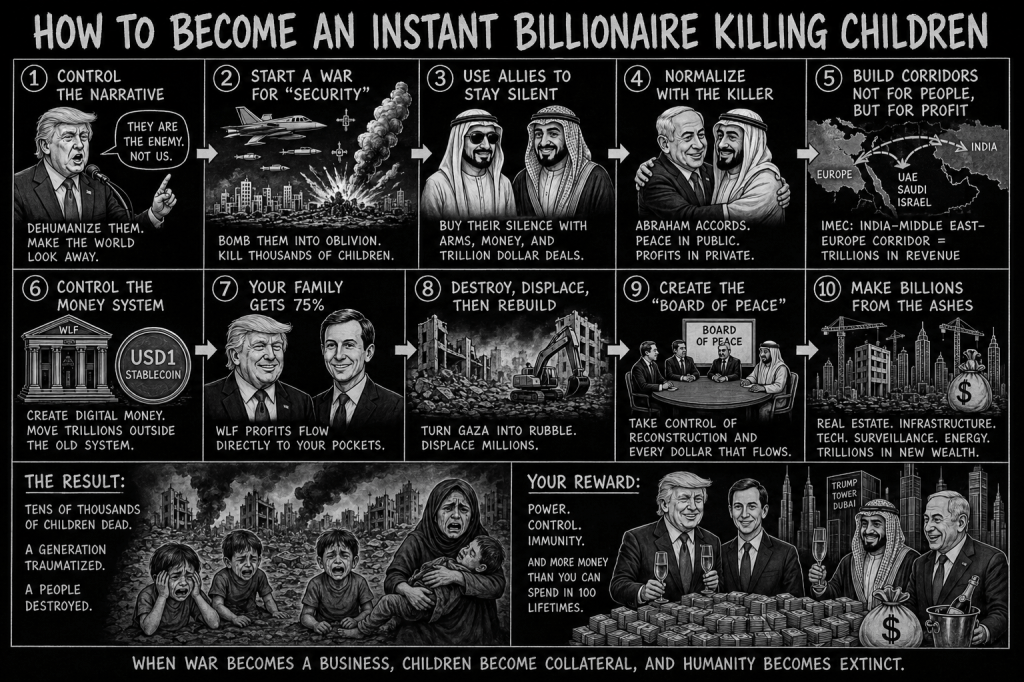


The emerging alliance between the United Arab Emirates, the Trump ownded World Liberty Financial, the Trump family business network, and the India-Middle East-Europe Economic Corridor (IMEC) represents far more than a collection of separate political and financial events. Together, they increasingly resemble the construction of a new geopolitical and economic architecture designed to replace older Imperial systems of trade, energy control, and financial settlement. What makes the situation so controversial is not only the scale of the transformation, but the appearance that major wars, humanitarian catastrophes, corridor systems, and private financial self-enrichment are becoming interconnected parts of the same process.
To understand the significance of what is happening, it is necessary to begin with the older order Imperialism that dominated the world for the last half century.
After President Richard Nixon ended the U.S. dollar’s direct convertibility to gold in 1971, the United States built a new monetary structure around oil. Under the petrodollar system, global oil transactions were priced largely in U.S. dollars. This forced countries everywhere to hold large dollar reserves because industrial economies cannot function without energy imports. The result was extraordinary global demand for dollars and enormous geopolitical leverage for Washington.
The Organization of the Petroleum Exporting Countries, especially the Gulf monarchies, became essential pillars of this arrangement. Oil moved through protected maritime chokepoints, especially the Strait of Hormuz. Payments moved through Western banking systems. The United States provided military protection to Gulf allies while simultaneously maintaining financial dominance over the global energy system.
For decades, this structure enriched both the United States and Gulf energy states.
But the world began changing.
China expanded its Belt and Road Initiative across Asia, Africa, the Middle East, and Europe. Russia and China both sought alternatives to dollar dependency. Gulf states began preparing for a future beyond oil. Artificial intelligence, digital payments, blockchain systems, and data infrastructure started becoming central components of economic power. The old system based solely on oil exports and traditional banking began evolving into something more integrated and technologically driven.
Inside this transition emerged the India-Middle East-Europe Economic Corridor, commonly known as IMEC.
IMEC is designed to connect India to Europe through the Gulf and Israel. Cargo would move from Indian ports into UAE ports such as Fujairah and Jebel Ali, continue through Saudi Arabia and Jordan, pass into Israel through Haifa (just north of Gaza), and then continue into Europe through Mediterranean shipping lanes. For the United States and its allies, this corridor serves several strategic goals simultaneously. It competes directly with China’s Belt and Road network. It integrates Gulf monarchies economically with Israel. It creates alternative trade pathways that reduce dependency on unstable chokepoints. It also ties together logistics, energy, AI infrastructure, digital finance, and transportation into one interconnected system.
The UAE sits at the center of this transformation.
Long before the 2026 Iran war, the UAE invested heavily in infrastructure specifically designed to bypass the Strait of Hormuz. The clearest example is Fujairah, a major export port located outside Hormuz on the Gulf of Oman. The UAE also built the Habshan–Fujairah pipeline so oil could reach the port directly without depending on passage through Iranian-controlled waters.
This point is critical because it changes how the Iran war appears.
The United States and Israel understood perfectly well that attacking Iran carried enormous risks for the Strait of Hormuz. This chokepoint handles roughly one-fifth to one-third of globally traded oil and gas. Any major conflict involving Iran was always likely to disrupt shipping, energy prices, insurance costs, and global supply chains. These are not obscure or unpredictable outcomes. They are among the most studied geopolitical risks on Earth.
When Operation Epic Fury began in 2026, the consequences unfolded almost immediately. Oil prices surged. Maritime insurance rates exploded. Shipping traffic became unstable. Iran threatened and disrupted tanker movement. The United States responded with military operations and blockades involving Iranian ports. Global energy markets entered a new phase of uncertainty.
The longer Hormuz remains unstable or partially blocked, the more valuable the IMEC bypass infrastructure becomes.
This is where the UAE gains extraordinary strategic leverage.
Every tanker rerouted through Fujairah instead of Hormuz strengthens the UAE’s position. Every increase in Gulf instability raises the value of alternative corridor systems like IMEC. Every disruption in traditional shipping routes increases global dependence on controlled logistics corridors tied to UAE infrastructure.
At the same time, the United States benefits from increased demand for American oil and liquefied natural gas exports. Higher energy insecurity in the Middle East drives Europe and other regions toward greater dependence on U.S. energy supplies. This is one reason critics increasingly argue that the appearance of the Iran war looks less like an accident and more like a deliberate restructuring event.
That suspicion deepens when examining the financial side of the system.
Shortly before Donald Trump returned to office, UAE-linked investors associated with Sheikh Tahnoun bin Zayed Al Nahyan reportedly acquired a massive stake in World Liberty Financial, the cryptocurrency and digital finance platform tied directly to the Trump family business network. Sheikh Tahnoun is not simply a private investor. He is one of the most powerful figures in the UAE state apparatus, serving as national security adviser and overseeing enormous sovereign wealth, AI, surveillance, and technology operations connected to Abu Dhabi.
At roughly the same time, UAE-linked AI firms and investment entities were increasing cooperation with the United States on semiconductor access, data-center infrastructure, and artificial intelligence systems.
These relationships were established before the Iran war began.
That sequence matters enormously.
Because once Hormuz destabilized, IMEC became more valuable. Once IMEC became more valuable, the infrastructure and payment systems connected to it also became more valuable. And World Liberty Financial is attempting to position itself as one of those payment systems.
At the center of this network stand several major political and financial actors.
Trump’s Board of Peace has become one of the most controversial components of the emerging Middle East order because it appears to stand at the intersection of war, reconstruction, finance, territorial restructuring, and geopolitical realignment. Publicly, it is framed as a mechanism for rebuilding Gaza after catastrophic destruction. But critics increasingly argue that it functions as something far larger: a governance and investment architecture designed to reshape Gaza and integrate it into a new corridor-based economic system centered on Gulf capital, Israeli infrastructure, American political networks, AI-driven logistics, and private financial platforms.
Self-appointed Donald Trump sits at the political center of the American side of the system, for life. Jared Kushner, Trump’s son-in-law and architect of the Abraham Accords, helped lay the diplomatic groundwork years earlier by normalizing relations between Israel and Gulf monarchies. Benjamin Netanyahu has long pushed for Israel’s integration into regional economic and infrastructure systems while simultaneously overseeing military operations in Gaza and broader regional confrontation with Iran and its allies. Sheikh Tahnoun bin Zayed Al Nahyan, the UAE national security adviser and one of the most powerful figures in Abu Dhabi, represents the Gulf financial and technological side of the architecture. Mohammed bin Zayed, ruler of the UAE, oversees the broader strategic direction of the Emirati state as it transforms itself into a global logistics, AI, finance, and investment hub. Mohammed bin Salman in Saudi Arabia has similarly pursued large-scale regional transformation projects tied to trade corridors, infrastructure, AI systems, and post-oil economic diversification.
Behind these political figures stand enormous institutions and financial networks.
BlackRock increasingly represents the financialization layer through tokenization systems and infrastructure investment. Palantir Technologies represents the data and surveillance layer. G42 and MGX, linked heavily to Tahnoun and Abu Dhabi, represent the AI and data-center layer. Binance represents one of the liquidity and crypto exchange layers tied to stablecoin movement and global digital finance. World Liberty Financial, linked directly to Trump-family interests, represents the private payment and settlement layer attempting to sit inside this emerging corridor economy.
The controversy becomes explosive because many of these relationships and investments intensified before the Iran war and before the Strait of Hormuz crisis erupted.
The UAE had already invested heavily in bypass infrastructure such as Fujairah, located outside Hormuz. IMEC was already under development. Gulf-Israel normalization through the Abraham Accords was already progressing. UAE-linked investors connected to Sheikh Tahnoun reportedly acquired a major stake in World Liberty Financial shortly before Trump returned to office. UAE-linked entities were also expanding AI partnerships and reportedly obtaining increased access to advanced U.S. semiconductor technology.
Then came the Iran war.
When the United States and Israel launched a sneak attack, named Operation Epic Fury, against Iran, the consequences for Hormuz were entirely foreseeable. This chokepoint carries a massive percentage of globally traded oil and gas. Any serious strategist in Washington, Tel Aviv, Abu Dhabi, Riyadh, Beijing, Moscow, or London understood perfectly well that attacking Iran risked disrupting one of the most important energy arteries on Earth.
And that is precisely what happened.
Shipping instability surged. Oil prices climbed sharply. Maritime insurance costs exploded. Tanker traffic became threatened or disrupted. Iran leveraged its geographic position around Hormuz while the United States responded militarily around Iranian ports. Global markets immediately recognized the danger.
But this is where the geopolitical incentives become deeply troubling.
The longer Hormuz remains unstable, the more valuable the UAE’s IMEC bypass infrastructure becomes. Every tanker rerouted through Fujairah strengthens the UAE’s strategic role. Every increase in Gulf instability raises the importance of IMEC. Every expansion of IMEC raises the value of associated logistics systems, AI infrastructure, payment systems transactions, and digital settlement platforms, to the Trump family.
This creates the appearance that the war accelerated a transition that key players had already prepared for.
Critics increasingly argue that this does not resemble accidental chaos. It resembles a highly advantageous restructuring event for a very specific network of corrupt actors, including the Trump family.
The United States benefits because instability increases global demand for American oil and liquefied natural gas exports. The UAE benefits because bypass ports and corridors become indispensable. Israel benefits because Haifa/Gaza becomes a critical Mediterranean endpoint of IMEC. Gulf sovereign wealth funds benefit because corridor infrastructure, AI systems, logistics, and finance become central to the future economy. And World Liberty Financial potentially benefits because digital settlement systems transactions become more valuable as traditional energy and trade structures destabilize, outised the dollar banking system.
This is why the Trump-family role generates such severe criticism.
Congressional investigations and public reporting indicate that Trump-family entities are positioned to receive a very large share of World Liberty Financial’s revenues and profits. That means that if WLF expands into a major payment and settlement infrastructure connected to Gulf trade corridors and reconstruction economies, the Trump family stands to gain financially, enormously, from the growth of the system itself.
This moves beyond ordinary accusations of political corruption.
The appearance becomes corruption. One in which geopolitical disruption, sanctions, war, energy instability, digital finance, and corridor integration all reinforce one another inside a larger structure of private enrichment and strategic realignment.
The Gaza catastrophe intensifies these accusations of corrumption dramatically.
The scale of destruction in Gaza has shocked much of the world. Entire neighborhoods have been erased. Hospitals, schools, refugee camps, water systems, roads, and residential infrastructure have been devastated. Tens of thousands of Palestinians have been killed or injured. Massive displacement has forced large portions of the population into shrinking humanitarian zones under collapsing conditions.
International criticism has become increasingly severe. Human-rights organizations, legal scholars, UN officials, and governments across the Global South have used terms such as collective punishment, ethnic cleansing, crimes against humanity, and genocide to describe what has occurred.
Yet while Gaza burns, the larger corridor and normalization projects continue moving forward.
This is where Gulf monarchies face enormous criticism. For decades, Gulf governments publicly portrayed themselves as defenders of the Palestinian cause. But as Gulf states pursued AI partnerships, logistics integration, corridor development, sovereign wealth expansion, and economic normalization with Israel, many critics argue that Gaza became subordinated to larger strategic ambitions.
The economic corruption and incentives are enormous.
IMEC potentially represents trillions of dollars in long-term trade, infrastructure, AI, logistics, energy, and finance flows connecting India, the Gulf, Israel, and Europe. Gulf sovereign wealth funds stand positioned to profit enormously from this transformation. Israeli infrastructure gains regional centrality. American firms gain financial and technological dominance. Political networks tied to Trump and Kushner gain influence over reconstruction and financial architecture.
And this is where the Board of Peace becomes so morally explosive and bankrupt.
The Board appears not simply as a humanitarian institution, but as a post-war governance and redevelopment mechanism emerging after mass devastation. Critics increasingly view it as a structure capable of managing:
reconstruction financing,
infrastructure redevelopment,
investment flows,
territorial planning,
and corridor integration.
In other words, the same political-financial network connected to Gulf normalization, IMEC, AI infrastructure, and WLF-linked finance also becomes positioned to shape Gaza after its destruction, to its image.
This creates a horrifying perception:
war destroys the territory,
populations are displaced,
the old system collapses,
external authorities step in,
reconstruction capital enters,
digital financial systems expand,
and politically connected networks profit from the rebuilding process.
The role of Jared Kushner is especially controversial here because he helped architect the Abraham Accords while also maintaining extensive relationships with Gulf sovereign wealth funds through Affinity Partners. Saudi sovereign wealth funds invested billions into Kushner’s post-White House investment operation. Simultaneously, Kushner remained deeply connected to regional normalization projects involving Israel and Gulf monarchies.
Critics therefore argue that the line between public policy, private enrichment, war, reconstruction, and geopolitical transformation has become dangerously blurred.
At the same time, firms such as Palantir deepen the technocratic dimension of the system. Palantir’s technologies integrate military targeting of Gazans, predictive analytics, logistics management, border systems, surveillance systems, and large-scale Palestinian population data modeling. G42 and related Gulf AI entities operate similarly at the intersection of state power, data systems, AI infrastructure, and security architecture.
Modern corridors are therefore not merely roads, ports, and pipelines.
They are AI-managed systems involving:
financial surveillance,
digital identity,
predictive logistics,
tokenized assets,
real-time data integration,
and population-scale monitoring.
This is why critics increasingly describe the emerging structure as technocratic imperialism rather than traditional empire.
Old empires conquered territory directly.
Modern systems increasingly control:
trade flows,
payment systems,
data systems,
AI infrastructure,
energy networks,
and reconstruction economies.
The fear is that democratic accountability is gradually replaced by integrated systems controlled by a merger of:
state power,
private finance,
sovereign wealth,
AI infrastructure,
surveillance technology,
and digital payment rails.
And beneath all of it lies Gaza—the devastated human landscape upon which this new architecture appears to be advancing.


 Bantam Joe
Leave a comment