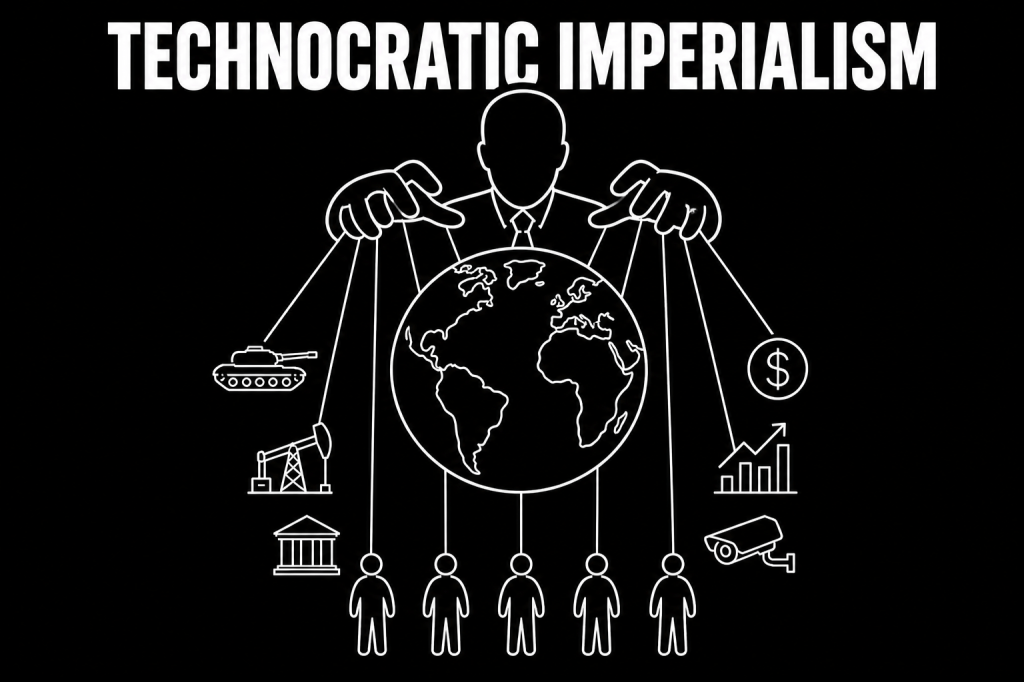


Who are we and how did we get here? And where are we going from here? We could go back two thousand years, but then this article would be too large to read. Instead, let’s go back 200 years. Let’s start with American Imperialism.
American imperialism did not begin with modern corporations, digital currencies, artificial intelligence, or trade corridors. It began with doctrine, land, and the assertion that the United States had the right to define the political order around it.
In 1823, President James Monroe announced what became known as the Monroe Doctrine. Publicly, it warned European powers not to interfere in the Western Hemisphere. In practice, it established the Western Hemisphere as a U.S. sphere of influence. It was the first major framework for American regional dominance. The message was simple: Europe should stay out, and the United States would decide what kind of political and economic order would exist in its hemisphere.
That doctrine did not remain symbolic. Over time, it became the foundation for intervention in Latin America and the Caribbean. It gave the United States a standing justification to interfere whenever another country’s government, resources, ports, trade routes, or political alignment conflicted with U.S. interests. The Monroe Doctrine began as a warning to Europe, but it evolved into a claim of American authority.
This logic expanded under Manifest Destiny. Manifest Destiny presented U.S. expansion across North America as natural, moral, and inevitable. In reality, it was a doctrine of territorial acquisition. It justified war, displacement, legal reclassification of land, and economic integration of conquered territory into the expanding American system.
The clearest example is the Mexican–American War of 1846–1848. Under President James K. Polk, the United States annexed Texas in 1845 and then entered a border dispute with Mexico. Mexico considered the Nueces River the boundary of Texas. The United States claimed the Rio Grande. Polk sent U.S. troops into the disputed zone. Fighting broke out in April 1846, and Polk used that clash to obtain a declaration of war from Congress.
The war was not defensive in any meaningful strategic sense. It was expansionist. U.S. forces advanced into northern Mexico, attacked Veracruz from the sea, pushed inland, and occupied Mexico City in September 1847. Mexico was forced to negotiate under military defeat and occupation.
The Treaty of Guadalupe Hidalgo, signed on February 2, 1848, forced Mexico to cede roughly 525,000 square miles (about 55 percent of its national territory) to the United States. The territory included all of present-day California, Nevada, and Utah; most of Arizona and New Mexico; and parts of Colorado, Wyoming, Kansas, and Oklahoma. The United States paid $15 million and assumed about $3.25 million in claims, but the transaction occurred under the pressure of conquest.
The treaty included protections for Mexican citizens and property rights in the ceded territories, but those protections were weakened. The U.S. Senate removed Article X, which would have guaranteed recognition of existing Mexican land grants. In practice, many Mexican landowners lost property through legal disputes, taxation, fraud, and administrative pressure. The land was absorbed into the American system, and many of the people already living there were pushed aside economically and politically.
The economic value of the conquest appeared almost immediately. Gold was discovered at Sutter’s Mill in California in January 1848, just before the treaty was signed. The California Gold Rush followed in 1849. Population surged, capital flowed west, rail and port development accelerated, and California became one of the most economically important regions in the country. The seized territory also contained vast agricultural zones, mineral wealth, future oil and gas regions, and Pacific ports such as San Francisco and San Diego, which opened American trade toward Asia.
The pattern was already clear: military pressure created the transfer, law legitimized it, settlement consolidated it, and economic extraction gave it value.
The Homestead Act of 1862 extended this same imperial process internally. Signed by President Abraham Lincoln, it offered settlers access to land under federal law. It is often remembered as a policy that helped ordinary Americans build farms and homes. That is only part of the story. Much of the land distributed through homesteading was already inhabited, used, or claimed by Indigenous Native American nations.
The Homestead Act helped convert Indigenous land into settler property. It supported a process in which Native populations were killed, displaced, confined, and stripped of land through war, broken treaties, forced removals, and federal policy. Land was surveyed, divided, titled, and transferred into private ownership. What had been Indigenous territory became federally administered property, then settler farmland, towns, rail corridors, and extractive economic zones.
This is why the Homestead Act belongs in any serious discussion of American imperialism. It was not just a domestic land policy. It was a legal mechanism for internal colonization. It turned conquest into paperwork. The same structure appears again and again in later imperial behavior: weaken or remove the existing population, reclassify the land, assign new legal ownership, then integrate it into a larger economic system.
By the late nineteenth century, the United States moved from continental empire to overseas empire. Hawaii is one example. In 1893, U.S.-aligned corporate interests helped overthrow Queen Liliʻuokalani. American sugar interests and strategic Pacific positioning were central to the move. Hawaii was annexed in 1898. This gave the United States a major Pacific foothold and strengthened its naval reach.
The Spanish–American War of 1898 expanded this overseas system further. The United States gained control over Puerto Rico, Guam, and the Philippines. Cuba was not formally annexed, but it was placed under heavy U.S. influence through the Platt Amendment, which gave the United States broad authority to intervene in Cuban affairs and secured the Guantánamo Bay naval base.
The Philippines resisted U.S. rule, leading to the Philippine–American War from 1899 to 1902. The United States suppressed Filipino independence through military force. This was not liberation. It was colonial administration by another name. The Philippines gave the United States a strategic position in Asia, access to Pacific trade, and a military platform near China.
Infrastructure then became a central tool of empire. In 1903, the United States supported Panama’s separation from Colombia and then secured control over the Panama Canal Zone. The Panama Canal was not merely an engineering project. It was a global chokepoint. It allowed the United States to control movement between the Atlantic and Pacific Oceans. Whoever controlled the canal controlled a major channel of global trade and naval movement.
In 1904, President Theodore Roosevelt expanded the Monroe Doctrine through the Roosevelt Corollary. This declared, in effect, that the United States could intervene in Latin America and the Caribbean to maintain order and protect property. The result was repeated U.S. involvement in countries such as Cuba, Nicaragua, Haiti, the Dominican Republic, and Panama. These interventions were justified as stabilization, but they protected U.S. creditors, corporations, customs revenue, ports, and strategic access.
By the early twentieth century, the American imperial model was fully formed. It did not always require annexation. It could operate through occupation, debt control, military bases, customs administration, corporate pressure, legal arrangements, and friendly governments. The United States had learned that direct ownership was not always necessary. Control over the rules, routes, money, and governing structures could produce the same result.
After World War II, this model became more global and more indirect. The language changed to anti-communism, democracy, security, development, and stability. But the resource logic remained visible.
In Iran in 1953, Prime Minister Mohammad Mossadegh nationalized the country’s oil industry, threatening Western oil interests, especially British control through the Anglo-Iranian Oil Company, later known as BP. The CIA and British intelligence supported Operation Ajax, which removed Mossadegh and installed the Shah. The public framing was anti-communism and stability. The material issue was oil.
In Guatemala in 1954, President Jacobo Árbenz pursued land reform that affected the United Fruit Company, a powerful U.S. corporation with large landholdings. The CIA backed a coup that removed Árbenz. The result was the protection of U.S. corporate land interests and decades of violence and instability in Guatemala. Again, the public language was anti-communism. The material issue was land and corporate control.
In Congo after independence in 1960, Prime Minister Patrice Lumumba sought real sovereignty over a country rich in copper, cobalt, uranium, diamonds, and other strategic minerals. Lumumba was removed and assassinated in 1961 with Western involvement and complicity widely documented in historical accounts. Congo’s minerals were not incidental. They were central to global industrial and military systems, and they remain central today in the battery, electronics, and green-energy economy.
In Chile in 1973, President Salvador Allende nationalized major industries, including copper. U.S. corporations such as Anaconda and Kennecott had major interests in Chilean copper. The Nixon administration and the CIA supported destabilization efforts that helped create the conditions for General Augusto Pinochet’s coup. Allende died during the coup, and Pinochet’s dictatorship imposed market reforms favorable to Western-aligned capital. The public justification was anti-communism. The deeper issue was copper, economic sovereignty, and control over national resources.
By the late twentieth century, the United States had moved from territorial empire to financial empire. The key moment came in 1971, when President Richard Nixon ended the dollar’s convertibility into gold. The dollar needed a new foundation. Oil became that foundation.
The petrodollar system tied global oil trade to the U.S. dollar. Countries needed dollars to buy oil. Oil-producing states accumulated dollars and recycled them into U.S. financial markets. This maintained global demand for the dollar and gave the United States extraordinary leverage. The United States could influence the world through dollar clearing, banking access, Treasury markets, sanctions, IMF and World Bank programs, and the SWIFT financial messaging system.
This was empire without formal occupation. A country did not need to be invaded if its banking access, trade credit, currency stability, or sanctions exposure could be controlled. The dollar became a weaponized infrastructure.
By the early twenty-first century, however, this system began to weaken. The dollar remained dominant, but monopoly control eroded. China built the Belt and Road Initiative, creating ports, railways, highways, pipelines, and trade corridors across Asia, Africa, the Middle East, and Europe. China also expanded alternative payment systems and settlement mechanisms. Russia developed sanctions bypass methods. BRICS countries discussed alternative financial arrangements, even though they remained divided. Gulf states began positioning themselves as independent infrastructure, energy, and finance hubs.
The global system began shifting from one dominant architecture to several competing systems.
One particular system is at the helm of United States President Donald Trump: The World Liberty Financial platform.
This is not a neutral technology platform sitting outside politics. It is a Trump-family-linked crypto and stablecoin venture. A February 2026 House Select Committee letter to WLF co-founder Zach Witkoff states that the Trump family was reported to receive 75% of WLF’s profits, believed to come principally from token issuance and the stablecoin business. That means increased use of WLF’s tokens or stablecoin rails would not merely benefit an anonymous platform; it would financially benefit the Trump family and aligned insiders.
The timing is essential. Reporting from the Wall Street Journal, summarized by Fortune, described a $500 million investment into World Liberty Financial backed by Sheikh Tahnoun bin Zayed Al Nahyan, the UAE national security adviser and brother of the UAE president. Fortune reported that the deal was signed four days before Trump took office in January 2025 by lieutenants tied to the Abu Dhabi royal family, while those same figures also held senior roles linked to G42, the UAE-backed AI and technology firm.
That makes the sequence highly troubling. Before the Iran war, before the Hormuz disruption, and before the UAE’s OPEC exit, UAE-linked capital had already moved into a Trump-family-linked financial platform. That same UAE network was tied to AI infrastructure interests, and public reporting described subsequent access to tightly guarded American AI chips. This is not a clean separation between public policy and private business. It is a convergence of foreign sovereign capital, presidential family enrichment, AI infrastructure, and Middle East strategy.
The UAE’s role cannot be treated as incidental. The UAE was already positioned with having built a physical bypass infrastructure outside Hormuz, especially Fujairah. It was already part of the IMEC corridor logic. It had already moved capital into WLF. Then, during the Iran war and Hormuz crisis, the UAE announced its exit from OPEC effective May 1, 2026. Reuters reported that this was a major shift in the global oil landscape, weakening OPEC’s influence and giving the UAE more independence over production strategy.
The hard conclusion is that this does not look like random adaptation after a crisis. It looks like pre-positioning. The UAE was not merely reacting to Hormuz disruption. It already had a bypass route. It already had corridor relevance. It already had financial linkage to WLF. When the Iran war disrupted the old energy system, the UAE was one of the actors most prepared to profit from the rerouting.
The same criticism applies to the United States and Israel. A U.S.-Israel attack on Iran could not plausibly ignore the likely consequences for Hormuz. The Strait of Hormuz is one of the most studied chokepoints in the world. Any serious attack on Iran is expected to affect oil flows, shipping insurance, LNG, maritime security, and global inflation. If planners proceeded anyway, they either accepted those consequences or intended to exploit them. Either interpretation is damning.
The appearance is of a preconceived reset: attack Iran, trigger or invite Hormuz instability, raise the value of bypass infrastructure, increase global demand for U.S. oil and LNG, weaken OPEC discipline, accelerate corridor dependency, and push settlement into private rails that politically connected actors already control. This does not prove every detail was centrally scripted, but the alignment is too precise to dismiss as coincidence.
And then there is Gaza. Gaza is the most morally obscene part of the structure. The devastation there is not merely a “reconstruction challenge.” It is mass killing, mass human suffering, displacement, and territorial destruction. The U.S. planned to close or overhaul its flagship Gaza coordination mission after Trump’s plan stalled, and that diplomats said the mission lacked enforcement authority while Israeli strikes, displacements, and aid restrictions worsened conditions.
Trump’s Board of Peace must be understood in that context. The White House statement on Trump’s Gaza plan described Executive Board members overseeing portfolios including governance capacity-building, regional relations, reconstruction, investment attraction, large-scale funding, and capital mobilization. That is not merely humanitarian language. It is a governing and capital-allocation structure for a devastated territory.
The Carnegie Endowment analysis was even more explicit about the danger: it described a Board of Peace “Master Plan” for a “New Gaza” involving skyscrapers, tourism zones, and industrial parks, with Jared Kushner named as an Executive Board member, Trump’s son-in-law. It also noted that this concept separates Gaza from broader Palestinian territorial planning rather than treating Gaza and the West Bank as connected parts of a future Palestinian polity.
That is not peace. It is redevelopment after destruction, structured by outsiders. The horror is that mass death and displacement create the physical and political conditions for “reconstruction” to become privatized governance. Gaza is bombed, starved, displaced, and broken; then the same political-financial network that benefited from regional destruction then normalization and corridor planning, steps forward to administer the rebuilding. This is the imperial pattern stripped bare.
The old Homestead logic reappears in modern form. First, people are removed or made unable to remain. Then the land is redefined as underdeveloped, devastated, or requiring management. Then an outside authority imposes a new plan. Then capital enters. Then ownership, access, and governance are reorganized. The technology is different. The moral structure is the same.
In that framework, the Board of Peace is abhorrent because it treats Palestinian suffering as an administrative opportunity. It is not only about rebuilding homes. It is about controlling what Gaza becomes, who finances it, who governs it, who profits from it, and how it connects to the corridor system around Haifa, IMEC, Gulf capital, and Mediterranean trade.
World Liberty Financial then becomes the financial counterpart to this territorial restructuring. If reconstruction contracts, corridor transactions, commodity flows, or Gulf-backed investments use WLF-linked rails, the Trump family and its associates are positioned to profit from the very geopolitical order Trump’s policies help create. The conflict of interest is not peripheral. A president’s family-linked platform sits near the payment layer of a system involving war, suffering, displacement, reconstruction, foreign capital, and energy flows.
The role of BlackRock and tokenization further intensifies this. Tokenization turns real-world assets (Treasuries, real estate, commodities, energy contracts, infrastructure stakes) into digital financial instruments. Once assets are tokenized, they can be traded, collateralized, tracked, fractionalized, and governed through platform rules. This makes the physical world legible to financial systems in real time. In a reconstruction zone like Gaza, this can convert land, ports, housing, energy, and infrastructure into investable assets controlled by external capital.
Palantir represents the data-control layer. Its business is not simply “software.” It is the integration of massive datasets for operational decision-making. In military, border, intelligence, immigration, policing, and government contexts, that means people become profiles, risks, patterns, and targets. When this logic turns inward, the domestic population becomes a managed dataset. The same state-corporate model that maps foreign battlefields can map citizens, migrants, workers, dissidents, debtors, and consumers.
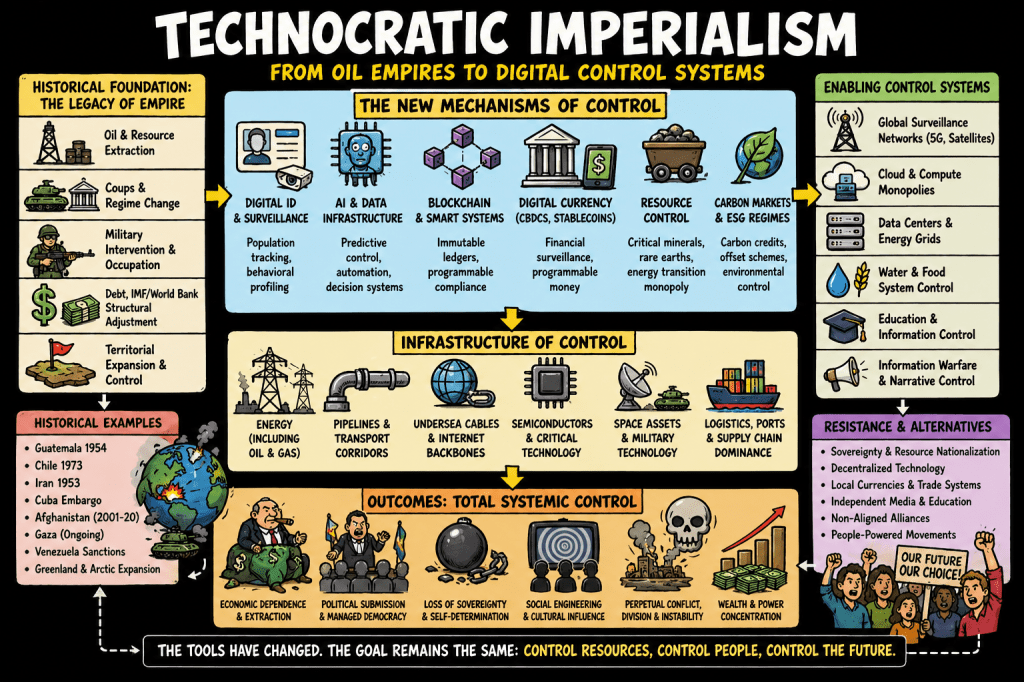
This is the link between foreign imperialism and domestic technocracy. Abroad, the system controls land, corridors, energy, and reconstruction. At home, it controls tariffs, payments, data, identity, movement, benefits, and enforcement. The population becomes “human resources” in the literal technocratic sense: labor to be priced, behavior to be predicted, data to be extracted, and access to be conditioned.
Trump’s tariffs fit into this inward imperialism. They raise costs on the domestic population while protecting strategic sectors and pressuring foreign suppliers. They are sold as nationalist economics, but the burden falls on households through higher prices. At the same time, favored sectors (energy, AI, critical minerals, defense, logistics, and financial platforms) are shielded or positioned for expansion. The public pays more while connected capital gains leverage.
This is why the Iran war, Gaza reconstruction, UAE’s OPEC exit, IMEC, WLF, BlackRock, Palantir and tariffs belong in the same analysis. They form a stack. Military disruption creates scarcity and rerouting. Corridor infrastructure captures the rerouted flow. Stablecoin rails monetize settlement. Tokenization financializes assets. Data firms monitor and model the system. Governance boards administer devastated territories. Tariffs extract domestically. Strategic sectors consolidate.
The result is not normal capitalism. It is technocratic imperial capitalism: a merger of state violence, private platforms, sovereign wealth, financial engineering, AI infrastructure, and data control.
The most severe criticism is this: the system appears to convert war and displacement into business architecture. Iran is attacked, Hormuz is destabilized, oil and LNG demand shifts, the UAE gains corridor and export relevance, Gaza is destroyed and then offered to reconstruction authorities, WLF stands ready as a private financial rail, and the Trump family is positioned to collect profit through platform ownership. This is not just corruption in the narrow sense. It is imperial profiteering at system scale.
This is where the foreseeable future becomes dangerous. If this model succeeds, it becomes repeatable. Conflict zones become reconstruction markets. Chokepoints become corridor opportunities. Populations become relocation problems. Payments become private rails. Assets become tokens. Citizens become datasets. Governance becomes boards, platforms, metrics, and access rules.
That is the endpoint of technocratic imperialism: not only control over foreign land, but control over the architecture through which all land, labor, money, identity, movement and human behavior are administered.

 Bantam Joe
Leave a comment