

Since early 2025, a consistent pattern has emerged across U.S. policy, financial markets, and foreign actions. The pattern aligns with measurable structural changes in the global system rather than isolated political decisions.
Key data points come from established institutions:
- The International Monetary Fund shows the U.S. dollar’s share of global reserves declining from approximately 72% in 2001 to about 56.77% by 2025
- The World Bank and IMF document continued fragmentation of global supply chains following pandemic disruptions and geopolitical realignment
- The World Trade Organization has seen reduced enforcement relevance as countries bypass formal dispute mechanisms
- China’s alternative financial infrastructure, operated by the People’s Bank of China, expanded its Cross-Border Interbank Payment System (CIPS) to approximately $24.47 trillion in transactions in 2024
These changes indicate a shift from a centralized, U.S.-dominated system toward a fragmented, multi-system environment. The old system is not collapsing outright, but its ability to coordinate global economic activity is weakening.
Summary: Data from the IMF, World Bank, WTO, and the People’s Bank of China shows that the U.S.-led global system is no longer operating as a single dominant structure. The decline in dollar reserve share and the rise of alternative systems such as CIPS indicate a redistribution of financial power across multiple centers.
In this environment, policymakers are not acting to restore the previous order but are repositioning within a changing system, prioritizing control of key assets and infrastructure rather than maintaining global coordination through traditional institutions.
The Crypto Alignment: Donald Trump, SEC Actions, and Industry Funding
During the 2024 election cycle, cryptocurrency firms became one of the largest sources of political funding directed toward Donald Trump and aligned political structures.
Documented contributions include:
- Approximately $238 million in total industry influence spending
- Around $18 million directed to Trump-controlled inauguration funds
Specific companies contributing to Trump-aligned political entities:
- Coinbase → ~$2 million
- Robinhood → ~$2 million
- Kraken → ~$1 million
- Crypto.com → ~$1 million plus ~$10 million to pro-Trump PACs
- Ripple Labs → approximately $4.9 million
Following Trump’s inauguration, regulatory activity shifted under the U.S. Securities and Exchange Commission:
- No new cryptocurrency enforcement cases were initiated
- Ongoing cases were paused, reduced, or dismissed
Affected entities included:
- Binance
- Coinbase
- Kraken
- Ripple Labs
- Robinhood
- Crypto.com
A notable individual case:
- Justin Sun invested approximately $75 million into a Trump-linked crypto venture; SEC enforcement actions against him were subsequently paused
Oversight and reporting:
- Jamie Raskin released a House Judiciary Committee report in November 2025 documenting these patterns
Summary: Cryptocurrency firms including Coinbase, Ripple Labs, Kraken, and Crypto.com directed significant financial contributions to Donald Trump’s political and inaugural funds, after which the SEC halted or reduced enforcement actions against those same firms, establishing a direct sequence linking political funding to regulatory outcomes.
The SEC’s shift from active enforcement to near-total inactivity in crypto cases, combined with favorable treatment of individuals such as Justin Sun following financial alignment, demonstrates a transition from rule-based regulation to access-based advantage, where political proximity influences legal exposure.
World Liberty Financial: Trump, UAE Capital, and Strategic Technology Access
World Liberty Financial serves as a central financial structure connected to Donald Trump and his family.
Key structural facts:
- Approximately 75% of net proceeds controlled by Trump-linked entities
- A $500 million investment was made by a vehicle linked to Tahnoon bin Zayed Al Nahyan
Following this investment, U.S. policy actions enabled access to advanced AI chips for UAE-linked entities.
Institutions involved in such approvals typically include:
- U.S. Commerce Department (export controls)
- National security review bodies overseeing advanced semiconductor distribution
Corporate linkage:
- Trump Media & Technology Group entered into a business arrangement valued at approximately $1 billion with Crypto.com
The sequence demonstrates a consistent pattern:
Foreign capital enters a Trump-linked financial structure → policy decisions enable access to restricted strategic resources.
Summary: World Liberty Financial, controlled by Donald Trump and his family, received a $500 million investment from an entity linked to UAE national security adviser Tahnoon bin Zayed, followed by policy decisions that granted related firms access to advanced AI chip technology.
This sequence connects foreign investment, private financial gain, and U.S. strategic technology access, showing that high-value technological resources such as advanced semiconductors are being positioned within a framework that blends geopolitical relationships with private financial interests.
USD1 Stablecoin: Binance, Changpeng Zhao, and Capital Concentration
The USD1 stablecoin expanded rapidly in early 2026.
Key financial drivers:
- Approximately $500 million in UAE-backed investment
- Around $2 billion in transaction activity linked to Binance
Control structure:
- Binance holds approximately 86% of circulating USD1 supply
Key individual:
- Changpeng Zhao, who previously pleaded guilty to anti-money-laundering violations before receiving a pardon
Investor incentives:
- USD1 offered returns near 20% annually
Such yields exceed realistic backing levels for stablecoins tied to traditional reserve assets.
Summary: USD1’s rapid rise was driven by concentrated capital from Binance under Changpeng Zhao and UAE-backed investors, with Binance controlling the majority of circulating supply and supporting the system through high-yield incentives.
This structure depends on continued inflows rather than stable underlying assets, indicating a concentration-based financial model where liquidity dominance and investor incentives maintain valuation rather than long-term sustainability.
Household Funding Mechanism: Tariffs, Tax Cuts, and Named Analysis
Tariffs implemented under Donald Trump reached:
- Approximately 7.7% average rate (highest since 1947; Tax Foundation)
- Estimated cost of $1,000–$1,300 per U.S. household annually
Distributional analysis:
- Yale Budget Lab found lower-income households bear about 2.5× greater burden relative to income
- Institute on Taxation and Economic Policy found the lowest 20% pay roughly four times the share compared to the top 1%
Legislation:
- “One Big Beautiful Bill” (July 2025)
- $4.5 trillion in tax cuts, heavily weighted toward higher-income groups
- Over $1 trillion in cuts to Medicaid and Affordable Care Act programs
- Approximately 15 million projected to lose health coverage
Economic projections:
- Penn Wharton Budget Model estimates:
- ~6% long-run GDP reduction
- ~5% wage decline
- ~$22,000 lifetime loss for middle-income households
Summary: Tariffs imposed under Donald Trump functioned as a regressive tax, increasing costs for households, while analysis from Yale Budget Lab and ITEP shows that lower-income groups bore a disproportionate burden compared to higher-income households.
At the same time, large-scale tax cuts and reductions in public healthcare spending redistributed financial benefits upward, creating a structured system where the general population indirectly financed asset accumulation and fiscal advantage at higher income levels.
Project Vault: Critical Minerals, the Export-Import Bank, and Protected Inputs
On February 3, 2026, Donald Trump signed an executive order launching Project Vault, a federal critical-minerals stockpile program.
The stated purpose was to reduce American dependence on foreign sources for minerals needed in defense, electronics, energy systems, and advanced manufacturing.
Named institutions and funding structure:
The U.S. Export-Import Bank provided the main public financing mechanism through a $10 billion loan. Private capital added approximately $1.67 billion, bringing the total projected stockpile structure to roughly $12 billion.
The materials prioritized were not ordinary commodities. They were strategic industrial inputs:
Rare earth elements.
Lithium.
Cobalt.
Copper.
These materials are essential for artificial intelligence hardware, semiconductors, electric vehicles, batteries, missiles, radar systems, satellites, sensors, drones, grid storage, and advanced energy infrastructure.
The important policy detail is that these materials were carved out from the broader tariff structure. While ordinary imported goods faced higher costs, critical minerals were protected from those same friction costs.
This reveals the actual hierarchy of priorities.
Consumer goods were taxed.
Strategic inputs were protected.
Households absorbed higher prices.
Industrial and military supply chains were shielded.
Summary: Project Vault, backed by the U.S. Export-Import Bank and authorized by Donald Trump, created a $12 billion critical-minerals stockpile focused on rare earths, lithium, cobalt, and copper. These are not optional materials; they are core inputs for AI, defense systems, energy storage, electric vehicles, and advanced electronics.
The tariff exemptions show that the administration understood the United States could not disrupt access to these materials without damaging its own future industrial base. This creates a clear policy split: the public pays more for consumer goods, while the strategic materials needed by defense contractors, AI firms, energy companies, and advanced manufacturers are insulated.
AI Chips: UAE Capital, Commerce Department Controls, and Compute as a Strategic Asset
The UAE-linked investment into World Liberty Financial is followed by another important development: access to advanced artificial intelligence chips.
The named foreign figure is Sheikh Tahnoon bin Zayed Al Nahyan, the United Arab Emirates national security adviser and brother of the UAE president.
The key sequence is:
A UAE-backed investment vehicle purchased a major stake in World Liberty Financial.
World Liberty Financial was tied to Donald Trump and his family.
Afterward, UAE-linked firms received access to advanced AI chips.
This occurred despite national security concerns about possible technology diversion to China.
Advanced AI chips are normally controlled through federal channels involving the U.S. Commerce Department, export-control rules, and national security review processes. These chips are not ordinary commercial products. They are strategic compute assets.
Compute now functions like oil did in the twentieth century. It determines who can train large AI systems, run surveillance platforms, operate advanced defense simulations, build autonomous systems, control logistics networks, and dominate next-generation financial and intelligence platforms.
That makes advanced chips a geopolitical currency.
The concern is not simply that a foreign partner received chips. The concern is the timing and structure: foreign capital moved into a Trump-family-linked private venture, followed by access to strategic U.S.-controlled technology.
Summary: The UAE-linked investment tied to Sheikh Tahnoon bin Zayed was followed by access to advanced AI chips, which are among the most strategically controlled technologies in the modern economy. These chips are essential for AI development, defense applications, surveillance systems, and large-scale computational infrastructure.
This creates a direct connection between private financial investment and strategic technology access. When foreign capital enters a politically connected private venture and is followed by favorable treatment involving advanced semiconductor access, compute becomes part of an exchange system linking personal enrichment, state policy, and geopolitical leverage.
DOGE: Elon Musk, Federal Databases, Regulatory Agencies, and Conflicted Power
The Department of Government Efficiency, known as DOGE, was publicly presented as a cost-cutting and anti-waste initiative.
Its deeper importance is institutional.
Named actor:
Elon Musk operated as the de facto leader of DOGE during the first months of the administration.
Named agencies and institutions connected to Musk’s business interests:
NASA — major contracts involving SpaceX.
Department of Defense — defense and satellite-related contracts involving SpaceX and related systems.
Federal Aviation Administration — regulatory authority over launches and aviation.
National Highway Traffic Safety Administration — regulator of Tesla vehicle safety.
Food and Drug Administration — regulator relevant to Neuralink and medical-device oversight.
Musk’s private companies reportedly held more than $20 billion in contracts with NASA and the Department of Defense while DOGE gave him access to sensitive federal systems and databases across agencies.
The conflict structure is direct:
A private businessman with major federal contracts gained internal access to the government agencies that fund, regulate, or investigate his companies.
DOGE’s original public goal was to cut $2 trillion in federal spending. That figure was later reduced to approximately $150 billion, and independent budget experts disputed whether even that number represented verified savings.
The more concrete result was not fiscal efficiency. It was institutional weakening.
DOGE reduced federal staffing, disrupted oversight capacity, weakened regulatory bodies, and helped create conditions where agencies had less ability to investigate, enforce, or resist executive pressure.
Congressional concern was raised by House Oversight Committee Democrats, who warned that Musk was positioned to redirect taxpayer money while reducing programs, agencies, and safeguards that ordinary Americans depend on.
A federal judge also identified Musk as DOGE’s de facto leader, raising constitutional concerns about whether he should have required Senate confirmation under the Appointments Clause.
Summary: DOGE, under Elon Musk’s de facto leadership, placed a private billionaire with more than $20 billion in federal contract exposure inside the machinery of government while his companies remained dependent on NASA, the Department of Defense, the FAA, the NHTSA, and the FDA. That created a direct conflict between public authority and private business interest.
The practical result was not a clean efficiency program. DOGE weakened oversight infrastructure, reduced agency capacity, disrupted enforcement systems, and helped clear institutional resistance from the broader deregulation agenda. Its importance was not the disputed savings figure; it was the reduction of government capacity to supervise politically connected capital.
Venezuela: Nicolás Maduro, JD Vance, Chris Wright, Doug Burgum, PDVSA, Oil, Gold, and Rare Earths
Venezuela is one of the clearest examples of resource-focused foreign policy.
The named political figure at the center is Nicolás Maduro, Venezuela’s president.
On January 3, 2026, U.S. special forces captured Maduro and his wife in an operation Donald Trump publicly described as successful.
Within twenty-four hours, Vice President JD Vance stated that the United States would “control the energy resources” of the country.
That phrase matters.
He did not say stabilize.
He did not say democratize.
He said control the energy resources.
Energy Secretary Chris Wright followed by saying the United States was going to market the crude coming out of Venezuela.
Venezuela’s resource importance is not minor. It holds the world’s largest proven crude oil reserves, estimated at 19.4% of global reserves as of 2024.
After the operation, Trump called on American oil and gas companies to invest $100 billion in reviving Venezuela’s energy sector.
The legal framework was then rewritten to favor foreign entry.
Key restructuring points:
The state oil company PDVSA no longer had to remain the principal stakeholder in all exploration and production.
Royalty payments were reduced.
Foreign energy firms gained the ability to settle disputes through international arbitration instead of Venezuelan courts.
U.S. and Western companies received licenses to operate.
Then the asset focus widened.
Interior Secretary Doug Burgum arrived in Caracas on March 4, 2026, after Energy Secretary Wright’s visit. Burgum signed an agreement with Venezuela’s mining company to purchase up to 1,000 kilograms of gold.
The United States also pursued Venezuelan rare earth minerals. These minerals are essential for precision-guided missiles, radar systems, sensors, satellites, and other defense technologies.
The International Crisis Group analyzed the U.S. interest in Venezuela’s rare earths. Chatham House identified the Venezuela operation as a major step away from a rules-based international order and toward a direct assertion of power over another nation’s resources.
The policy doctrine attached to this regional posture was described as the “Donroe Doctrine,” a reassertion of U.S. dominance in the Western Hemisphere.
Donald Trump also reportedly stated at an Easter luncheon that the United States could “just take their oil,” and that he would prefer doing that.
Summary: Venezuela was treated as an energy and mineral prize. Nicolás Maduro was removed, JD Vance stated that the United States would control Venezuelan energy resources, Chris Wright spoke of marketing Venezuelan crude, and Doug Burgum moved into gold-purchase arrangements. This was not abstract diplomacy; it was a direct sequence from political intervention to resource access.
The legal changes around PDVSA, royalty payments, foreign arbitration, and investment licensing shifted Venezuela’s oil sector away from state control and toward U.S. and Western corporate access. The addition of gold and rare earths shows that the operation extended beyond oil into strategic minerals needed for defense and advanced technology.
Iran: Operation Epic Fury, Strait of Hormuz, Energy Leverage, and Global Price Shock
On February 28, 2026, the United States launched Operation Epic Fury against Iran.
The stated objectives were:
Destroy Iran’s nuclear program.
Reduce Iran’s ballistic missile capability.
Break Iranian naval power.
Those are the public military goals.
The resource and logistics dimension is just as important.
Iran sits on one of the most important energy positions in the world:
Second-largest proven natural gas reserves.
Fourth-largest proven oil reserves.
Control-adjacent position near the Strait of Hormuz.
The Strait of Hormuz is a narrow maritime chokepoint between Iran and the Arabian Peninsula. It is roughly twenty-one miles wide at its narrowest point.
The International Monetary Fund warned in March 2026 that Hormuz disruption represented one of the most severe shocks to global oil markets in modern history.
The Strait carries a major portion of:
Global crude oil.
Liquefied natural gas.
Fertilizer-related supply flows.
When Hormuz becomes unstable, the effect spreads immediately through global pricing:
Oil prices rise.
LNG prices rise.
Shipping insurance rises.
Marine war-risk premiums rise.
Fertilizer costs rise.
Food production costs rise.
Before the war, Brent crude traded near $70 per barrel. By March 31, 2026, it had reached approximately $110.69, according to Fortune’s cited oil-price reporting.
Shipping through the region also became far more expensive. War-risk insurance premiums rose from approximately 0.25% of a vessel’s value to as much as 3%, a twelvefold increase, according to Howden Re’s analysis of Hormuz marine war-risk markets.
Donald Trump’s public message during the disruption was also significant. He told countries unable to get fuel because of Hormuz disruption to buy oil from the United States because America had plenty.
That statement links the war directly to U.S. energy-market leverage.
Summary: Operation Epic Fury was publicly described as a campaign against Iran’s nuclear, missile, and naval capabilities, but Iran’s position over major oil and gas reserves and its proximity to the Strait of Hormuz make the operation inseparable from energy strategy. The IMF, Fortune, and Howden Re data show how quickly the conflict translated into oil-price increases, shipping-risk increases, and broader economic pressure.
Trump’s message that disrupted countries should buy American oil shows the energy-leverage layer clearly. The conflict does not merely weaken Iran; it increases demand for alternative suppliers, including the United States, while raising global costs that move through fuel, fertilizer, shipping, food production, and consumer prices.
Greenland: Donald Trump, Mike Waltz, Donald Trump Jr., GreenMet, Tanbreez, Critical Metals Corp, and Rare Earths
Greenland’s importance is not symbolic. It is mineral and strategic.
Named political figures:
Donald Trump repeatedly demanded U.S. acquisition of Greenland, saying the United States would have it “one way or another.”
Mike Waltz, Trump’s national security adviser, stated that Greenland was about critical minerals and natural resources.
Donald Trump Jr. traveled to Greenland on January 7, 2025, before the inauguration.
Named private actors:
George Sorial, former executive vice president of the Trump Organization.
Keith Schiller, former Trump Organization security director.
Named companies:
GreenMet — company in which Trump-linked former officials held shares.
Tanbreez Mining Greenland — holder of a mining license for one of Greenland’s large rare earth deposits.
Critical Metals Corp — company tied to the Tanbreez mine financing pathway.
Named government financing institution:
U.S. Export-Import Bank — sent a $120 million loan letter of interest to Critical Metals Corp for the Tanbreez mine in June 2025.
Named reporting and analysis sources:
OCCRP reported on private financial links.
CSIS analyzed Greenland’s mineral significance.
The mineral base is substantial:
Greenland is estimated to hold 36–42 million metric tons of rare earth oxides.
It also contains gold, copper, germanium, and gallium.
These are not generic resources. They are important for:
Semiconductors.
Missiles.
Sensors.
Satellites.
Optics.
Advanced electronics.
AI infrastructure.
Energy systems.
The timing matters.
Trump-linked individuals were connected to Greenland mining interests before or during the administration’s public push to acquire or control Greenland’s strategic future.
In January 2026, Trump announced a framework deal with NATO Secretary-General Mark Rutte, describing it as covering both security and minerals. The specific terms were not made public.
Summary: Greenland is a rare-earth and strategic-minerals target involving Donald Trump, Mike Waltz, Donald Trump Jr., George Sorial, Keith Schiller, GreenMet, Tanbreez Mining Greenland, Critical Metals Corp, and the U.S. Export-Import Bank. The island’s rare earth oxides, copper, gold, germanium, and gallium make it central to advanced manufacturing, defense systems, and AI-era infrastructure.
The key issue is timing and overlap. Private actors connected to Trump-world were positioned around Greenland mining interests before or alongside official U.S. pressure over Greenland. The Export-Import Bank’s $120 million loan interest in Critical Metals Corp adds a public-financing layer to a mineral strategy already linked to private political networks.
Cuba: Arable Land, Oil Cutoff, Blackouts, Property Claims, Ports, Energy, and Tourism
Cuba is often discussed as if it has no major resource value to the United States. That is incorrect.
Cuba’s primary strategic value is not oil. It is land, agriculture, ports, energy infrastructure, tourism, and unresolved property claims.
Named sources and figures:
Britannica documents Cuba’s fertile red limestone soils.
René Dumont, the French agronomist, assessed that Cuba could feed several times its population under proper agricultural management.
CBS Miami reported on the revival of Cuban property claims.
Council on Foreign Relations reported on negotiation structures.
World Socialist Web Site reported on Cuban officials inviting American and Miami exile investment.
Cuba’s agricultural base:
Nearly one-third of Cuba is arable land.
Highly fertile red limestone soil extends from west of Havana to Cienfuegos and across western Camagüey province.
This land can support multiple harvests under proper management.
Historical property issue:
Between 1959 and 1961, Fidel Castro’s government seized approximately 6 million hectares, nearly 15 million acres, of agricultural and commercial land.
This included:
American cattle operations.
Sugar plantations.
Agribusiness holdings.
Commercial property.
Land claimed by Cuban exile families and former American owners.
Those claims remained frozen for decades.
The 2026 pressure sequence changed the situation.
After Venezuela’s oil supply was disrupted by the Maduro operation, Cuba lost its primary oil lifeline.
Donald Trump declared a national emergency and imposed pressure against any country supplying oil to Cuba. He stated: “NO MORE OIL OR MONEY GOING TO CUBA.”
By late January 2026, Cuba reportedly had only 15 to 20 days of oil supply remaining.
In March 2026, Cuba suffered three nationwide blackouts.
Its agricultural system, already weak, deteriorated under fuel shortages and sanctions pressure.
Then came the opening.
Cuban officials invited American companies and Miami exile investors to make large investments, especially in:
Infrastructure.
Ports.
Energy.
Tourism.
Negotiation structures reportedly included:
An exit pathway for Cuba’s current president.
Castro family members remaining on the island.
Deals involving ports, energy, tourism, and property claims.
The practical asset opening is land.
Millions of acres of fertile agricultural land, seized more than sixty years earlier, could become accessible again through negotiated settlement and outside investment.
Summary: Cuba’s strategic value lies in fertile land, ports, energy infrastructure, tourism, and unresolved property claims, not primarily in oil. Britannica, René Dumont, CBS Miami, CFR, and other sources identify Cuba’s agricultural capacity, property-claim history, and current investment opening as the central assets.
The mechanism is economic strangulation followed by forced negotiation. Venezuela’s oil disruption, U.S. pressure on oil suppliers, fuel shortages, blackouts, and agricultural stress created conditions in which Cuban officials invited American and Miami exile investment. That reopens land and infrastructure assets that had been politically inaccessible since the Castro-era seizures.
The Pattern Across Venezuela, Iran, Greenland, and Cuba
The same operational model appears across all four cases.
Venezuela:
Oil, gold, rare earths.
Named actors: Nicolás Maduro, JD Vance, Chris Wright, Doug Burgum, PDVSA.
Mechanism: government removal, legal restructuring, corporate access.
Iran:
Oil, gas, Strait of Hormuz leverage.
Named action: Operation Epic Fury.
Named institutions: IMF, FAO, Howden Re, Fortune.
Mechanism: military pressure, energy disruption, U.S. export leverage.
Greenland:
Rare earths, copper, germanium, gallium.
Named actors and companies: Donald Trump, Mike Waltz, Donald Trump Jr., George Sorial, Keith Schiller, GreenMet, Tanbreez Mining Greenland, Critical Metals Corp, Export-Import Bank.
Mechanism: private positioning, public pressure, mineral financing.
Cuba:
Arable land, ports, energy, tourism, property claims.
Named sources and actors: Britannica, René Dumont, CBS Miami, CFR, Cuban officials, Miami exile investors.
Mechanism: sanctions, fuel cutoff, blackouts, forced investment opening.
The asset differs by country. The method stays consistent.
Identify the resource.
Create or exploit pressure.
Weaken existing control.
Open the asset to aligned capital.
Move quickly before the global window closes.
Summary: Venezuela, Iran, Greenland, and Cuba are not separate policy categories. They represent different applications of the same asset-access model. Oil, gas, rare earths, gold, fertile land, ports, and energy infrastructure are the targets, while military pressure, sanctions, financing, legal restructuring, and private investment networks are the tools.
The named institutions involved—White House, Department of Energy, Department of the Interior, U.S. Export-Import Bank, Commerce Department, Department of Defense, IMF, FAO, Chatham House, CSIS, CFR, and congressional oversight bodies—show that this is not a single-sector event. It spans finance, military policy, resource strategy, trade, and domestic regulatory power.
Historical Continuity: The Pattern Did Not Begin in 2025
The current asset-grab pattern is not new. What is new is how openly it is being done.
For most of the twentieth century, U.S. foreign policy was publicly described through ideological language: stopping communism, defending democracy, fighting terrorism, preventing instability, or protecting human rights. But when the historical record is examined closely, many major interventions also involved access to resources, trade routes, land, labor, or strategic geography.
The structure is usually the same:
A country controls a valuable resource.
Its government limits foreign corporate access.
The United States identifies the government as hostile, unstable, communist, authoritarian, or dangerous.
Economic, political, intelligence, or military pressure follows.
The government is weakened, overthrown, or forced into concessions.
Foreign capital gains access to the asset.
The public explanation changes by era. The material logic remains consistent.
Summary: The current resource strategy fits a longer historical model where U.S. power is used to reshape foreign governments, markets, and legal systems around access to valuable assets. The stated justification may be ideological or security-based, but the recurring outcome is the opening of land, minerals, oil, labor, ports, and infrastructure to U.S.-aligned interests.
This matters because it prevents the current moment from being misread as an abnormal break from history. The same operating logic appears repeatedly across Latin America, Southeast Asia, the Middle East, and Central Asia; the difference today is that the language has become more direct and the timeline more compressed.
Guatemala 1954: United Fruit, the CIA, and Land Reform
Guatemala is one of the clearest historical examples.
The named figures and institutions:
- Jacobo Árbenz — democratically elected president of Guatemala
- United Fruit Company — U.S. corporation controlling major Guatemalan landholdings
- Central Intelligence Agency (CIA) — organized the coup operation
- John Foster Dulles — U.S. Secretary of State
- Allen Dulles — CIA Director
- Eisenhower administration — approved the operation
Jacobo Árbenz pursued land reform. His government targeted unused large landholdings, including land controlled by the United Fruit Company. United Fruit was not a minor actor. It owned major agricultural assets, controlled transportation infrastructure, and had deep influence in U.S. political circles.
The conflict was framed publicly as anti-communism. Árbenz was portrayed as a communist threat in the Western Hemisphere.
But the corporate conflict was direct: land reform threatened United Fruit’s holdings.
The Dulles brothers had strong ties to United Fruit. John Foster Dulles had worked for the law firm that represented the company. Allen Dulles also had connections to the company’s interests. This created a close relationship between private corporate exposure and U.S. foreign-policy action.
In 1954, the CIA backed a coup that removed Árbenz and installed a more U.S.-aligned government. The long-term result was catastrophic: decades of civil war, repression, and mass death in Guatemala.
The resource was land.
The legal barrier was land reform.
The public label was communism.
The outcome was corporate protection.
Summary: Guatemala 1954 shows the basic template: Jacobo Árbenz threatened United Fruit Company’s landholdings through reform, and the CIA under the Eisenhower administration helped remove him while presenting the operation as anti-communist defense. John Foster Dulles and Allen Dulles illustrate how closely U.S. state power and corporate interests overlapped.
The real issue was not abstract ideology alone; it was control over land, agriculture, and infrastructure. The coup protected U.S. corporate property interests and opened the door to decades of instability, showing how resource and property access can be hidden beneath national-security language.
Chile 1973: Copper, Allende, Nixon, and Pinochet
Chile followed a similar structure.
Named figures and institutions:
- Salvador Allende — democratically elected socialist president of Chile
- Richard Nixon — U.S. president
- Henry Kissinger — National Security Adviser and later Secretary of State
- Augusto Pinochet — Chilean general who seized power
- CIA — involved in destabilization efforts
- Anaconda Copper and Kennecott Copper — U.S. mining interests affected by nationalization
Allende’s government nationalized major copper mines. Copper was Chile’s most important strategic resource and a major global industrial input. U.S. corporations had significant interests in Chilean copper, including Anaconda and Kennecott.
The Nixon administration viewed Allende as unacceptable. Publicly, the concern was Marxism and Soviet influence. Materially, Allende’s policies threatened U.S. corporate and strategic control over copper.
The U.S. worked to destabilize Chile economically and politically. Nixon’s instruction to make the Chilean economy “scream” became one of the defining phrases of this period.
In 1973, General Augusto Pinochet overthrew Allende. Allende died during the coup. Pinochet’s dictatorship followed, marked by torture, disappearances, executions, and mass repression.
The resource was copper.
The legal barrier was nationalization.
The public label was Marxism.
The outcome was regime change and restored corporate alignment.
Summary: Chile 1973 shows the same pattern operating through copper. Salvador Allende’s nationalization of copper mines threatened U.S. corporate interests, especially Anaconda and Kennecott, while Richard Nixon, Henry Kissinger, and the CIA treated Allende’s government as a strategic threat.
The Pinochet coup replaced democratic nationalization with dictatorship and market restructuring. The stated issue was communism, but the material conflict centered on control over Chile’s most valuable resource and the ability of foreign capital to operate without national restrictions.
Vietnam and Southeast Asia: Rubber, Tin, Rice, Oil, and Strategic Geography
The Vietnam War is usually explained through Cold War ideology: stopping communism, containing China and the Soviet Union, and preventing the “domino effect.”
That explanation is incomplete.
Named figures and references:
- Richard Nixon — repeatedly emphasized Southeast Asia’s resource importance
- Pentagon Papers — revealed deeper strategic thinking behind U.S. policy
- Indochina congressional study mission — described the region’s wealth in rice, rubber, coal, and iron ore
- Indonesia — described by Nixon as a major strategic prize
- Malaya/Malaysia — important for rubber and tin
- Japan — dependent on Southeast Asian trade routes and raw materials
In 1953, Nixon argued that if Indochina fell, then Thailand, Malaya, Indonesia, and Japan would be affected. His reasoning was not only ideological. He specifically mentioned Malaya’s rubber and tin and the economic orientation of Japan.
A congressional study mission described Indochina as wealthy in rice, rubber, coal, and iron ore. The region’s importance was tied to resources and geography.
The concern was not only that communism would spread. It was that the resource base of Southeast Asia could shift outside the U.S.-aligned economic order.
Vietnam itself became the battlefield, but the wider prize was regional control: shipping routes, raw materials, plantation economies, mineral access, and the orientation of Japan’s postwar industrial economy.
The resource base was regional.
The legal/political barrier was nationalist or communist control.
The public label was containment.
The outcome was decades of war.
Summary: Vietnam cannot be understood only as an anti-communist war. U.S. strategic thinking, including statements by Richard Nixon and material later reflected in the Pentagon Papers, tied Southeast Asia to rubber, tin, rice, coal, iron ore, oil routes, and Japan’s industrial dependence on regional trade.
The war functioned as part of a broader attempt to prevent Southeast Asia’s resources and trade corridors from moving outside U.S.-aligned control. The public narrative was containment, but the strategic logic included resource security and regional economic orientation.
Indonesia 1965: The “Greatest Prize” of Southeast Asia
Indonesia is central to understanding U.S. resource strategy in Asia.
Named figures and institutions:
- Sukarno — Indonesian president before the 1965 coup
- Suharto — general who took power after the coup
- Richard Nixon — referred to Indonesia as a major prize
- CIA — involved in anti-communist networks and support structures
- Freeport-McMoRan — later gained major mining access in Indonesia
- Grasberg mine — one of the world’s largest gold and copper mines
Indonesia had immense strategic value:
Oil.
Rubber.
Tin.
Nickel.
Copper.
Gold.
Large population.
Strategic maritime geography.
Sukarno pursued a non-aligned and nationalist path. He resisted full integration into the U.S.-led economic structure. That made him unacceptable to U.S. strategic planners.
In 1965, Suharto rose to power after mass anti-communist violence that killed hundreds of thousands of Indonesians. The new regime opened Indonesia to Western capital.
One of the most significant later outcomes was the expansion of foreign mining access, including Freeport-McMoRan’s role in the Grasberg mine in West Papua.
The resource was not one commodity. It was an entire archipelago’s strategic and mineral base.
Summary: Indonesia’s 1965 transition from Sukarno to Suharto opened one of the world’s most resource-rich countries to Western capital. The country’s oil, minerals, maritime routes, and population made it central to U.S. regional strategy, and Nixon’s description of Indonesia as a major prize reflected that material importance.
The public framing was anti-communism, but the outcome was economic opening. Suharto’s regime aligned Indonesia with Western corporate access, including major mining interests such as Freeport-McMoRan’s later position in the Grasberg gold and copper mine.
Cuba: Batista, Castro, Sugar, Land, and the Long Embargo
Cuba’s conflict with the United States is often explained as anti-communism, but the property question came first.
Named figures and institutions:
- Fulgencio Batista — U.S.-backed Cuban ruler before Castro
- Fidel Castro — revolutionary leader who nationalized property
- CIA — involved in assassination plots and the Bay of Pigs invasion
- Eisenhower administration — broke relations after nationalization
- Kennedy administration — approved Bay of Pigs operation
- American sugar companies — major land and industry holders before the revolution
Before Castro, Cuba was deeply penetrated by U.S. corporate interests. American companies controlled large portions of sugar land, utilities, tourism, and commercial infrastructure. Batista protected that structure.
Castro’s revolution overturned it. His government nationalized land, sugar plantations, refineries, utilities, and corporate property. That directly threatened U.S. owners and Cuban elites tied to U.S. capital.
The United States then imposed economic pressure, supported invasion efforts, and maintained a decades-long embargo.
The public label became communism.
The material trigger was expropriation of property.
The long-term goal was reversal of nationalization.
This makes Cuba directly relevant to the current moment. The old property claims never disappeared. They remained dormant until political conditions made them usable again.
Summary: Cuba’s conflict with the United States began with property and land before it became permanently framed as communism. Batista protected U.S. sugar, utility, tourism, and commercial interests; Castro nationalized those assets, triggering U.S. hostility, CIA plots, the Bay of Pigs, and the long embargo.
The unresolved property claims from the Castro period remain central. The current reopening of investment discussions, property claims, ports, energy, tourism, and agricultural land is not a new issue; it is the continuation of a conflict over ownership that began with nationalization after the revolution.
Iran 1953: Mossadegh, Oil Nationalization, MI6, and the CIA
Iran’s modern conflict with the West has deep roots in oil.
Named figures and institutions:
- Mohammad Mossadegh — democratically elected prime minister of Iran
- Shah Mohammad Reza Pahlavi — restored to power after the coup
- Anglo-Iranian Oil Company — later became BP
- MI6 — British intelligence
- CIA — U.S. intelligence
- Operation Ajax — covert operation to remove Mossadegh
- Eisenhower administration — approved U.S. involvement
Mossadegh nationalized Iran’s oil industry. That directly threatened British control through the Anglo-Iranian Oil Company.
Britain first attempted economic pressure. When that failed, British intelligence worked with the CIA to remove Mossadegh.
Operation Ajax overthrew Mossadegh in 1953 and restored the Shah’s authority. The Shah then ruled as a U.S.-aligned monarch until the 1979 Iranian Revolution.
The resource was oil.
The legal barrier was nationalization.
The public language became anti-communism and stability.
The outcome was restored Western access and dictatorship.
Summary: Iran 1953 is one of the clearest examples of resource-driven regime change. Mohammad Mossadegh nationalized the oil industry, threatening Anglo-Iranian Oil Company interests, and MI6 worked with the CIA through Operation Ajax to remove him and restore the Shah.
The long-term result was not stability but deep Iranian hostility toward U.S. and British power, eventually contributing to the 1979 revolution. The current conflict with Iran cannot be separated from this history of oil, nationalization, and foreign intervention.
Afghanistan: Lithium, Copper, Rare Earths, and the Pentagon Mineral Memo
Afghanistan was publicly framed as a counterterrorism war after September 11, 2001. That was the immediate trigger. But by 2010, the mineral dimension had become explicit.
Named institutions and figures:
- Pentagon — internal memo described Afghanistan as the “Saudi Arabia of lithium”
- U.S. Geological Survey (USGS) — mapped mineral potential using Soviet-era survey data
- David Petraeus — U.S. general who publicly referenced Afghanistan’s mineral wealth
- New York Times — reported the $1 trillion estimate in 2010
- China — moved into mining contracts after the U.S. withdrawal
Estimated mineral value:
- At least $1 trillion
- Some assessments approached $3 trillion
Resource categories:
Iron ore.
Copper.
Cobalt.
Gold.
Lithium.
Rare earth elements.
Lithium is especially important because it is essential for batteries, electric vehicles, grid storage, electronics, and military energy systems.
The United States spent twenty years and roughly $2.4 trillion on the Afghanistan war. It withdrew in 2021. China moved quickly into mining and infrastructure deals afterward.
The result is historically significant: the United States bore the enormous military cost, but China gained major postwar mineral positioning.
Summary: Afghanistan was publicly justified as counterterrorism, but by 2010 the Pentagon, USGS, David Petraeus, and major media reporting openly discussed its massive mineral potential, especially lithium, copper, cobalt, iron, and rare earths. The phrase “Saudi Arabia of lithium” captured Afghanistan’s importance to future battery and technology supply chains.
The outcome exposed the failure of the U.S. model. Washington spent trillions and fought for twenty years, but after withdrawal China moved into the mining space. This shows that military dominance does not automatically translate into long-term resource control when the political structure collapses.
Gaza Marine: Offshore Gas, Reconstruction, Israel, the UAE, and ADNOC
Gaza is usually discussed in humanitarian, religious, security, or territorial terms. But it also has an energy dimension.
Named entities and institutions:
- Gaza Marine field — offshore natural gas field discovered in 2000
- Palestinian Authority — maritime rights under Oslo-related arrangements
- Israel — controls surrounding security and access conditions
- United Arab Emirates — involved in reconstruction and energy discussions
- ADNOC — Abu Dhabi National Oil Company
- Middle East Eye — reported discussions involving Gaza offshore gas and reconstruction
Resource base:
- Gaza Marine estimated at approximately 1.1 trillion cubic feet of natural gas
- Marine 2 estimated at additional reserves
- Located offshore, around twenty-two miles from Gaza’s coast
The fields have never been developed. Political control, security restrictions, Israeli approval, Palestinian governance divisions, and regional power politics have blocked development.
By late 2025, discussions reportedly involved using gas profits to fund reconstruction, with UAE-linked energy actors potentially taking part.
This creates a familiar structure:
A territory is devastated.
Its people lack direct control over the resource.
External powers discuss development.
Energy revenue becomes tied to political reconstruction terms.
Summary: Gaza Marine is an undeveloped offshore gas field with significant natural gas reserves located off the Gaza coast. Although Gaza is usually discussed through humanitarian and security language, the existence of Gaza Marine means any reconstruction plan also carries an energy-resource dimension.
The involvement of Israel, the Palestinian Authority, the UAE, and ADNOC-linked discussions indicates that Gaza’s future is not only about rebuilding destroyed infrastructure but also about who controls offshore gas revenues. That places Gaza within the same pattern of resource access following devastation and political dependency.
Latin America’s View: Jeffrey Sachs, John Coatsworth, and the Intervention Record
Much of Latin America does not view U.S. foreign policy the way many Americans are taught to view it.
Named scholars:
- Jeffrey Sachs — Columbia University economist and former adviser to UN Secretaries-General
- John Coatsworth — historian and former Columbia University provost
Reported intervention record:
- Sachs has cited roughly 70 documented regime-change operations between 1947 and 1989
- Total post-World War II operations exceed 100 by broader counts
- Coatsworth documented at least 41 U.S. interventions in Latin American governments between 1898 and 1994
This history is not obscure in the countries affected by it. In Latin America, families and national histories remember coups, sanctions, corporate control, military governments, disappearances, and economic restructuring.
The U.S. domestic debate often asks whether America is a force for good. In much of the Global South, the question is not debated the same way because the effects are part of national memory.
The recurring pattern is:
U.S. corporate or strategic interest.
Local nationalist or redistributive government.
U.S. pressure.
Political destabilization.
Authoritarian or market-aligned replacement.
Resource and capital access restored.
Summary: Jeffrey Sachs and John Coatsworth identify a long record of U.S. intervention, especially in Latin America, where coups and political pressure were repeatedly tied to strategic or corporate interests. This record is widely understood outside the United States because the consequences are embedded in national histories.
The U.S. public often receives these events as isolated Cold War or security decisions, but Latin America generally sees continuity: land, oil, copper, fruit, labor, ports, and sovereignty repeatedly subordinated to foreign access. That difference in memory explains why current events are interpreted very differently inside and outside the United States.
Hugo Chávez and Venezuela’s Resource Nationalism
Hugo Chávez is important because he directly challenged the resource-extraction model.
Named figure:
- Hugo Chávez — Venezuelan president from 1999 to 2013
Named institutions and context:
- PDVSA — Venezuelan state oil company
- Citgo — U.S.-based subsidiary of PDVSA
- National Endowment for Democracy — linked to opposition funding in Venezuela
- Bush administration — hostile to Chávez
- 2002 coup attempt — briefly removed Chávez before mass mobilization restored him
Chávez argued that Venezuela’s oil should serve Venezuelans first. He used oil revenue for:
Schools.
Hospitals.
Literacy programs.
Food programs.
Public housing.
Regional development.
He also offered discounted heating oil to low-income Americans through Citgo, which made the political contrast sharper: Venezuela was assisting poor Americans while Washington treated Chávez as a threat.
The United States and U.S.-aligned media framed him as a dictator, clown, demagogue, or socialist danger. But from the Global South perspective, Chávez represented a direct challenge to the rule that resources in poorer countries should remain accessible to foreign capital.
Venezuela’s later economic collapse had multiple causes:
Oil-price collapse.
Mismanagement after Chávez.
Corruption.
Sanctions.
Currency failure.
Political conflict.
But the collapse was used retroactively to discredit the principle Chávez defended: national control over national resources.
Summary: Hugo Chávez challenged the extraction model by using Venezuela’s oil revenue for domestic social development and regional independence rather than allowing foreign capital to dominate the resource base. PDVSA, Citgo, and the 2002 coup attempt are central to understanding why Washington treated him as a threat.
The later collapse of Venezuela’s economy is often used to dismiss Chávez entirely, but that simplifies the record. The deeper issue was that he asserted a principle dangerous to the extractive order: the resources beneath a country should primarily benefit the people living above them.
The Treaty of Guadalupe Hidalgo: Mexico, Land, and the American Southwest
The asset-grab pattern also exists inside U.S. territorial history.
Named treaty and institutions:
- Treaty of Guadalupe Hidalgo — signed in 1848
- United States Senate — ratified the treaty but removed Article X
- Mexico — forced to cede territory after the Mexican-American War
- Library of Congress and National Archives — preserve treaty history
In 1846, the United States invaded Mexico. In 1848, Mexico was forced to cede approximately 55% of its national territory.
That territory became:
California.
Nevada.
Utah.
Most of Arizona.
Colorado.
New Mexico.
Parts of Oklahoma, Kansas, and Wyoming.
The U.S. paid Mexico $15 million.
The removed Article X is critical. It would have protected Mexican land grants. Its removal allowed land claims by Mexican families and communities to be challenged, weakened, ignored, or stripped over time.
This means many Mexican-descended communities in the Southwest are not immigrants in the simple political sense. Their ancestors were already there when the border moved.
The land did not move.
The border moved.
The present immigration debate often ignores this history. The same state that absorbed Mexican land now criminalizes movement across borders drawn through historical Mexican geography.
Summary: The Treaty of Guadalupe Hidalgo transferred more than half of Mexico’s territory to the United States, creating the modern American Southwest. By removing Article X, the U.S. Senate weakened protection for Mexican land grants, allowing long-term dispossession of families and communities already living there.
This history links domestic territorial expansion to the same extraction logic seen abroad. Land, law, borders, and labor were reorganized to benefit the expanding U.S. state, while the descendants of the people displaced by that process are later treated as outsiders.
The Historical Pattern in One Frame
Across Guatemala, Chile, Vietnam, Indonesia, Cuba, Iran, Afghanistan, Gaza, Venezuela, and the American Southwest, the same framework repeats.
Named resources:
Guatemala — land, bananas, agriculture.
Chile — copper.
Vietnam/Southeast Asia — rubber, tin, rice, coal, iron, trade routes.
Indonesia — oil, gold, copper, nickel, maritime geography.
Cuba — sugar, land, utilities, ports, tourism.
Iran — oil and gas.
Afghanistan — lithium, copper, cobalt, rare earths.
Gaza — offshore gas.
Mexico/Southwest — land, minerals, agriculture, strategic territory.
Venezuela — oil, gold, rare earths.
Named tools:
CIA operations.
Sanctions.
Coups.
Military intervention.
Debt pressure.
Legal restructuring.
Embargoes.
Private corporate entry.
International arbitration.
Export financing.
Security agreements.
Named public explanations:
Anti-communism.
Democracy promotion.
Counterterrorism.
Nonproliferation.
Stability.
Human rights.
Anti-corruption.
Security.
The public explanation changes. The material structure remains.
Summary: The historical record shows a repeated operating model: valuable resources are identified, local control becomes a problem, pressure is applied, and foreign access is restored or expanded. The named cases differ in geography and era, but the underlying mechanics remain consistent.
This does not mean every intervention is only about resources. It means resource access is repeatedly present beneath the public justification. Ignoring that material layer makes the pattern appear random when it is not.
The Mask-Off Phase: Direct Language, Reduced Cover, Accelerated Action
What distinguishes the current phase from earlier decades is not the underlying pattern—it is the removal of indirect language and institutional cover.
In previous eras, actions involving resource access, regime change, or economic pressure were framed through layers of justification: anti-communism during the Cold War, counterterrorism after 2001, democracy promotion, stabilization, or humanitarian intervention. The language functioned as insulation between policy action and public perception.
That insulation has weakened.
Named officials now use more direct language tied to material outcomes. **JD Vance publicly stated that the United States would “control the energy resources” of Venezuela. The wording is precise and transactional. It refers directly to the asset, not to governance, reform, or ideology.
**Donald Trump has repeatedly framed geopolitical situations in terms of acquisition and control. Statements such as preferring to “take the oil” are materially explicit. They align with policy behavior that prioritizes access to energy, minerals, and infrastructure.
Cabinet-level actions follow the same pattern. Energy and interior officials moved rapidly from political events to resource positioning—marketing oil, restructuring legal frameworks, and negotiating access to minerals and gold. The sequence between action and asset is shortened.
At the same time, institutional buffering has weakened.
Regulatory bodies such as the SEC reduced enforcement in key sectors. Oversight capacity was diminished through structural changes in federal agencies. Executive actions increasingly bypassed slower legislative processes. Decisions that previously required extended institutional coordination now move through narrower channels.
This produces two observable changes:
Language becomes more direct.
Execution becomes faster.
The removal of indirect language is not rhetorical drift. It reflects reduced need—or reduced time—to maintain narrative framing.
Summary: The current phase differs from earlier periods because officials such as JD Vance and Donald Trump are now describing outcomes in direct material terms—control of energy, access to resources, acquisition—rather than relying on indirect framing like democracy promotion or security doctrine. The language aligns closely with the actual policy outcomes being pursued.
At the same time, institutional processes that previously moderated or slowed these actions—regulatory enforcement, congressional sequencing, bureaucratic oversight—have been weakened or bypassed. The result is a system operating more openly and at higher speed, with fewer layers between decision, execution, and asset control.
Why the Window Is 2026: Energy, Fertilizer, Shipping, and Delayed Impact
The urgency is not theoretical. It is embedded in supply-chain timing.
The key factor is delay.
Energy shocks do not immediately appear as food-price increases. They move through a chain:
Energy cost rises →
Fertilizer production cost rises →
Farm input cost rises →
Planting decisions change →
Crop yield adjusts →
Food manufacturers renegotiate contracts →
Retail prices increase later.
This delay is typically measured in months to over a year.
Named institutional data supports this:
The International Monetary Fund identified disruption in the Strait of Hormuz as a major global energy shock.
The Food and Agriculture Organization reported rising global food prices and warned that fertilizer disruptions would affect future yields.
Shipping insurers such as Howden Re documented marine war-risk premiums rising from approximately 0.25% to as much as 3%.
Oil prices rose from roughly $70 per barrel to over $110 within weeks in early 2026.
Each of these increases feeds forward into production cost.
Farmers do not react instantly. They make seasonal decisions. If fertilizer becomes too expensive or unreliable, they may:
Use less fertilizer.
Plant less acreage.
Switch to lower-yield crops.
Those decisions do not appear immediately in grocery stores. They appear in the next harvest cycle.
Food manufacturers then negotiate annual supply contracts. That locks in pricing for future retail distribution.
This means:
Costs incurred in early 2026
→ affect agricultural output in mid-to-late 2026
→ appear in consumer food prices in 2027
This is the lag.
Summary: The 2026 window exists because energy disruptions, fertilizer costs, shipping insurance increases, and supply-chain stress do not impact consumers immediately. IMF and FAO data show that these inputs are already rising, but their full effect moves through agricultural cycles and contract pricing delays.
The result is that the most significant household impact—especially food prices—arrives later, often in 2027, after the decisions that caused it are already locked in. The window for adjustment exists before the visible impact, not after it appears.
The Dollar: Declining Monopoly, Not Immediate Collapse
There is widespread misunderstanding about the dollar’s position.
The dollar is not collapsing. It is changing.
Named data sources:
The International Monetary Fund reports global reserve share at approximately 56.77%.
The Bank for International Settlements reports the dollar still involved in about 89% of foreign exchange transactions.
The People’s Bank of China expanded CIPS, creating an alternative settlement system.
Central banks increased gold purchases, documented by the World Gold Council, exceeding 1,000 tonnes annually in recent years.
At the same time, the BRICS bloc is not unified.
India, a key BRICS member, has maintained independent policy decisions, including alignment with U.S. trade arrangements in certain contexts. Indian officials have explicitly stated there is no unified plan to replace the dollar.
This creates a nuanced situation:
The dollar is still dominant.
It is no longer a monopoly.
Alternative systems are growing.
Fragmentation is increasing.
This is slower and more complex than collapse narratives suggest.
Summary: IMF and BIS data confirm that the U.S. dollar remains dominant in global finance, but its share of reserves has declined, and alternative systems such as China’s CIPS are expanding. Central banks are hedging through gold accumulation rather than abandoning the dollar outright.
The transition is from monopoly to multipolar usage, not sudden replacement. The risk is not immediate currency collapse but gradual fragmentation, which reduces predictability, increases volatility, and forces governments and institutions to hedge across multiple systems.
The 2027 Military Threshold: China, Taiwan, and Strategic Capability
China’s 2027 timeline is often misunderstood.
Named sources:
U.S. Department of Defense annual reports on Chinese military power
Public statements from U.S. defense officials
The 2027 goal is specific:
China aims to be capable of conducting a successful military operation against Taiwan, even with potential U.S. involvement.
This does not mean:
Global military parity with the United States
Equivalent global projection capability
Equal naval dominance
China currently operates three aircraft carriers. Long-term projections suggest expansion toward a larger fleet, but not immediate parity.
Where China has advanced significantly:
Precision missile systems
Anti-ship capabilities
Regional naval power
Cyber capabilities targeting infrastructure
The DF-27 missile, for example, is assessed to have extended range and strategic reach.
The 2027 threshold is therefore regional:
Taiwan scenario capability
Pacific theater pressure
Reduced margin for U.S. intervention without escalation
Summary: The 2027 military threshold refers specifically to China’s ability to conduct a Taiwan operation, not to full global military parity. Pentagon reports indicate major advances in missiles, naval capability, and cyber operations, but not complete equivalence with U.S. global forces.
The significance is regional pressure and reduced decision time. The United States must account for a more capable China in the Pacific, which adds strategic tension at the same time that economic and supply-chain stresses are increasing.
What Is Already Happening Locally
The macro-level changes are already producing local behavioral shifts.
Observed trends include:
Increased backyard food production
Rising demand for seeds and gardening supplies
Growth of local agriculture and small-scale farming
Interest in food independence and supply resilience
Policy discussions have also shifted. Some analyses now describe local food systems as critical infrastructure, not lifestyle choices.
These changes are not driven by ideology. They are driven by price signals and uncertainty.
People respond when:
Food becomes more expensive
Supply becomes less predictable
Access becomes less reliable
The change begins before full crisis conditions appear.
Summary: Local behavior is already changing in response to rising costs and uncertainty. Increased interest in growing food, securing local supply, and reducing dependency on centralized systems reflects practical adaptation rather than ideological movement.
These early changes indicate that the system is signaling stress before full disruption is visible. Individuals and communities are adjusting based on price and availability, not waiting for formal confirmation of systemic breakdown.
What Ordinary People Should Do
The practical response is not abstract.
It is based on reducing dependency and increasing local capability.
Core areas:
Food
Grow what is possible locally
Store non-perishable food
Build relationships with local producers
Water
Maintain basic storage
Use filtration systems where needed
Energy
Develop backup systems (solar, generators)
Reduce reliance on single-source supply
Tools and repair
Maintain the ability to fix basic systems
Acquire essential tools
Local networks
Build relationships for exchange and support
Use barter or direct trade where possible
Financial exposure
Reduce unnecessary debt
Avoid dependence on volatile assets
The objective is not isolation. It is resilience.
Summary: The practical response is to reduce dependence on centralized systems and increase local capability in food, water, energy, tools, and community networks. These steps are not ideological; they are functional responses to supply uncertainty and rising costs.
Resilience comes from diversification and proximity—local production, local relationships, and reduced reliance on systems that may become less predictable under stress.
Final Conclusion
The pattern is consistent across time and scale.
Historically, resource access has driven intervention, whether in Guatemala, Chile, Iran, Indonesia, or elsewhere. The structure has remained stable even as the public language changed.
In the present, that structure is accelerating.
Domestic policy has shifted toward asset positioning.
Foreign policy aligns with resource access.
Institutional buffers have weakened.
Language has become more direct.
Execution has become faster.
At the same time, global systems are fragmenting.
The dollar remains dominant but no longer exclusive.
Supply chains are under stress.
Energy shocks are feeding forward into food systems.
Military tension is increasing in key regions.
The timing is critical.
Actions taken in 2026 will produce visible effects in 2027.
By the time those effects are fully visible, many underlying decisions will already be locked in.
This is not a sudden collapse. It is a transition.
And transitions do not wait for confirmation.
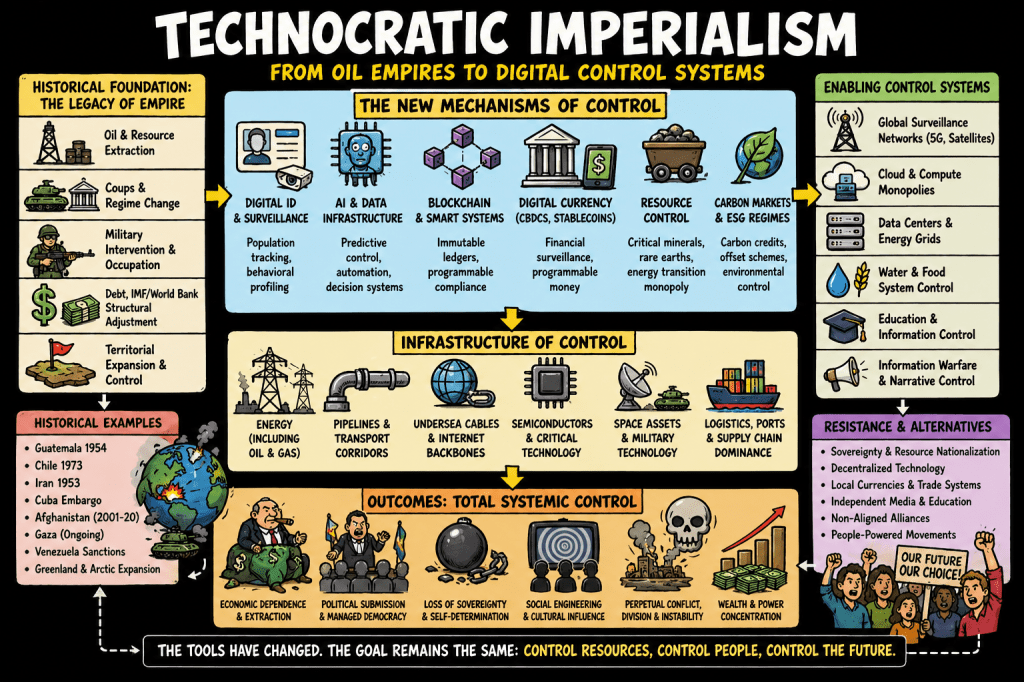
The old imperial model was control oil, ports, land, minerals, labor, and shipping lanes.
The emerging model is control energy, data, compute, digital identity, currency rails, carbon accounting, food systems, water, and critical minerals.
That is the bridge between U.S. imperial history, Agenda 2030, the WEF’s Great Reset language, AI, blockchain, digital ID, CBDCs, carbon credits, electrification, and current U.S./Trump/Israel policy.
The UN’s Agenda 2030 is officially framed as 17 Sustainable Development Goals covering poverty, food, health, energy, infrastructure, climate, cities, institutions, and global partnerships. The UN presents it as a development framework for “people, planet and prosperity.” (17 SDG). The important point is not that Agenda 2030 itself proves a conspiracy. The important point is that it provides the global policy language for restructuring economies around sustainability metrics, digital monitoring, energy transition, climate finance, food systems, public-private partnerships, and international coordination.
The WEF’s Great Reset and Fourth Industrial Revolution language fits into the same transformation, but from the corporate-governance side. Klaus Schwab and the WEF describe a technological revolution involving AI, robotics, digital systems, biotech, automation, and stakeholder capitalism, with public, private, academic, and civil-society actors integrated into governance. In plain terms: the WEF framework is not old-style socialism or old-style free-market capitalism. It is a managed public-private system where corporations, states, banks, NGOs, and technical platforms coordinate policy and infrastructure.
That is where technocracy enters.
A technocratic world is not necessarily ruled by scientists in lab coats. Modern technocracy means governance by systems: data systems, risk models, compliance scores, digital identity, automated payments, carbon accounting, AI decision-making, surveillance infrastructure, and platform access. It does not need to abolish private property. It can manage access to property, credit, mobility, food, energy, services, and markets through digital permission systems.
AI, blockchain, and digital ID are the operating tools.
AI supplies prediction, classification, automation, surveillance, logistics, and behavioral scoring.
Blockchain supplies auditable ledgers, programmable assets, tokenized ownership, stablecoins, carbon credits, supply-chain tracking, and automated contract settlement.
Digital ID supplies the identity layer: who you are, what you are allowed to access, what benefits you receive, what payments you can make, what credentials you hold, and what restrictions apply.
CBDCs and stablecoins supply the payment layer. A CBDC is central-bank-issued digital money; the Atlantic Council describes CBDCs as a public digital-money response to the spread of crypto and stablecoins. Its tracker covers more than 130 countries representing most of global GDP. Stablecoins are private or semi-private digital dollar substitutes. The practical distinction is this: fiat cash is bearer money; bank money is account-based money; CBDCs and regulated stablecoins can become programmable, trackable, and rule-bound money if designed that way.
Digital currency versus fiat currency is therefore not only about money form. It is about control architecture. Fiat currency can be physical cash, bank deposits, Treasury debt, and commercial money. Digital currency can be faster and more efficient, but it can also support programmable restrictions, automatic taxation, negative rates, spending limits, identity-linked access, or geofenced transactions. Not every CBDC will do all of that, but the technical potential exists.
Carbon credits and the green economy add the environmental accounting layer.
The green economy shifts value from unrestricted consumption toward measured consumption. Carbon credits turn emissions into tradable units. ESG reporting, carbon markets, green bonds, climate disclosures, and carbon-offset systems all create a financial layer over energy use, agriculture, transport, construction, and industrial production. With AI and blockchain, those credits can become automated, tracked, traded, scored, and enforced across supply chains.
This is where the “Great Reset” style language connects to Agenda 2030. Agenda 2030 gives the development goals. The WEF gives the corporate transformation language. AI and digital ID give the management tools. Digital currency gives the payment rails. Carbon credits give the rationing/accounting mechanism. Electrification gives the new energy dependency. Critical minerals give the new resource base.
The direction is technocratic.
Not necessarily as one centralized world government. More likely as a networked technocratic order: governments, central banks, corporations, defense contractors, cloud platforms, AI firms, payment processors, NGOs, and global institutions all managing different layers of life through interoperable systems.
That brings it back to Trump, the U.S., and Israel.
Trump’s role is not anti-technocratic in practice. It is anti-globalist in rhetoric but technocratic in execution where power is concerned. Crypto, stablecoins, AI chips, tariffs, critical minerals, border systems, military expansion, energy deals, and resource seizures all fit a hard-nationalist version of technocracy. It is not the soft UN/WEF version of “sustainable inclusion.” It is a hard-asset, militarized, nationalist version: control the inputs, own the rails, dominate the chokepoints, and let private allies profit.
Israel’s role fits through security technology, regional energy, Gaza, AI/military systems, surveillance, and strategic alignment with U.S. Middle East policy. Israel is not merely a small regional actor; it is deeply tied into U.S. defense, intelligence, cyber, AI, drone, border-tech, and surveillance ecosystems. In a technocratic order, security states become testbeds for surveillance, biometric control, counterinsurgency AI, drone systems, and urban-control models. Gaza is important because of offshore gas, reconstruction finance, regional normalization, and control of territory after devastation.
Petroleum is not simply disappearing. It is being repositioned.
The world is not moving from oil to “clean energy” in a simple moral sense. It is moving from one resource dependency to another. Oil, gas, and coal are important because they power industry, shipping, war, fertilizer, plastics, and backup electricity. But electrification increases dependence on copper, lithium, cobalt, nickel, graphite, rare earths, semiconductors, transformers, grid hardware, batteries, and data centers.
So the old oil empire becomes an electrified mineral empire.
Petro-fuel decline does not end imperial behavior. It changes the target list.
Old targets: oil fields, pipelines, ports, canals, shipping lanes.
New targets: lithium fields, copper mines, rare earth deposits, chip fabs, data centers, AI compute clusters, water supplies, grid nodes, battery plants, cloud infrastructure, and digital payment rails.
This is why Greenland, Venezuela, Iran, Gaza, Congo, Chile, Bolivia, Ukraine, Taiwan, the South China Sea, and Central Asia are targeted. They are not just places on a map. They are nodes in the next resource architecture.
AI farms make the energy and water problem worse.
The International Energy Agency projects global electricity demand rising strongly through 2030, driven by industry, electric vehicles, air conditioning, and data centers. (IEA) Recent reporting and analysis also show data centers becoming a major driver of U.S. electricity-demand growth. (Fortune) AI data centers also require water for cooling, either directly through evaporative cooling or indirectly through power generation. That means AI competes with households, farms, rivers, aquifers, and local grids.
That connects water scarcity to AI power.
In a technocratic world, water becomes not only a human necessity but a strategic input for computation, agriculture, energy, and urban control. AI does not live in the cloud. It lives in buildings that require land, electricity, chips, cooling systems, fiber, backup power, and water.
This ties directly to U.S. imperial history.
The old empire used military power, intelligence agencies, debt, sanctions, coups, and corporate law to secure bananas, copper, oil, land, ports, and minerals. The new empire uses the same basic tools to secure compute, chips, critical minerals, digital rails, energy corridors, payment systems, water, and carbon markets.
The pattern is continuous:
Guatemala: land and United Fruit.
Chile: copper and nationalization.
Iran 1953: oil and Mossadegh.
Indonesia: minerals, oil, and Western corporate entry.
Afghanistan: lithium, copper, rare earths.
Iraq: oil and regional control.
Gaza: land, security, reconstruction, and offshore gas.
Venezuela: oil, gold, and minerals.
Greenland: rare earths and Arctic position.
Cuba: land, ports, property claims, and tourism.
The modern layer adds:
AI compute.
Digital ID.
CBDCs/stablecoins.
Carbon credits.
Critical minerals.
Electrified grids.
Water-intensive data centers.
So the core answer is this:
Agenda 2030, the WEF Great Reset, AI, blockchain, digital ID, CBDCs, carbon credits, electrification, critical minerals, U.S. foreign policy, Trump’s hard-asset nationalism, and Israel’s security-tech role all intersect around the same structural transition: the world is moving from an oil-dollar-industrial empire into a data-energy-mineral-finance control system.
That does not mean every actor has the same plan. The UN, WEF, Trump, Israel, China, banks, AI firms, and defense contractors do not all have identical goals. But their systems converge because they all need the same things:
- identity verification,
- digital payment rails,
- energy control,
- data control,
- mineral access,
- AI infrastructure,
- security enforcement,
- carbon accounting,
- and compliant populations.
That is the technocratic danger: not one villainous institution, but many institutions building compatible control systems for different reasons.
The final plain-language conclusion:
The old empire controlled what came out of the ground.
The new empire controls what moves through the grid, the cloud, the wallet, the ID system, the carbon ledger, the food chain, and the water supply.
That is how all of this fits together.

 Bantam Joe
Leave a comment