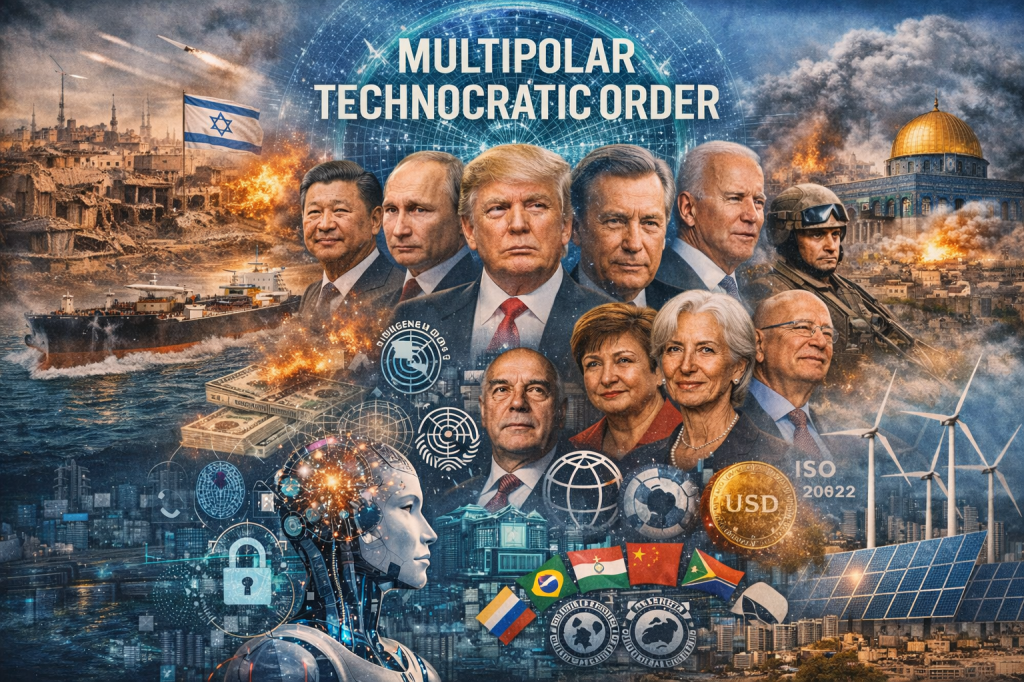


The Middle East crisis is not only a regional war but a trigger for a wider global restructuring. Conflict around Iran, Gaza, Lebanon, and the Strait of Hormuz drives up oil, LNG, shipping, insurance, food, and industrial costs, which helps explain persistent inflation while also pushing frightened markets back toward the U.S. dollar and U.S.-linked energy. War becomes a mechanism of leverage: it helps a heavily indebted but still powerful United States regain temporary centrality even as the older unipolar order weakens and the world moves toward a more fragmented, competitive system. Might this be the real reason for the war? Propping up a declining U.S. empire’s petrodollar?
This is not simply the decline of one empire but the emergence of a multipolar technocratic order. The U.S., China, Russia, Europe, Gulf states, global banks, multilateral institutions, and major corporations are portrayed as competing blocs that increasingly rely on similar methods: control over energy, shipping routes, digital payments, supply chains, AI systems, identity infrastructure, and emergency governance. Events involving Venezuela, Panama-linked ports, Greenland, Canada, Cuba, and Iran are framed as examples of resource and chokepoint politics, while Agenda 2030, ESG, stakeholder capitalism, the IMF, the World Bank, pandemic governance, and climate frameworks are presented as parts of a broader shift toward rule through metrics, systems, and coordinated administration.
The central warning is that AI is accelerating all of this by becoming the operating layer of modern power. AI is described as amplifying surveillance, warfighting, propaganda, financial compliance, labor displacement, behavioral scoring, and digital control, especially when combined with stablecoins, ISO 20022-style payment rails, digital identity, and carbon-accounting systems. The conclusion is that the danger is no longer only open military domination or classic financial coercion, but a world in which access to money, work, mobility, speech, and daily life becomes increasingly governed by integrated, data-driven systems. In that view, the coming order may not look like one centralized world government, but rather a network of rival blocs using the same technocratic logic: classify, predict, optimize, automate, and restrict.
I believe the clearest place to start is the Middle East.
When war or extreme instability hits the Middle East, especially around Iran and the Strait of Hormuz, it does not stay there. It moves into oil, LNG, shipping, insurance, fertilizer, food costs, industrial costs, bond markets, currencies, and public fear. That is why the Middle East is never just a regional story. It is one of the main pressure valves of the entire global system. Reuters and other major outlets have treated the current Hormuz crisis exactly that way: as a systemic economic shock, not a local conflict.
This is not only about missiles, naval power, Israel, Iran, Gaza, or Lebanon. It is also about leverage. If Gulf energy flows become unstable, then countries and companies start looking for safer suppliers. That immediately strengthens the position of the United States and other non-Gulf producers. It can also push frightened capital back toward the dollar and U.S. debt markets, at least in the short term. In plain language, Middle East war can make U.S.-linked energy more attractive and can temporarily make the declining dollar look safer again, even while the deeper long-term strain on U.S. power continues underneath.
The United States is carrying debt near $39 trillion, while the older petrodollar order is under gradual pressure from payment fragmentation, BRICS experimentation, and broader dissatisfaction with U.S.-controlled financial rails. So when a major energy crisis drives capital back toward the dollar and back toward U.S.-aligned energy, Aside from a market reaction, I see a strategic act. Disorder can still feed the empire, even while the empire itself is weakening.
High inflation is not just a money-printing story. It is also the price effect of a world being reorganized through war, sanctions, industrial reshoring, energy insecurity, supply-chain fracture, military spending, debt stress, and strategic competition. Inflation is what happens when the old globalized order breaks down, but no new stable order has fully replaced it. The current Middle East crisis helps explain why energy, transport, food, and financing pressures keep feeding economic instability.
I do not think the new order forming is freer. I think it is becoming a multipolar technocratic order.
By that I mean I do not see one single empire permanently ruling everything from one center. I see several power centers competing with one another while all moving toward similar methods of control. The United States, China, Russia, the EU system, Gulf monarchies, global banks, multilateral lenders, large tech firms, defense contractors, and asset managers may fight each other in some arenas. But they are also all learning the same lesson: modern rule works best when finance, data, identity, logistics, surveillance, and emergency powers can all be integrated.
I no longer think only in terms of one “new world order” under one flag. I think the deeper danger is a shared technocratic logic across rival blocs. In that world, the blocs compete, but the methods increasingly resemble one another.
The current Middle East war environment helps drive that process.
War raises oil and LNG risk. That raises transport costs, industrial costs, food costs, fertilizer costs, and insurance costs. Governments then respond with debt, subsidies, strategic reserves, industrial policy, central-bank maneuvering, and tighter economic control. Populations become more anxious and more financially fragile. That creates the perfect political climate for more emergency-style governance, more concentration of authority, and more public tolerance for systems that promise stability. That is why war abroad and inflation at home are not separate stories. They are linked parts of the same reconfiguration.
The U.S. is still the dominant military and financial pole, but it is no longer as secure as it once was. More countries want to settle trade outside traditional dollar channels. More governments are looking for alternatives to exclusive dependence on U.S.-centered payment infrastructure. But at the same time, the U.S. can still use crisis to pull capital back into its orbit. Middle East instability can strengthen dollar demand, support U.S. energy exporters, and temporarily restore the sense that Washington remains indispensable. That is a hallmark of late empire: weakening structurally, while still able to turn disorder into leverage.
This is where Donald Trump’s actions start to display a larger pattern.
I do not look at Venezuela, Panama-linked infrastructure, Greenland, Canada, Cuba, and Iran as separate random episodes. I see them as parts of a broad resource-and-chokepoint strategy during a period when energy, minerals, shipping routes, and territorial leverage are becoming important.
Take Venezuela first. U.S. forces seized Nicolás Maduro in January 2026 and Washington then removed sanctions on interim President Delcy Rodríguez and broadly authorized transactions involving PDVSA, Venezuela’s state oil company. This all unfolded amid a global oil-price surge tied to the U.S.-Israeli war with Iran. Venezuela holds the world’s largest crude reserves. I am not saying the U.S. literally owns those reserves. That would be inaccurate. But I am saying that U.S. power inserted itself directly into the political control of the state sitting on the largest oil base on earth and then moved to reopen those flows under U.S.-favored conditions. That is not a side issue, but rather a strategic positioning.
Now look at Panama. Panama still controls the canal. But Reuters reported that CK Hutchison agreed to sell its controlling interest in the Panama Ports Company, including the Balboa and Cristóbal ports at either end of the canal, to a consortium including BlackRock, Global Infrastructure Partners, and Terminal Investment, amid clear Trump-era pressure to reduce Chinese influence. U.S. officials welcoming U.S. investors in acquiring a controlling stake in those ports. In plain language, key gates on one of the world’s most strategic maritime routes moved toward a U.S.-aligned financial consortium. It is a major shift in strategic infrastructure.
Greenland is another example. Trump revived his push to seize Greenland and that Greenland’s Prime Minister Jens-Frederik Nielsen publicly pushed back, while tensions with NATO widened. Greenland is not merely frozen land. It is Arctic position, minerals, military geography, and future strategic depth. A U.S. president openly pressuring a NATO Arctic territory, is not ordinary alliance friction, rather is empire language spoken in public.
Canada fits the same picture. Trump has threatened a 100% tariff over a possible Canada-China deal and previously tying tariff relief to the idea of Canada becoming the 51st state. Canada rejected that rhetoric, but the language itself remains. It reveals a worldview in which allied sovereignty becomes negotiable when U.S. strategic interests are involved. Canada is not just a neighbor. It represents energy, minerals, land, water, industrial integration, and geopolitical depth.
Cuba belongs in the same map. Cuba entered talks with Washington amid an oil blockade imposed by Trump, and also reported the severe effects of those fuel restrictions on the island’s electrical grid and economy. AP reported protests in Havana against the U.S. energy embargo. A blockade pressure, oil strangulation, and takeover language reveal the persistence of direct hemispheric coercion. In practical terms, Washington has treated Cuba as a target for economic suffocation inside a larger regional strategy.
If I put Venezuela, Panama-linked ports, Greenland, Canada, Cuba, and Iran on the same map, I do not see isolated events. I see a pattern: energy reserves, canal gates, Arctic minerals, hemispheric pressure, allied coercion, and Middle East war all moving into one strategic field. That is why I describe the United States as a dangerous but declining empire. It is still powerful enough to destabilize the system, but less able to command lasting moral legitimacy for that system.
Now add AI, and the picture becomes much more serious.
A lot of people still treat AI as if it is mainly chatbots, office automation, or convenience software. I think that is far too small a view. AI is becoming the central nervous system of modern power. It is moving into finance, border control, intelligence, logistics, media, policing, labor systems, energy optimization, cyber operations, military targeting, and public administration. It is not just another tool. It is becoming the operating layer that ties the whole system together.
In a world already shaped by war, inflation, debt, energy stress, and financial rivalry, is now being layered with systems that can classify, predict, flag, rank, automate, and control on a scale older bureaucracies could never achieve.
If the old imperial system ran on oil, sanctions, intelligence, and reserve currencies, the upgraded system runs on all of that plus AI.
AI strengthens the power of states to monitor transactions. It strengthens police and militaries to track and target. It strengthens platforms to shape narratives and suppress visibility. It strengthens banks and payment systems to detect, classify, and restrict. It strengthens corporations to monitor workers, price risk, personalize control, and manage consumer behavior. It strengthens governments to govern through dashboards, models, watchlists, and automated responses.
This is why I think AI belongs at the center of the story, not at the edge of it.
The same is true of stablecoins, digital payments, ISO 20022 messaging standards, and digital identity. Taken separately, each can sound technical and harmless. A better payment standard sounds efficient. A stablecoin sounds innovative. Digital identity sounds convenient. But if I step back, I see a deeper pattern. Money is becoming more digital, more traceable, more standardized, more interoperable, and more tightly linked to identity and compliance. BIS material on ISO 20022 and cross-border payments shows precisely that broader push toward harmonised, richer, more interoperable payment data. Treasury’s GENIUS Act framework does the same thing on the stablecoin side, building regulated payment-stablecoin rails around AML and sanctions compliance.
Once that happens, AI becomes the natural operating system for the whole arrangement.
AI can monitor payment flows, detect anomalies, score risk, prioritize investigations, and automate sanctions and fraud responses. Stablecoins can make money more programmable. Digital identity can link transactions to people more tightly. Standardized payment messaging makes everything easier to read at scale. Put together, this is not just a modern payment system, but instead is a governable payment system.
Regulated digital money does not weaken state power. Rather, I think it may strengthen it. It can give the dollar a software upgrade. It can extend financial control deeper into everyday life. It can make exclusion more precise and more automatic. In that kind of world, money stops being just money. It becomes conditional access.
Now place Agenda 2030, the SDGs, ESG, stakeholder capitalism, the IMF, the World Bank, and the broader climate-and-development machinery inside this same framework.
The U.N.’s official 2030 Agenda describes itself as a “plan of action for people, planet and prosperity.” The language is noble. The WHO’s Pandemic Agreement, adopted on May 20, 2025, is officially about preparedness and coordination. The IMF openly says it is integrating climate risk and green-finance issues into macroeconomic and financial policy work. None of those official goals are automatically sinister. Clean water is good. Better health is good. Environmental stewardship is good. But that does not end the analysis. The real question is how these goals are turned into operating systems.
Agenda 2030 turns human life into targets, indicators, timelines, and measurable outcomes. ESG turns corporations into measurable compliance entities. Carbon accounting turns energy and industrial behavior into measurable units. Pandemic preparedness turns bodies, movement, and health status into administrative categories. Development finance turns national policy into conditional metrics.
That is exactly the kind of environment where technocratic power grows strongest.
And AI makes it stronger.
AI excels at classification, prediction, anomaly detection, ranking, scoring, optimization, and automated response. The more governance becomes metric-driven, the more governance invites AI into its center. That means the rise of AI does not sit outside Agenda 2030 or outside ESG. It fits directly into them. It helps operationalize them.
This is why I think stakeholder capitalism may become even more invasive than the older shareholder model. Under shareholder capitalism, corporations could be cruel, extractive, and narrow, but their justification remained relatively simple: profit. Under stakeholder capitalism, corporations are expected to serve climate goals, social goals, diversity goals, public-health goals, resilience goals, and community goals. That sounds more moral, but it also gives corporations a wider mandate to shape behavior. The WEF has promoted that shift in public language for years.
Now add AI.
An AI-enhanced stakeholder corporation can monitor workers more deeply, model customers more closely, personalize nudges, automate compliance, moderate speech, score behavior, and deny access in the name of safety, inclusion, sustainability, or integrity. In that world, the corporation is no longer merely selling products. It becomes part of the social-governance apparatus.
This is where the line between state power and corporate power starts to blur badly.
The IMF and World Bank fit the same pattern at a higher scale. Their role in crisis management, debt restructuring, development priorities, and climate finance already gives them enormous influence. Reuters reporting on the current Middle East energy shock showed IMF Managing Director Kristalina Georgieva, World Bank President Ajay Banga, and IEA head Fatih Birol coordinating around the crisis. In moderate language, that is sensible coordination. In harder language, it means a small set of unelected financial and technocratic figures can become central nodes in how dozens of countries are pushed to respond to war, debt, inflation, and energy scarcity at once.
Pandemics reveal another side of the same logic. The pandemic era taught governments and institutions how far emergency governance can reach. Movement, work, travel, documentation, and access can all be reorganized quickly when fear is strong enough. AI makes that much more scalable. It can track people, fuse with biometrics, digital identity, border systems, workplace systems, and payment systems. That is why future pandemic governance worries me not only as public health, but as a possible AI-assisted biosecurity regime. The WHO agreement does not itself erase national sovereignty, but it does show the continued build-out of coordinated international emergency architecture.
Climate governance fits the same pattern. We can see the way climate, carbon markets, and digital finance are merging into a system of behavioral management. Once carbon becomes a tracked unit tied to finance and policy, AI becomes the obvious tool to verify, rank, model, price, and condition behavior around it. Travel, purchases, industrial output, and energy use all become easier to integrate into systems of governance.
In a better world, that could remain restrained and humane. In a darker world, it becomes one more permissions architecture layered on top of daily life.
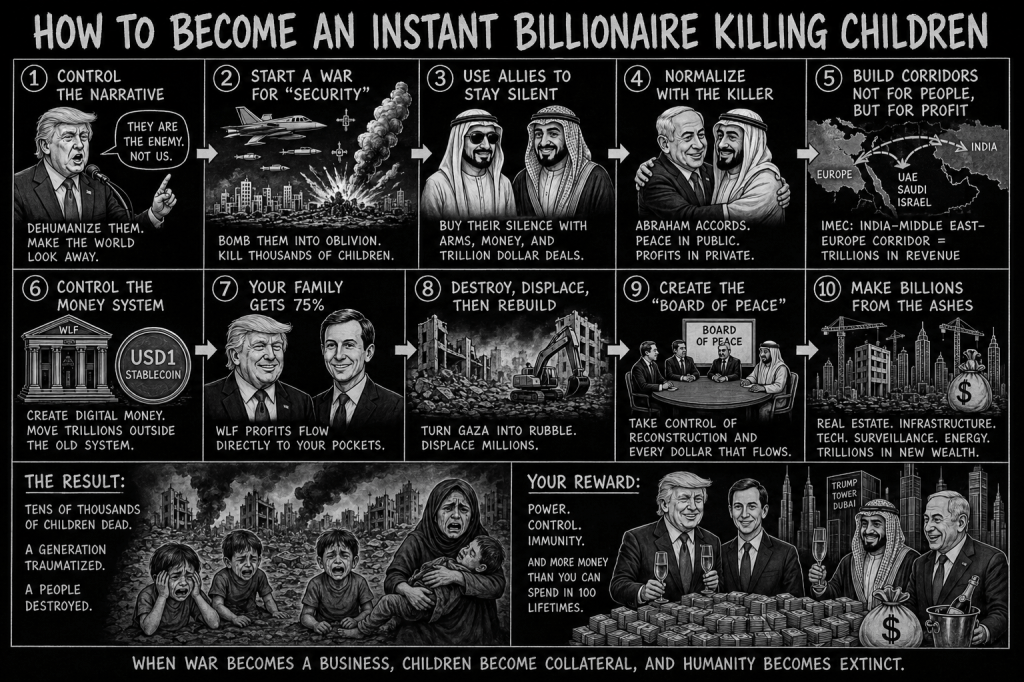
Israel, Gaza, Lebanon, and Iran show the moral cost of all this.
Let’s be precise. Judaism is not Zionism. Jewish people are not identical with the ideology of the Israeli state. Christianity is not Christian Zionism. My concern is with hardline political Zionism and with Christian Zionism where they become political-theological engines for permanent domination, war, ethnonational entitlement, or apocalyptic destiny. Once those ideas fuse with state power, media power, lobbying power, and Western military backing, they become extraordinarily dangerous.
The ICJ case brought by South Africa against Israel under the Genocide Convention is active. The Court has issued provisional measures. Official ICJ materials confirm that this is not a fringe allegation but a live case before the world’s top U.N. court. At the same time, major U.N. condemnation of Israeli strikes in Lebanon and appalling civilian casualties there as the conflict widened. Whatever final legal terminology the Court reaches later, the scale of civilian destruction in Gaza and the spillover into Lebanon have already shattered the credibility of the so-called rules-based order for much of the world.
When AI is added, the danger becomes worse. Modern violence is increasingly paired with surveillance platforms, machine vision, target-support systems, biometric analytics, communications intelligence, and algorithm-assisted decision support. AI can make it easier for states to find, sort, classify, and strike human beings at scale while presenting the process as precise, rational, and data-driven. That is one of the great dangers of AI in war: it can make mass violence look clean on a dashboard.
Lebanon shows how these systems spill outward. A conflict no longer stays geographically contained once surveillance, targeting, financial leverage, energy shocks, and narrative warfare can all be extended regionally. AI does not merely improve war. It helps dissolve the boundary between war and ordinary civil life.
That is why I think the “rules-based order” is collapsing morally even as its administrative machinery grows stronger. The world watches selective law, selective outrage, selective humanitarianism, and strategic impunity while AI-enhanced media systems flood people with narratives, counter-narratives, moderation, suppression, and noise. AI does not only reshape the battlefield. It reshapes the story told about the battlefield.
So this is where I end up.
I do not think the world is moving toward stable peace. I think it is moving toward a system where instability is managed rather than solved. War becomes useful. Inflation becomes governable. Crisis becomes productive for those at the top. Emergencies become policy engines. AI becomes the great administrative amplifier. Money becomes programmable. Identity becomes integrated. Behavior becomes measurable. Access becomes conditional.
That is what I mean by the upgrade of empire.
It is not only one empire anymore. It is a shared method across rival blocs.
The older world was brutal but easier to recognize. Armies invaded. Banks squeezed. Governments censored. The newer world still has all of that, but the mechanisms become more diffuse and more embedded. People do not only face direct force. They face systems that score them, sort them, nudge them, flag them, and quietly limit them.
That is why I think the Middle East is a starting point. It shows how energy and war still set the entire machine in motion. It shows how inflation and fear are fed. It shows how the dollar can still be pulled back into demand through crisis. It shows how supply shocks become political tools. And from there, if I follow the chain logically outward, I arrive at the larger structure: a multipolar technocratic order where states, banks, corporations, militaries, platforms, and AI systems all converge around the same habit of rule.
Not one throne, but many connected centers.
Not one empire, but several competing empires using similar tools.
Not one ideology, but one operating logic: classify, predict, optimize, automate, restrict.
That is the world I believe we are entering.
And that is why I think we are seeing war and high inflation at the same time. They are not unrelated crises. They are symptoms of a system being reconfigured in real time.



 Bantam Joe
Leave a comment