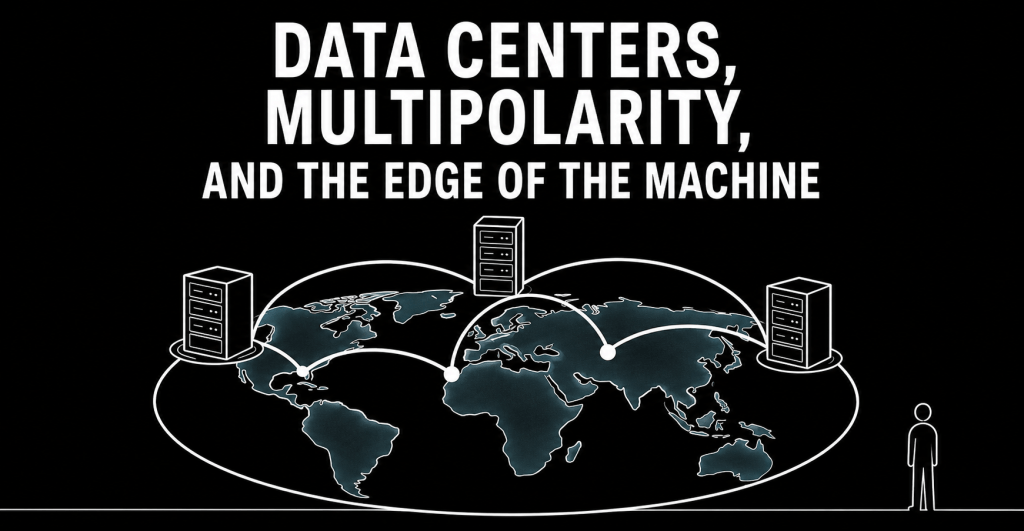


The world is not simply becoming multipolar. It is becoming computational.
A multipolar world means power is no longer held by one dominant empire or one dominant bloc. It means the United States, China, Russia, India, Europe, the Gulf states, BRICS networks, and other regional powers are all competing for influence, resources, trade routes, energy flows, currencies, technology, and military advantage. On the surface, this looks like a struggle between different civilizations, governments, and economic models. In many ways, it is. But beneath the flags, speeches, sanctions, wars, alliances, and trade deals, a deeper convergence is taking place.
Nearly every major power is moving toward the same technological operating system.
That system is built from data centers, artificial intelligence, cloud computing, digital identity, programmable finance, surveillance infrastructure, smart cities, autonomous systems, military networks, predictive analytics, tokenized assets, and automated administration. The political language changes from country to country, but the architecture increasingly looks the same. One bloc calls it innovation and national security. Another calls it social stability and industrial planning. Another calls it digital sovereignty and regulation. Another calls it smart-city modernization and post-oil transformation. The words differ, but the machine underneath converge.
This explains why the massive expansion of data centers is important. These facilities are not merely warehouses for personal data. They are not only places where photographs, emails, videos, or business files are stored. They are becoming the industrial plants of the digital age. In the old industrial economy, power came from factories, railroads, steel mills, oil refineries, ports, and power stations. In the new computational economy, power also comes from server farms, GPU clusters, fiber networks, cloud regions, AI training facilities, satellite systems, and secure data infrastructure.
A modern data center is a factory that produces computation. Its product is not a car, a barrel of oil, or a piece of machinery. Its product is prediction, automation, simulation, storage, routing, command, surveillance, analysis, and decision support. It processes the information that runs banking, logistics, medicine, insurance, e-commerce, video streaming, government records, military systems, emergency services, education platforms, digital identity systems, and artificial intelligence.
The United States has so many data centers because it sits at the center of the global cloud and AI economy. Amazon, Microsoft, Google, Meta, Oracle, Apple, Nvidia-linked partners, major telecom carriers, defense contractors, financial exchanges, health systems, universities, intelligence agencies, logistics firms, and federal departments all require enormous computing capacity. The U.S. has deep capital markets, major cloud companies, large land availability, advanced fiber networks, large energy markets, and massive demand from both commercial and government customers.
The largest new driver is artificial intelligence. AI is not just a matter of storing files. It requires massive compute. Advanced models need specialized chips, GPU clusters, liquid cooling, backup power, high-speed networking, and vast electrical capacity. This is why data centers are increasingly being discussed like heavy industry. They consume power, water, land, chips, copper, transformers, cooling equipment, and grid capacity. They are digital factories with physical consequences.
But the purpose of this buildout cannot be reduced to one explanation. It is not only about commerce. It is not only about surveillance. It is not only about war. It is all of these things together.
Corporations need data centers for cloud services, advertising, customer profiling, logistics, automation, e-commerce, software, entertainment, fraud detection, and labor replacement. Banks and financial institutions need them for payment systems, risk modeling, trading, settlement, credit scoring, compliance, tokenization, and programmable finance. Governments need them for administration, identity systems, taxation, emergency response, border control, health records, policing, and public services. Militaries need them for command systems, intelligence fusion, satellite data, battlefield cloud, drone coordination, cyber operations, logistics, and simulation. AI companies need them for training models, running models, building autonomous agents, generating synthetic media, and automating complex decision processes.
This is the deeper meaning of the data-center buildout. It is the physical foundation of a new control layer.
That control layer does not have to look like a dictator barking orders from a palace. It can look like an app. It can look like convenience. It can look like faster payments, better traffic management, improved health care, smarter logistics, safer cities, efficient disaster response, climate modeling, fraud prevention, and personalized services. Many of these uses are genuinely useful. Hospitals need reliable data. Weather prediction saves lives. Logistics systems keep goods moving. Emergency systems need coordination. Farmers can benefit from better forecasting. Engineers can benefit from better modeling. Small businesses can benefit from digital tools.
The danger is not technology itself. Humanity has always used technology. Fire, writing, roads, plumbing, electricity, radio, refrigeration, engines, computers, medicine, and agriculture are all technologies. The danger begins when technology stops being a tool under human judgment and becomes the system that judges human beings.
That is the line.
A tool helps a person act. A control system decides whether the person is allowed to act.
When money, identity, movement, speech, health records, employment, education, utilities, transportation, insurance, communication, and reputation all become dependent on networked digital systems, the person becomes easier to score, sort, approve, deny, reward, punish, insure, employ, exclude, or monitor. This does not require one global tyrant. It can happen through layers of institutions, contracts, platforms, regulations, banks, apps, algorithms, and automated risk systems.
This is why the issue is larger than personal data collection. Human data is only one input. The machine also needs financial data, weather data, satellite data, traffic data, shipping data, energy-grid data, agricultural data, medical data, industrial data, legal data, communications data, and synthetic training data. The goal is not merely to know what people are doing. The deeper goal is to model reality well enough to predict, price, influence, automate, and manage it.
This is where the idea of a digital twin Earth becomes evident. It is not a fantasy in the technical sense. Digital twins are already used in industry, climate science, urban planning, logistics, military planning, energy systems, and infrastructure management. A factory can have a digital twin. A power grid can have a digital twin. A city can have a digital twin. A battlefield can have a digital twin. A supply chain can have a digital twin. A human body, in medical modeling, can be approximated through digital systems. Weather and climate models are forms of Earth-system simulation.
A full digital twin of the Earth would not appear all at once as one official machine with one name. It would more likely emerge through overlapping models: a twin of the financial system, a twin of supply chains, a twin of traffic, a twin of cities, a twin of weather, a twin of agriculture, a twin of energy, a twin of military theaters, a twin of consumer behavior, a twin of public health, and a twin of social activity. Each model would be built for its own purpose. Together, they would begin to form a digital replica of civilization.
This is the hidden convergence. The world may remain politically divided, but the technical direction is the same across competing powers.
The United States may build its cloud-AI-defense-finance stack. China may build its state-industrial-AI-surveillance stack. Europe may build its regulated digital-sovereignty stack. Gulf states may build their AI-city-energy-finance-logistics stack. BRICS nations may build alternative settlement systems, commodity-backed finance, sovereign cloud systems, and regional infrastructure networks. Private technology firms may sell chips, cloud platforms, AI models, cybersecurity, surveillance tools, and financial rails across these blocs.
That is not necessarily one world government in the old sense. It is something new, more technical and, in some ways, more difficult to see. It is a world of interoperable technocratic blocs. They may compete politically while converging structurally.
This is why multipolarity alone does not solve the problem. It may reduce the dominance of one empire. It may give countries more room to maneuver. It may weaken sanctions. It may create alternatives in trade, currency, energy, and diplomacy. Those are real effects. But multipolarity does not automatically restore human freedom, local autonomy, privacy, cash, small business independence, local agriculture, spiritual grounding, or the right to live outside the machine.
A multipolar world can still become a technocratic world.
The deeper question is not simply who rules the world. The deeper question is what kind of system all rulers are adopting. If every major pole builds AI clouds, digital IDs, programmable payments, biometric borders, smart cities, drone networks, cyber commands, predictive policing, tokenized assets, and automated bureaucracies, then humanity is still being pulled into the same machine logic under different flags.
That machine logic is simple: sense everything, digitize everything, model everything, predict everything, price everything, automate everything, and control everything that can be controlled.
This is the logic of machine-managed civilization.
The public justification will always be efficiency. Faster services. Safer cities. Less fraud. Better medicine. Cleaner energy. Faster disaster response. Better logistics. Stronger defense. More accurate forecasting. More convenient payments. More personalized education. Smarter agriculture. These benefits make the system attractive.
But the same architecture can be turned toward behavioral scoring, speech restriction, account freezing, automated exclusion, social pressure, insurance discrimination, programmable money limits, biometric gatekeeping, permanent tracking, predictive policing, and military automation. The same system that can help a hospital can also help a security state. The same AI that can improve farming can also optimize drone warfare. The same digital ID that can reduce fraud can also become a permission gate. The same payment rail that can make settlement faster can also make money programmable and conditional.
The tool and the leash can be built from the same wire.
This is why the proper response is not a childish rejection of all technology. That is neither realistic nor wise. Technology is not the enemy by itself. The enemy is dependency without fallback, convenience without boundaries, automation without moral judgment, and centralized control without human override.
A person cannot fully escape the technological system. Not realistically. Modern life still requires identification, money, medicine, fuel, property records, transportation, communication, parts, weather alerts, emergency services, and some interaction with institutions. To completely leave the grid would require large amounts of money, land, skill, health, supplies, legal stability, and a local support network. Even then, no one is fully outside the world.
But a person can reduce dependency.
That is the practical path.
The goal is not to disappear. The goal is to stop being a total endpoint of the system. A person should not have every basic need tied to cloud accounts, smartphones, banks, apps, subscriptions, platforms, smart meters, digital wallets, online identity, or remote permission structures. The more life depends on centralized systems, the easier life becomes to interrupt, price, monitor, condition, or deny.
The answer is to build manual fallbacks.
Use digital tools, but keep paper records. Use online banking, but keep some cash and local trade options. Use the electric grid, but build backup power. Use smartphones, but keep radios, printed contact lists, offline maps, and physical documents. Use modern appliances, but keep manual cooking, lighting, water, and heating options. Use the internet, but store important books, manuals, documents, and knowledge offline. Buy food, but grow some food. Use supply chains, but keep spare parts and repair skills. Use technology, but do not let every basic need require corporate permission.
This is not retreat. It is household-level decentralization.
A realistic life on the edge is not fully inside the machine and not pretending to be fully outside it. It uses what is useful while reducing what is controlling. It accepts that the modern world still exists, but it builds independence around the essentials: water, food, power, shelter, sanitation, cooking, lighting, refrigeration, tools, communications, medicine, security, and local relationships.
This is more practical than pure off-grid fantasy. Full off-grid living is expensive and difficult. Edge-grid living is layered and incremental. It allows a person to use modern systems while slowly building backups that are local, repairable, low-power, non-cloud, and understandable.
Don’t be afraid to get your hands dirty or make mistakes. Just do it.
The first layer is normal life. The second layer is backup systems. The third layer is emergency systems. The fourth layer is skill and community.
Normal life may still include electricity, internet, banking, vehicles, phones, and stores. Backup systems include stored food, backup water, battery power, solar charging, paper records, offline files, tools, spare parts, radios, and alternative cooking methods. Emergency systems include manual pumps, gravity water, candles or oil lamps, printed maps, first aid, basic sanitation, and simple repair equipment. The deeper growth layer is skill: gardening, electronics repair, mechanical repair, food preservation, radio use, first aid, carpentry, small-engine work, sewing, water filtration, local barter, and neighbor trust.
This is how a household becomes harder to capture, harder to frighten, harder to disable, and more useful to others.
The key is to focus on real value. Real value is not merely digital access, financial speculation, platform status, or algorithmic reputation. Real value is food, clean water, tools, seeds, repair knowledge, energy, shelter, health, trustworthy people, local trade, practical skill, and moral steadiness. These things still matter when markets fall, platforms disappear, accounts freeze, supply chains break, storms hit, power fails, or institutions lose credibility.
A balanced world order begins at the human scale. It begins when people stop confusing extraction with value. A system that extracts wealth, attention, labor, data, and obedience without giving back real value is not healthy. A person, household, business, community, or nation adds value when it produces, repairs, grows, teaches, protects, builds, heals, stores, preserves, and strengthens what others need to live.
That principle cuts through the noise.
The modern technological order wants everything connected, measured, optimized, and monetized. A sane human order must keep some things grounded, local, physical, moral, and free. Not everything should be tokenized. Not everything should be automated. Not everything should be surveilled. Not everything should require an app. Not every transaction should need a cloud. Not every human action should produce a score.
The human person must remain above the system.
That is the central issue. The future will not be decided only by whether the world is unipolar or multipolar. It will be decided by whether human beings remain morally and practically sovereign over the systems they build. A world with many poles can still become a prison if every pole copies the same machine logic. A world with advanced technology can still remain humane if technology is bounded by conscience, local autonomy, privacy, human override, and the right to live simply.
The real battle is not man versus machine. It is tool versus master.
If technology remains a tool, it can serve medicine, education, agriculture, communication, engineering, emergency response, and human flourishing. If technology becomes the master, it can reduce human beings to managed components inside a system they cannot understand, repair, appeal, or escape.
The path forward is not panic. It is preparation. It is not fantasy isolation. It is practical independence. It is not hatred of technology. It is disciplined boundaries around technology. It is not withdrawal from humanity. It is renewed commitment to household, neighbor, land, skill, repair, faith, and local usefulness.
The future may be filled with data centers, AI systems, smart infrastructure, digital money, surveillance networks, sovereign clouds, and competing technocratic blocs. That larger trend may not be stoppable by ordinary individuals. But ordinary individuals are not powerless. They can reduce dependency by simply building fallback systems. They can keep knowledge offline. They can grow food. They can repair tools. They can lower debt. They can keep cash. They can maintain radios. They can store water. They can build local trust. They can refuse to place every vital function behind a remote permission gate.
That is how a person lives on the edge.
Not by escaping the world completely.
Not by surrendering to it completely.
But by standing at the boundary with enough skill, tools, faith, and judgment to use what is useful and resist what is dehumanizing.
The machine may keep expanding. The blocs may keep competing. The data centers may keep multiplying. The digital twins may keep forming. The algorithms may keep spreading. But the human task remains older than all of it: preserve life, protect conscience, build and share real value, help your neighbor, serve God or nature, and refuse to become merely another managed component in someone else’s system.
I want to thank everyone who has shared kind words about the closing of BantamJoe.com. My WordPress account remains active until June 7. After that, I may still post on Facebook from time to time, but not as often.
I sincerely hope each of you finds ways to step back from the machine and reconnect with real life. Put your hands in the dirt. Grow vegetables and fruit. Pick up a hammer, a screwdriver, or whatever tools you have, and repair what needs fixing. Learn practical skills. Build something. Fix something. Participate with nature and live life as fully and honestly as you can.
Again, thank you all for your kindness, encouragement, and friendship.



 Bantam Joe
Leave a comment