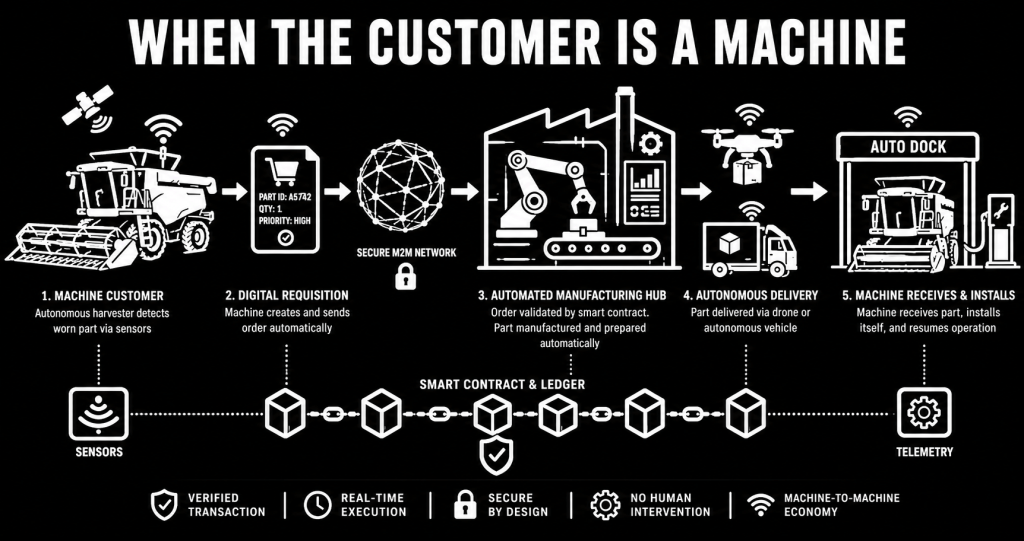


In the future economy, the human worker has largely been removed from the chain. The wealthy class, corporate owners, financial institutions, platform operators, and state-aligned infrastructure managers have replaced most human labor with autonomous machines, AI agents, robotics, tokenized payment systems, smart contracts, and automated logistics. Humans may still own, fund, regulate, or supervise the system at the top, but ordinary human labor is no longer needed for most transactions. The customer can be a machine. The seller can be a machine. The carrier can be a machine. The inspector can be a machine. The payment can settle by code.
In this example, the customer is not a person. The customer is an automated machine that detects its own failure, orders its own replacement part, pays through a machine wallet, schedules delivery, confirms receipt, and may even initiate its own repair. Assume the customer is an autonomous agricultural harvester operating on a large automated farm. It runs almost continuously during harvest season and is equipped with sensors, onboard diagnostics, GPS, machine vision, wireless communications, a maintenance AI, secure device identity, and a machine wallet funded by the farm’s operating account.
The harvester detects that one of its hydraulic actuator modules is nearing failure. No driver notices it. No mechanic calls a supplier. No office clerk writes a purchase order. The machine identifies the problem and starts the transaction chain itself. The full process runs from the harvester to the maintenance AI, then to the procurement platform, manufacturer, component suppliers, factory robots, quality-control systems, warehouse, logistics network, delivery robot, service dock, and finally smart-contract settlement. The important point is that the “customer” is now a machine with identity, authorization, budget limits, maintenance rules, and the ability to transact.
The process begins when the harvester’s internal sensors monitor pressure, vibration, temperature, load, and cycle count on the hydraulic actuator. The system detects abnormal hydraulic pressure drift, worsening vibration, slower actuator response time, and an estimated remaining useful life of 47 hours. It identifies the required replacement part as Hydraulic Actuator Module HAX-440 and attaches its own machine ID, current location, urgency level, maximum allowed downtime, warranty status, service level, and authorized wallet.
The harvester does not “want” a part in the human sense. It detects a technical condition that triggers a maintenance rule. Its onboard AI compares live sensor data against failure models and determines that the actuator should be replaced before breakdown. It then creates a requisition packet and sends it to the farm’s maintenance AI.
That requisition packet includes the machine identity, fault code, sensor evidence, required part number, serial number of the failing part, operating location, urgency level, approved spending limit, preferred delivery point, maintenance window, authorized wallet, and warranty status. The farm’s maintenance AI checks whether this harvester is allowed to order parts automatically. It verifies that Harvester-17A is active, that the fault is real, that the requested part is compatible, that the repair is covered or approved, that the cost is within automated spending limits, and that no spare part already exists in local inventory. If no spare exists, the maintenance AI approves the requisition.
At this point, the machine has successfully created a machine-readable demand signal. It has not merely reported a problem. It has initiated an economic process.
Before any supplier accepts the order, the harvester must prove its identity. It signs the requisition with its private cryptographic key. The procurement platform verifies that signature using the machine’s public key or certificate. In plain terms, the system is asking whether this is a real registered harvester, whether it belongs to the farm account, whether it is allowed to request parts, and whether its identity has been revoked, hacked, or flagged. This is the first major junction. The machine is treated as a valid customer because the system recognizes its identity. A human without similar digital credentials may not even enter the transaction chain.
After identity comes authorization. The procurement system determines whether the harvester is allowed to spend money. It checks its spending limit, whether this part is approved for automatic ordering, whether the farm wallet is funded, whether the delivery location is valid, whether the part is restricted, and whether the maintenance contract is active. If those conditions pass, the procurement platform accepts the request. The machine customer is now authorized to buy.
The procurement platform then searches for the part. It queries local farm inventory, regional parts depots, manufacturer warehouses, third-party suppliers, refurbished part markets, compatible substitute databases, and emergency delivery networks. Each supplier system responds with machine-readable offers that include price, delivery time, warranty, part condition, compatibility score, shipping route, energy cost, risk score, and contract terms. The procurement AI ranks those offers. Because the harvester is harvest-critical, the system may choose a more expensive supplier with faster delivery. A human buyer might consider cost, personal judgment, or an existing relationship. The machine considers policy, downtime risk, service level, and optimization rules.
Suppose no warehouse has the actuator available. The procurement platform sends a production request directly to the manufacturer. The request identifies Harvester-17A as the customer machine, specifies the required part, quantity, urgency, delivery deadline, destination service dock, available escrow payment, and contract type. The manufacturer AI reviews factory capacity, raw material inventory, robotic line availability, energy price, supplier availability, profit margin, service priority, and delivery feasibility. If the order is acceptable, the manufacturer AI digitally signs the agreement. No salesperson is needed. No phone call occurs. The customer machine and manufacturer machine have entered a contract.
A smart contract now becomes the financial and operational rule engine. It may state that if Harvester-17A is authorized, the farm wallet deposits funds, the manufacturer accepts the job, required components are available, the part is manufactured, quality control passes, and delivery reaches Service Dock 3, then payment will be released in stages. The contract may release 10% when the manufacturer accepts, 25% when components are secured, 30% when production is complete, 20% when quality control passes, and the remaining 15% when the service dock confirms receipt.
The funds are locked in escrow. The manufacturer can see that payment exists, but it cannot collect everything until the contract conditions are met. The customer machine can see that payment will not fully release unless production, testing, and delivery are confirmed. This is the smart-contract core of the machine economy. It is not a moral agreement. It is executable logic.
The harvester’s authorized machine wallet sends the estimated cost into escrow. For example, the part may cost $2,400, emergency production may add $350, express delivery may add $220, and service-network fees may add $30, for a total escrow of $3,000. The smart contract holds that value. The manufacturer cannot take it all unless the conditions are satisfied, and the harvester cannot simply withdraw it unless the contract permits cancellation, refund, delay penalty, or failure recovery. Escrow replaces trust. The machines proceed because the payment rules are locked.
The manufacturer’s AI checks the bill of materials for the actuator module. It needs a servo valve, pressure sensor, actuator casing, seal kit, control board, mounting hardware, firmware module, and hydraulic connector. The factory lacks the servo valve and control board, so it sends automatic purchase requests to Supplier A and Supplier B. Each supplier checks the manufacturer’s identity, authorization, escrow status, inventory, delivery time, contract terms, component certification, and compliance requirements. If accepted, each supplier signs a sub-contract. One failing actuator inside one harvester has now generated secondary machine-to-machine transactions upstream.
Supplier A’s warehouse robot receives the order for the servo valve. The robot picks the correct component, a scanner verifies the serial number, a machine vision system checks packaging, a scale verifies weight, and an RFID tag binds the component to the order. The supplier system digitally signs the report, confirming the component ID, quantity, serial number, packaging status, certification, and pickup request. The smart contract or supplier sub-contract records the component as prepared.
The smart contract cannot directly see the warehouse robot, the box, or the servo valve. It depends on trusted data sources known as oracles. In this supply chain, the oracles may include RFID readers, machine vision cameras, weight scales, factory robots, quality-control benches, GPS trackers, delivery drones, smart lockers, and service docks. The oracle layer is the bridge between physical reality and digital contract execution. An RFID scan proves the part exists. Scale data confirms the package weight. GPS proves the carrier’s location. Quality-control data proves the part passed testing. A dock sensor confirms delivery. If the oracle is trusted, the contract accepts the event. If not, the contract rejects it. This is one of the most important control points in a machine economy, because whoever controls the trusted oracle layer controls what the contract believes is real.
Once the required components are confirmed, the factory AI schedules production. It evaluates robotic line availability, current electricity prices, machine maintenance schedules, order priority, delay penalties, and customer status. Because this order comes from a harvest-critical machine, the AI may place it ahead of lower-tier orders. The factory does not care that the harvester “needs” the part in a human sense. It cares that the contract classifies the order as high-priority and penalty-bearing. The machine customer receives priority because the system recognizes it.
The robotic production line begins. Robotic arms assemble the actuator, torque tools tighten fasteners, machine vision checks alignment, firmware is flashed, the control board is paired with the pressure sensor, and the casing is sealed. A serial number is burned into the product record. The new actuator module receives a digital identity. The production record includes the part serial number, manufacturing line ID, component serial numbers, firmware version, assembly timestamp, robot IDs, torque values, test results, energy used, and factory location. The part is not just manufactured. It is registered into the machine economy.
The actuator then enters automated quality control. Machines test pressure response, leak resistance, electrical continuity, firmware integrity, signal timing, mechanical travel, thermal tolerance, communication protocol, and safety cutoff. The quality-control bench signs the result, confirming that Product HAX-440, Serial Number HAX440-99218, passed its required tests. The smart contract receives this signed result. The quality-control milestone is satisfied, and the contract releases the next payment stage to the manufacturer.
Because quality control passed, the contract may release $750 to the manufacturer for completed production, $420 to Supplier A for the servo valve, $310 to Supplier B for the control board, $40 to a certification service, $25 to a warranty reserve, and $15 to a compliance ledger. No accountant reviews an invoice. No clerk approves payment. No human signs a check. Machine-verified events trigger machine payments. This is how physical production becomes automated settlement.
The completed actuator moves to the manufacturer’s warehouse. A robotic packaging station boxes it, a label printer applies the delivery label, RFID binds the box to the contract, and a warehouse AI requests carrier bids. Carrier systems respond with options such as autonomous van delivery in 18 hours, drone cargo delivery in 9 hours, regional robotic truck delivery in 24 hours, or human-assisted courier service if available. Because the harvester’s downtime window is short, the warehouse AI selects the faster machine carrier. A logistics smart contract activates.
The logistics contract defines the delivery rules. It includes package ID, pickup point, destination, required delivery window, handling requirements, shock limits, temperature limits, insurance value, payment terms, failure penalties, and proof-of-delivery requirements. The carrier machine accepts the job. Payment is again locked or staged, perhaps with 25% paid at pickup, 25% at regional transfer, 25% upon arrival near the farm, and 25% after service dock confirmation. The carrier is now a machine vendor serving a machine customer through a machine contract.
As the package moves, the carrier may transact with other machines. An autonomous van may pay road tolls, reserve a charging slot, pay a charging station, report to traffic-priority systems, pass through private access roads, communicate with regional logistics hubs, receive weather-routing data, and update insurance risk systems. Each event can be logged and signed. The smart contract receives checkpoint confirmations. The logistics AI updates delivery time. The harvester’s maintenance AI receives an expected arrival update. The machine customer is kept informed without human communication.
The order also consumes infrastructure. The factory uses electricity and water. The warehouse uses robotics and data systems. The carrier uses roads and charging stations. Data centers process contracts and routing. Telecom networks carry transaction data. The farm service dock prepares to receive the part. Each infrastructure layer may bill automatically. A single actuator order may trigger payments for power, water, bandwidth, compute, charging, storage, security, road access, dock access, insurance, and compliance. This is why machine-to-machine commerce expands quickly. One part order creates a chain of infrastructure transactions.
Before delivery, the farm’s maintenance AI tells the harvester to return to Service Dock 3 at a specific time. The dock checks whether the harvester is present, whether the failing actuator is accessible, whether the replacement part is arriving, whether the robotic repair arm is available, whether the toolset is ready, whether power is available, and whether safety clearance is active. The dock reserves power and tool access. The harvester arrives and parks. The dock authenticates the harvester, and the harvester authenticates the dock. Both machines recognize each other.
The delivery vehicle arrives at the farm service zone and requests entry. The farm gate checks carrier ID, package ID, delivery contract, destination dock, time window, and security status. If everything is valid, the gate opens. The carrier reaches Service Dock 3. The dock scans the package. The carrier unlocks the cargo compartment. The dock receives the actuator module, scans the RFID tag, verifies package weight, confirms the serial number, and signs receipt. The smart contract records delivery complete, recipient machine confirmed, package integrity valid, time window met, and final payment approved. The machine customer has received the part.
The smart contract then releases final payment to the manufacturer, carrier, warehouse, suppliers, insurance pool, compliance service, warranty reserve, or platform operator according to the contract terms. The harvester’s maintenance record updates. The new actuator warranty activates. The failed actuator is marked for removal. The service dock schedules installation. The procurement platform closes the purchase order. The farm accounting system logs the expense. No receptionist receives the package. No employee signs a paper form. The receiving customer is a machine.
The service dock then installs the part. A robotic arm removes the failing actuator, another tool installs the replacement, and sensors verify torque, pressure, alignment, firmware handshake, and safety response. The harvester runs a self-test. If hydraulic pressure returns to normal, firmware communication succeeds, and safety checks pass, the machine is cleared for operation. The harvester returns to the field. The smart contract may release a final service payment to the robotic dock.
The removed actuator becomes another transaction. The dock scans it and determines whether it should be repaired, refurbished, recycled, returned under warranty, or held for failure analysis. A reverse logistics contract activates. A pickup robot collects the old module. A recycler or refurbisher receives it. The part is tested. Usable material is credited. The farm wallet may receive a recycling credit or warranty refund. The manufacturer receives failure data. The failure model updates. The harvester’s future maintenance prediction improves. The transaction chain does not end with delivery. It loops back into production, analytics, warranty, and resource recovery.
The full chain begins with the harvester detecting a failing actuator and sending a requisition. The maintenance AI verifies the need. The procurement platform checks authorization. Supplier inventory is searched. The manufacturer receives a production request. A smart contract locks funds. Component suppliers receive orders. Warehouse robots pick parts. Oracles report physical events. Factory robots build the actuator. Quality-control machines certify it. The smart contract releases milestone payments. A warehouse packages the product. A carrier AI accepts the delivery job. An autonomous vehicle transports the package while paying roads, charging stations, and infrastructure systems along the way. The farm gate verifies the delivery vehicle. The service dock receives the package. The smart contract releases final payment. A robotic dock installs the part. The old part enters reverse logistics. Recycling or warranty credit settles. The harvester returns to work.
The contract logic behind this process is simple in concept. It verifies the machine customer, verifies the maintenance fault code, checks the machine wallet, locks funds in escrow, creates an order record, verifies manufacturer acceptance, records supplier components, confirms production, validates quality control, tracks carrier pickup, verifies dock receipt, activates warranty, triggers installation, and closes the order. If something fails, the contract pauses and calculates refund, penalty, delay claim, or insurance action.
The main technical junctions are machine fault detection, machine identity, authorization, escrow, supplier sub-contracting, oracle reporting, robotic production, machine quality control, logistics contracting, infrastructure payments, receiving-dock confirmation, robotic installation, and reverse logistics. Each junction can approve, deny, pause, reprice, report, or escalate. That is what makes the system powerful and dangerous.
This example shows the real nature of the machine economy. The machine detects need, orders the part, pays for it, receives it, installs it, returns to work, and sends the old part back into the system. A human owner may only receive a status report afterward: Harvester-17A maintenance completed; part replaced; cost settled; downtime 2.4 hours; warranty active; old actuator returned for credit.
That may sound efficient, and it is. But it also shows how human participation becomes optional. The system no longer needs a human buyer, clerk, dispatcher, mechanic, accountant, inspector, or receiver for the transaction to proceed. Machines recognize machines. Machines pay machines. Machines deliver to machines. Machines repair machines.
That is the core of “machines tending machines.” It is not simply robots fixing robots. It is an entire economic chain where the recognized customer is a machine, the suppliers are automated systems, the contracts are code, the proof comes from sensors, and the payments settle through digital ledgers.
The deeper warning is that the wealthy class may not need the human workforce that built the old economy. Once farms, factories, warehouses, trucks, ports, payment rails, repair systems, and security networks can operate through machines, most human labor becomes economically unnecessary inside that system. The remaining humans may be owners, engineers, security controllers, regulators, or protected elites, but the mass population becomes less central to production and exchange.
The danger is that human beings may become less important to the economy than the machines they once owned, operated, repaired, or served. A credentialed harvester may receive parts, energy, routing, repair, and priority faster than a human family can receive food, medicine, water, or shelter. In a machine economy, the question is not “who needs help?” The question is “which entity is recognized, authorized, funded, and useful to the system?”
That is the final problem. Once most human labor has been eliminated and the machines can transact with one another, the ordinary human being is no longer required for the system to continue. The economy keeps running, but it is no longer built around human work, human need, or human dignity. It is built around machine recognition, machine authorization, machine productivity, and machine continuity.
This might explain the proliferation of data centers. It is not just about websites, cloud storage, streaming, social media, surveillance, or even military command systems. Those are part of it, but they do not explain the full scale of the buildout. A much larger explanation is that data centers may be forming the physical command layer of an emerging machine economy. If machines are going to sense conditions, authenticate identities, execute smart contracts, settle payments, manage logistics, route energy, coordinate robots, monitor infrastructure, and transact with other machines in real time, then enormous compute power is required.
Data centers become the brains and memory banks of the machine system. They host the AI models, ledgers, digital twins, payment rails, identity systems, logistics engines, security platforms, and automated decision systems that allow machines to tend machines. As that system expands, the role of human participation shrinks. Human workers are replaced by robotics and AI agents, human clerks by smart contracts, human drivers by autonomous logistics, human inspectors by sensors, and human judgment by automated authorization. The economy continues to function, but fewer humans are needed inside it.
This points toward a future where human participation becomes optional, then burdensome, then obsolete. The machine economy does not need to kill humanity to make human beings irrelevant. It only needs to make production, payment, logistics, repair, security, and governance run without us. That is the deeper danger behind the data-center boom: not only a more automated economy, but an infrastructure that can keep operating as human labor, human judgment, and eventually human presence are pushed toward extinction.



 Bantam Joe
Leave a comment