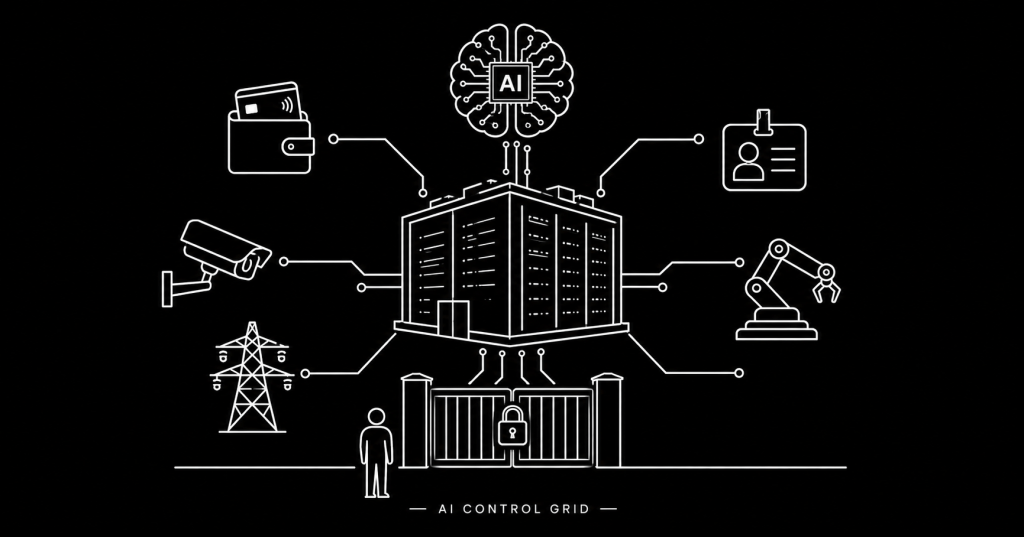


The danger is no longer just private technology companies building bigger platforms. The danger is that the federal government has now framed artificial intelligence as a national race, a national-security priority, an infrastructure priority, an export priority, and a scientific-mobilization project.
That changes the scale of economy and life’s functions.
“Winning the AI Race: America’s AI Action Plan” was released by the White House on July 23, 2025. It was created under Executive Order 14179, “Removing Barriers to American Leadership in Artificial Intelligence,” and presents AI dominance as a matter of economic power, military power, global influence, and national security. The White House describes the plan around three pillars: accelerating AI innovation, building American AI infrastructure, and leading in international AI diplomacy and security.
This is why data centers are no longer treated as ordinary commercial buildings. They now become national strategic infrastructure.
On the same day, July 23, 2025, the White House also issued an executive order titled “Accelerating Federal Permitting of Data Center Infrastructure.” That order is directly tied to the rapid buildout of AI infrastructure. It pushes federal agencies to speed permitting and support large-scale data-center development.
This means the data-center boom is not accidental. It is now policy-backed.
1. The AI Action Plan turns data centers into national infrastructure
The AI Action Plan frames AI as a race America must win. That means compute capacity becomes strategic. Chips, cloud systems, power grids, data centers, AI models, fiber networks, and energy contracts become part of national competition.
This means:
data centers get priority treatment
power generation becomes tied to AI expansion
federal permitting gets accelerated
private AI companies become national strategic partners
AI infrastructure becomes linked to defense and security
local objections may be treated as obstacles to national competitiveness
Now here is the danger.
Once data centers are classified as essential to national power, local communities lose leverage. Concerns about power use, water use, land use, noise, transmission lines, tax breaks, and grid strain can be overridden by the language of national security and technological leadership.
The public may see Data Centers as warehouses full of servers, but the state sees strategic compute infrastructure.
2. Data centers become the backbone of automated society
In the machine economy, data centers do not merely store information. They run the systems that decide access.
They support:
AI agents
digital ID verification
payment authorization
robot fleet coordination
employment screening
insurance scoring
health triage
public-benefit eligibility
predictive policing
energy-market optimization
automated logistics
national-security analytics
scientific modeling
financial settlement systems
This is why data-center expansion is pervasive. These facilities are the physical foundation for machine-to-machine commerce and automated governance.
If the AI Action Plan succeeds on its own terms, the country becomes more dependent on massive compute infrastructure. That compute infrastructure then becomes the hidden operating layer beneath ordinary life.
3. The transaction system becomes programmable
The machine economy requires fast, automated payments. Machines cannot wait in line at banks. AI agents, robots, autonomous vehicles, data systems, cloud services, and logistics platforms need machine-speed settlement.
That points toward transaction systems such as:
stablecoins
bank tokens
tokenized deposits
corporate credits
platform wallets
government settlement ledgers
smart contracts
closed machine wallets
energy credits
benefit credits
API-based automated payments
This does not mean free, open cryptocurrency wins. More likely, the dominant systems become permissioned and regulated.
That means crypto-like rails without crypto-like freedom.
A robot may pay a charger.
A vehicle may pay a toll.
A delivery drone may pay for landing access.
A factory AI may buy electricity in real time.
A medical AI may pay for diagnostic compute.
A software agent may buy data from another software agent.
A household AI may authorize groceries, subscriptions, insurance, and utility bills.
But every transaction can also be checked, scored, limited, delayed, taxed, or denied.
The danger is that money stops being a neutral medium of exchange and becomes a permission system.
4. The Genesis Mission expands the machine layer into science and government data
“The Genesis Mission” was launched by executive order on November 24, 2025. The White House describes it as a national effort to use AI to transform scientific research and accelerate discovery. The order compares the scale and urgency of the effort to major national scientific mobilizations and places the Department of Energy in a central role.
The Genesis Mission is not just about chatbots or office automation. It points toward an integrated AI science platform using federal data, supercomputers, cloud networks, scientific models, and automated laboratory systems. Outside analysis describes it as a unified national AI-enabled science platform connecting federal supercomputers, secure cloud networks, public and proprietary datasets, scientific foundation models, and automated labs.
The federal government is not only encouraging AI companies. It is building federal AI infrastructure around science, energy, security, and national laboratories.
That may produce benefits. It may accelerate medicine, materials science, grid design, nuclear research, weather modeling, robotics, defense systems, and manufacturing.
But it also creates a vast state-corporate AI architecture where public data, private data, scientific data, energy systems, cloud platforms, and national-security objectives are merged. This is the bad version.
5. AI policy plus digital transactions creates a control stack
The danger is the stack.
At the bottom: power plants, substations, transmission lines, water systems, cooling systems, fiber networks, and data centers.
Above that: cloud platforms, AI models, national labs, supercomputers, and secure data networks.
Above that: digital identity, wallets, payment rails, stablecoins, tokenized deposits, government ledgers, and machine wallets.
Above that: robots, drones, autonomous vehicles, logistics systems, smart meters, sensors, insurance models, benefit systems, health systems, and employment systems.
At the top: policy, national-security strategy, corporate governance, federal contracts, export controls, and global AI competition.
When these layers merge, society becomes machine-readable and machine-managed.
The human being does not simply buy, sell, travel, work, repair, speak, or receive services.
He authenticates. He is scored. He is routed. He is priced. He is granted or denied access.
6. The AI Action Plan encourages acceleration before consent
The central public concern is consent.
The AI Action Plan is written in the language of national competitiveness. The data-center permitting order is written in the language of speed. The AI export order is written in the language of global dominance and American AI technology-stack adoption worldwide.
That means the machinery is being accelerated from above.
The public is not being asked: “Do you want your town, your power grid, your water system, your job market, your banking access, your health care, and your public services reorganized around AI?”
Instead, the public is told: “America must win.”
That is a very different frame.
Once the issue becomes a race, caution is treated as weakness. Local resistance becomes obstruction. Regulation becomes delay. Public debate becomes friction. Human concern becomes anti-progress.
This is how democratic consent can be bypassed without formally abolishing democracy.
7. The machine economy creates a two-tier society
If this trend continues, society separates into two main layers.
The first layer is the machine-integrated population.
These people have valid digital ID, approved devices, stable wallets, reliable connectivity, clean records, acceptable risk scores, and jobs that still fit the automated economy.
Their lives are convenient.
Their AI agents handle bills.
Their payments clear.
Their vehicles charge.
Their insurance updates automatically.
Their groceries arrive.
Their health data is monitored.
Their children are tracked through education platforms.
Their work is filtered through corporate AI systems.
They are not free in the old sense. They are well-managed.
The second layer is the machine-excluded population.
These are people with broken identity records, bad credit, unsupported devices, unstable housing, rural connectivity problems, medical debt, frozen wallets, old vehicles, legal-name mismatches, expired documents, or low algorithmic trust.
They are not formally expelled.
They are simply blocked.
Transaction declined.
Identity mismatch.
Wallet limited.
Application rejected.
Manual review pending.
Service unavailable.
Eligibility not confirmed.
Device unsupported.
This is the new form of exclusion.
8. Data centers compete with citizens for energy
The AI Action Plan and Genesis Mission both imply enormous compute growth. Compute requires electricity.
That means the AI race is also an energy race.
The more AI becomes central to defense, science, finance, logistics, health care, robotics, and government operations, the more electricity is prioritized for machine infrastructure.
The future looks like this:
data centers receive long-term power contracts
AI campuses get priority grid upgrades
households face dynamic pricing
small businesses face higher utility costs
rural communities get transmission corridors
water use becomes contested
backup generators and gas plants expand
citizens are told to conserve
machines remain powered
This is the priority inversion.
The original purpose of infrastructure was to serve human communities. In the machine economy, human communities may be forced to adapt around compute demand and to serve machine data needs.
9. “The Genesis Mission” points toward automated scientific governance
The Genesis Mission may be sold as scientific acceleration, and that may be partly true. But the deeper issue is institutional architecture.
If federal datasets, scientific models, national labs, cloud platforms, automated labs, and AI systems are integrated, then science itself becomes increasingly machine-directed.
That can produce useful breakthroughs, but it will also create:
centralized research priorities
AI-guided funding decisions
automated lab systems
federal-corporate data-sharing structures
national-security classification layers
reduced public transparency
technocratic control over science and policy
In plain terms: science becomes faster, but also more centralized.
The public may be told that AI has found the best answer. But the public may not know who trained the model, what data it used, what assumptions were embedded, what interests shaped the objective, or what alternatives were excluded.
That is dangerous when AI outputs begin influencing health policy, energy policy, agriculture, climate policy, defense policy, and economic planning.
10. The bad future if the trend continues
If the AI Action Plan, data-center acceleration, Genesis Mission, digital identity, and programmable payments all continue in the same direction, the future is not a cartoon robot takeover.
It is an automated permission society.
Life may look like this:
You wake up in a smart home tied to your identity account.
Your AI assistant tells you which bills cleared, which subscriptions renewed, and when your appliances may run because energy pricing is high.
Your wallet works only if your identity, device, account status, location, and risk profile are acceptable.
Your vehicle charges only during authorized windows.
Your job applications are screened by AI before any human sees them.
Your health care is triaged by automated systems.
Your insurance rates change based on behavior.
Your child’s education profile follows him for life.
Your grocery purchases are shaped by wallet rules, benefit rules, health rules, or insurance incentives.
Your speech is not necessarily banned, but its reach is controlled by platform ranking.
Your business can survive only if payment processors, AI search systems, tax systems, and delivery platforms keep you visible and approved.
Your legal rights still exist, but practical access is decided by machines.
That is the real danger.
11. The bluntly speaking
“Winning the AI Race” and “The Genesis Mission” are not minor policy documents. They are signs that AI has moved from private innovation into national strategy.
The official promise is prosperity, security, discovery, and global leadership.
The risk is a machine economy built faster than the public can understand, consent to, or resist.
The danger is the fusion of:
AI national strategy
national security
data-center acceleration
federal supercomputing
secure cloud networks
scientific foundation models
automated labs
digital identity
programmable payments
machine wallets
robotics
surveillance
energy prioritization
platform dependence
If this stack is built without hard limits, local consent, cash alternatives, repair rights, privacy protections, human appeal, and public control, then the future will not need visible tyranny.
It will run through access.
The machine will not need to hate humanity.
It will only need to authenticate, score, price, approve, deny, and ignore people at scale.
Note: After June 7, 2026, this account (www.bantamjoe.com) will be discontinued and removed.

 Bantam Joe
Leave a comment