

The world is becoming increasingly uncertain. Corruption now appears in nearly every layer of public and private life: politics, finance, medicine, media, technology, education, business, and even within ordinary social relationships. Across the globe, people are surrounded by fear, misinformation, disinformation, greed, reckless behavior, extreme beliefs, hidden agendas, entitlement, self-serving ambition, paranoia, instability, delusions of importance, and a general loss of moral restraint.
Everywhere we turn, there is another crisis. The news cycle runs nonstop with warnings about extreme weather, pandemics, war, hunger, homelessness, economic collapse, sickness, social unrest, artificial intelligence, surveillance, and the possible rise of technocratic dictatorships. There are enough conspiracy theories, partial truths, propaganda campaigns, and institutional failures to fill entire libraries. Many people are left asking the same basic questions: What are we supposed to do? Why is this happening? Can it be stopped? Can it be prevented? Or are we already inside a system that has become too unstable to repair?
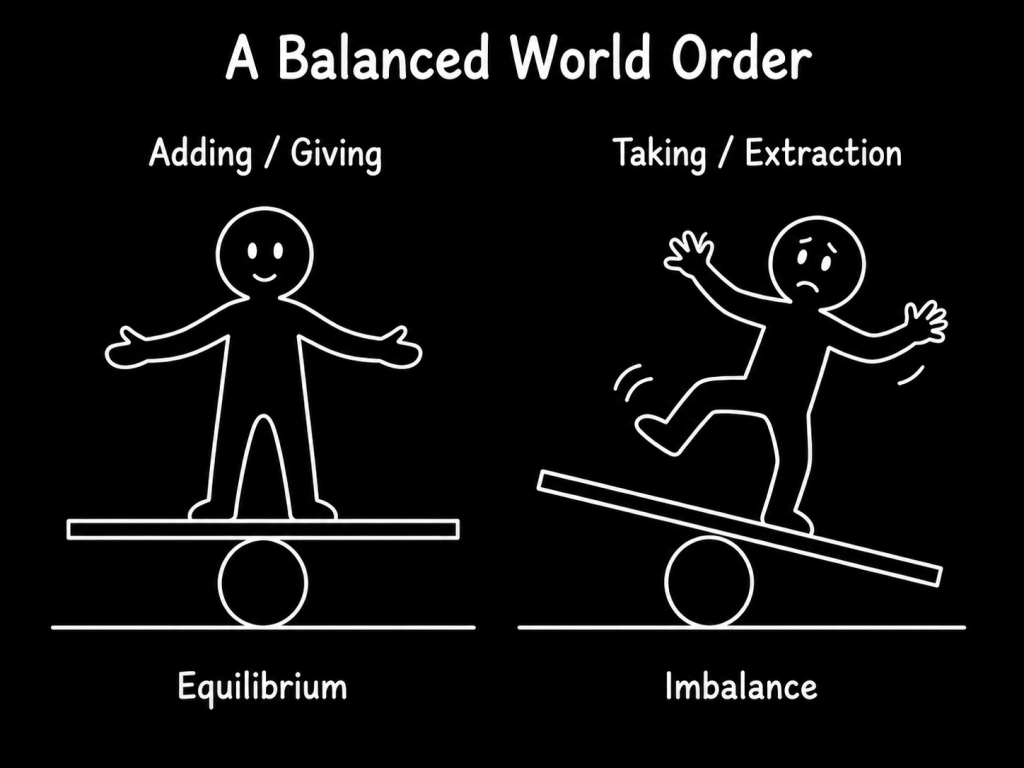
A possible answer stems from a principle I learned from systems engineering: systems often fail because the system has lost equilibrium.
In any healthy system, there has to be balance between input and output, taking and giving, consumption and replenishment, stress and recovery. In biology, this is called homeostasis. In engineering, it is equilibrium. In a community or economy, the same principle applies. A system can only remain stable if what is removed is replaced, repaired, or regenerated.
When a system takes more than it gives back, it eventually weakens its own foundation.
That is what we are watching now.
The problem is not only inflation, crypto, oil, debt, war, or supply-chain stress. Those are symptoms. The deeper problem is that many modern institutions have become extraction machines. They pull value out of people, land, labor, attention, data, health, families, and communities, while returning less and less real benefit.
There are two basic economic behaviors: adding value and extracting value.
Adding value means producing something useful, repairing something broken, growing food, teaching a skill, healing a person, building shelter, creating local power, maintaining tools, protecting neighbors, preserving knowledge, or solving a real problem. It strengthens the system without destroying the identity of the person, family, business, or community doing the work.
Extraction is different. Extraction means taking profit, control, data, labor, land, attention, or resources while giving back as little as possible. It is not fair exchange. It is one-sided exchange. It pushes the system out of balance. It also tends to erase autonomy, because extraction works best when people are dependent, interchangeable, tracked, indebted, confused, fearful, and unable to opt out.
This distinction matters now because the global economy is becoming more unstable. Energy routes are under pressure. Supply chains are strained. Debt is high. Food, fertilizer, fuel, housing, healthcare, insurance, and basic necessities are increasingly expensive. War and trade disruption are no longer distant events. They now affect daily prices, local availability, and public confidence.
This is where the old money game starts to crack.
A system built on adding value can absorb stress because it helps maintain balance. A system built on extraction becomes brittle because it keeps pulling from the base without restoring it.
Banking becomes extractive when debt becomes more important than productive lending. Speculation becomes extractive when profit comes from price movement without real production. Big Tech becomes extractive when it turns attention, behavior, and data into raw material. Big Agriculture becomes extractive when it drains soil, controls seed systems, depends on fragile fuel chains, and traps growers in dependency. Big Pharma and insurance become extractive when illness becomes recurring revenue instead of a problem to solve. Real estate becomes extractive when shelter becomes a financial weapon instead of a basic human need. The military-industrial system becomes extractive when permanent conflict becomes a business model.
These systems are not completely useless. Energy, farming, medicine, housing, technology, finance, and defense all have legitimate functions. The problem begins when the useful function becomes secondary and the extraction model becomes primary. That is the imbalance.
The world is not breaking because ordinary people failed. It is breaking because too many systems were optimized to take. They pull value upward, outward, and away from the people and places that actually produce it. That can continue for a while. Then the base weakens.
Food production depends on fuel, fertilizer, water, machinery, credit, trucking, ports, labor, and stable trade. If those inputs are disrupted, food prices rise and availability becomes less reliable. Energy is the same. When energy routes are threatened, everything downstream becomes more expensive: food, transport, manufacturing, construction, heating, cooling, and basic household living.
Healthcare depends on drug supply chains, equipment, staff, hospitals, insurance processing, billing systems, energy, and transportation. Housing depends on credit, interest rates, labor, lumber, concrete, metals, insurance, permits, and land access. Technology depends on electricity, rare minerals, chips, data centers, manufacturing capacity, global shipping, and constant connectivity. These systems are not independent. They are connected. When one becomes unstable, the others feel the pressure.
That is why equilibrium matters.
An adding economy strengthens the base. An extraction economy drains the base.
But an adding economy is not a forced collective. It is not a system where everyone must become the same, believe the same, own nothing, or submit to centralized management. It is a system where each participant keeps identity, property, skill, judgment, and autonomy while participating in exchange that benefits all sides.
That is the standard: good for all participants without vanquishing identity.
A farmer saving seed, rebuilding soil, and feeding a local area is adding value. A corporation controlling seed, centralizing food production, and trapping growers in dependency is extracting value. A technician repairing tools, radios, appliances, and equipment is adding value. A business model that makes products unrepairable so people must keep buying replacements is extracting value.
A doctor healing patients is adding value. A medical-financial system that profits from long-term dependency is extracting value. A local builder creating usable shelter is adding value. A financial system turning homes into speculative assets is extracting value. A communication tool that helps people coordinate while preserving privacy is adding value. A surveillance platform that captures behavior, predicts choices, and sells influence is extracting value.
The same test applies to crypto. Crypto may have technical uses. Some people may profit from it. But much of it functions as speculation. It does not directly produce food, water, shelter, power, medicine, repair, transportation, or local resilience. It depends on electricity, networks, exchanges, liquidity, and belief. That is not the same as durable value.
Durable value is what remains useful when the system becomes stressed. Food is durable value. Clean water is durable value. Tools are durable value. Repair skill is durable value. Seeds are durable value. Fuel, backup power, radios, medical basics, spare parts, local trade, trusted neighbors, and practical knowledge are durable value.
A society that forgets this becomes easy to destabilize. People become dependent on distant systems for everything: food, heat, cooling, payments, identity, medicine, transportation, news, work, and communication. That is not resilience. That is managed dependency.
Managed dependency is not homeostasis. It is control. It may look orderly from the outside, but internally it weakens the individual parts. A system cannot remain healthy if its members lose the ability to think, produce, repair, own, decide, refuse, and act for themselves.
A true stable system preserves agency. A family can cooperate without erasing the individual. A town can trade without becoming a hive. A nation can maintain order without reducing citizens to managed units. An economy can serve all participants without forcing sameness.
That is where many proposed solutions go wrong. They correctly identify disorder, but then offer control as the cure. They identify instability, then demand more surveillance. They identify scarcity, then demand more centralization. They identify conflict, then demand more obedience. But replacing extraction with control does not restore balance. It only changes the method of domination.
The practical question is not, “How do I profit from the chaos?” That is the extraction question.
The better question is, “How do I become useful, stable, and less dependent while helping others do the same without losing my own autonomy?”
That is the adding-value question.
In systems terms, it is the question of homeostasis. What helps the system stay alive? What restores balance? What reduces fragility? What gives back to the base? What allows each participant to remain free, useful, and distinct?
The future will punish overdependence on fragile systems. It will reward people and communities that can still function when those systems fail, stall, or become too expensive. This does not require fear. It requires a change in priorities.
We need to stop chasing only symbolic wealth and begin building real capacity. That means reducing unnecessary debt, holding useful supplies, keeping tools, learning repair, growing food where possible, strengthening local relationships, creating backup power, securing water, preserving knowledge, developing trade skills, and supporting people who add value at the ground level.
It also means protecting personal autonomy. We should not confuse cooperation with submission. We should not confuse resilience with central control. We should not confuse helping others with surrendering identity.
The coming breakdown, if current trends continue, may not happen as one dramatic collapse. It may arrive as a grinding sequence of price spikes, shortages, failures, regional conflicts, tighter controls, broken supply lines, and lost trust. Some systems will survive. Some will reorganize. Some will fail.
But the underlying rule will remain simple. Systems that only take eventually break equilibrium. Systems that give back help maintain homeostasis. Systems that erase identity may appear efficient, but they become brittle because they destroy the independent judgment and local capacity needed for survival.
That applies to soil, families, towns, economies, nations, and civilizations.
The old model asks, “How much can I take?” The false collective model asks, “How much must you surrender?” The better model asks, “What can I add that helps keep the system stable, useful, alive, and free for all participants?”
That is the line to watch now.
In a stable economy, extraction can hide behind complexity. In a breakdown, it becomes obvious. You can see who produces, who repairs, who feeds, who protects, who teaches, who builds, and who only skims from the flow. You can also see which systems preserve autonomy and which systems use crisis as an excuse to absorb everyone into centralized control.
The people and communities that endure will not be the ones with the best slogans, the most digital claims, or the most paper wealth. They will be the ones that can add real value when the paper systems, market systems, and institutional promises become unreliable. They will also be the ones that preserve identity, private judgment, local skill, ownership, and the right to say no.
The grounded takeaway is simple. Move away from extraction. Move toward usefulness. Build what restores balance. Keep what still works. Learn what cannot be easily taken from you. Support systems that give back more than they drain. Cooperate without surrendering autonomy. Help build stability without becoming property of the system.
Because any living system that loses homeostasis eventually fails. Any economy that forgets equilibrium eventually breaks. And any society that destroys individual identity in the name of stability is not healing itself. It is merely replacing extraction with control.
It’s time we push this old world order aside and evolve to a more just and balanced world.

 Bantam Joe
Leave a comment