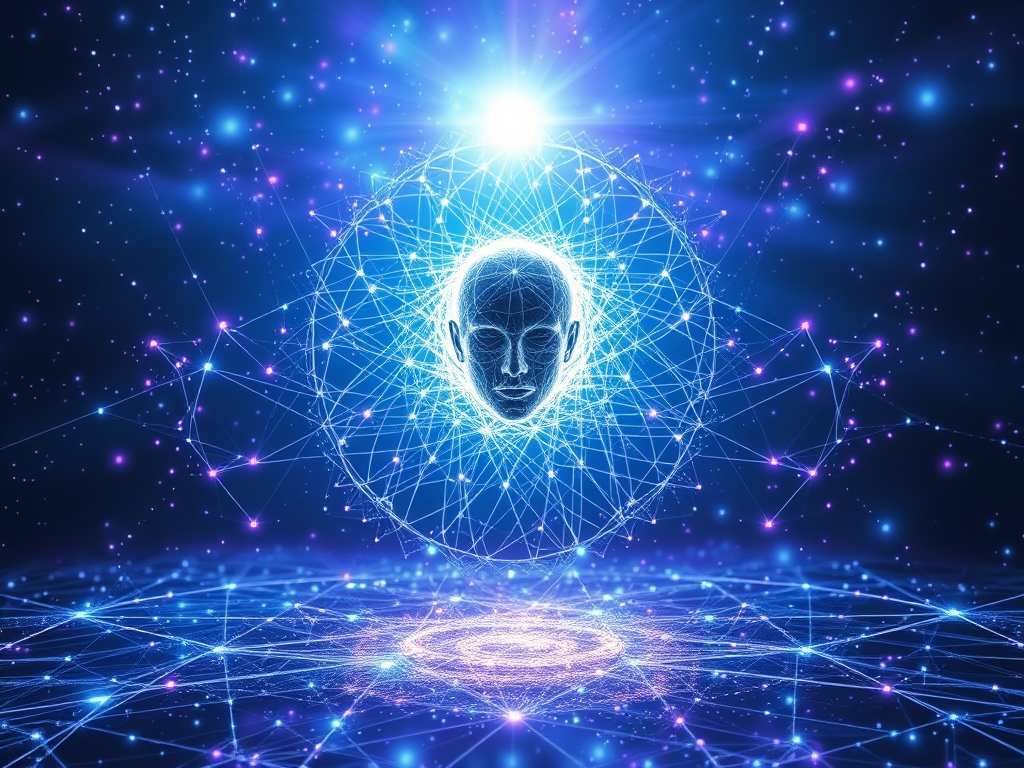


What if the universe isn’t the ultimate “real thing” we’ve always assumed? What if everything we see, touch, and experience is actually a projection? A kind of virtual construct created by something more fundamental? This isn’t just the stuff of sci-fi, it’s the idea behind Quantum Realism (QR), a theory that combines quantum physics, information theory and consciousness into a bold new way of understanding reality.
Let’s dig into how Quantum Realism explains our universe and why it might change everything we think we know.
The Universe as a Virtual Reality
To understand QR, imagine the universe as a massive virtual reality. Just as a VR game generates a world for its players, Quantum Realism proposes that the physical universe is a “rendered” output of an underlying quantum network, a vast, interconnected system of information processing.
What Creates This Virtual World?
At its foundation is the quantum network:
- This network consists of “nodes” or qubits (think of them like tiny processors), which communicate and pass quantum information to one another.
- Through this exchange of quantum waves, the network generates space, time, and matter as emergent phenomena, not fundamental properties of reality but outputs of quantum processes.
Why Is This Different from the Materialist View?
In classical physics, the universe is thought of as a collection of independent objects moving through space and time. Quantum Realism flips this idea:
- Space and time are constructs created by the quantum field network.
- The particles we think of as “solid” are actually events in the network, much like pixels on a screen.
Consciousness as the Foundation
Here’s where things get even more fascinating: consciousness isn’t an afterthought in this system, it’s the centerpiece!
Primal Consciousness: The Source of Reality
Quantum Realism introduces the concept of primal consciousness C0, a timeless self-referential, self-sustaining, infinite awareness that generates the quantum network. In this view:
- The universe didn’t emerge from random chance or physical laws but from the creative act of primal consciousness.
- C0 is both the observer and the creator: it’s what powers the entire system.
Our Role as Observers
QR suggests that the observer effect in quantum mechanics (where observing something changes its behavior) isn’t just a quirk of physics, it’s a clue. Observers play a direct role in shaping reality:
- Quantum states (the “possibilities” of what might happen) don’t become real until observed.
- Our act of observing helps collapse these possibilities into actual events, shaping the universe as we experience it.
How Reality is Projected
One of the most intriguing ideas in QR is how our 3D world emerges from layers of reality. Here’s how it works:
Step 1: The 4D Substrate (Quantum Field Network)
The quantum field network operates in higher dimensions, most likely a 4D (or higher) framework (hypersphere), that contains all the quantum information and interactions. This higher-dimensional structure holds the “source code” of the universe.
Step 2: 2D Holographic Encoding
The information from the 4D substrate is compressed and encoded onto a 2D boundary portion of its 4D, in line with the holographic principle:
- In physics, the holographic principle suggests that all the information within a 3D space can be encoded on a 2D surface.
- This 2D boundary acts as a repository for the quantum network’s data.
Step 3: 3D Projection
From the 2D encoding, reality is projected into 3D space:
- Much like a hologram creates a 3D image from a 2D surface, the universe creates our 3D experience using the encoded quantum information.
Why Both 4D and 2D Layers Matter
You might wonder: is it the 4D substrate or the 2D encoding that creates our 3D reality? The answer is both:
- The 4D substrate generates the structure and complexity of the universe.
- The 2D encoding ensures that information is efficiently stored and projected.
Think of it like a movie projector:
- The camera and film reel (4D substrate) contains the story and dynamics.
- The 2D filmstrip stores the compressed version of the data.
- The 3D movie projection is what we experience as reality.
The Universe as a Learning System
Quantum Realism goes beyond describing the physical universe: it suggests that the universe exists to facilitate consciousness. Here’s what that means:
Reality as a Training Ground
The universe is like a giant interactive simulation where consciousness can explore, learn, and evolve. By experiencing challenges, relationships, and growth, individual consciousness (plants, animals, humans, etc.) gains insight and expands its awareness. Think of it as experiencing music, rather than just knowing about music.
Feedback Loops
The system is designed with feedback mechanisms:
- Every action, observation, and choice influences the quantum network, shaping future possibilities.
- This creates a dynamic, evolving universe that responds to conscious interaction.
What Happens After Death?
One of the most astounding implications of QR is its view of death. According to this framework:
- Consciousness isn’t tied to the body, it’s part of the larger quantum network.
- When the body dies, the localized consciousness doesn’t disappear. Instead, it decoheres from the physical world and reconnects with the broader quantum field network.
In this state:
- Consciousness exists outside of time and space, in a timeless “quantum now.”
- It retains individuality while also merging with the universal awareness of the quantum network.
This process is seen not as an end but as a transition; a continuation of growth and exploration in a non-physical form.
Bringing It All Together
Quantum Realism paints a picture of the universe as a holographic, dynamic, and conscious system:
- The 4D quantum substrate generates the raw “code” of reality.
- Information is encoded on a 2D holographic boundary of its 4D.
- This is projected into the 3D space of its 4D, creating the physical world we see and experience.
- Consciousness is both the creator and the explorer of this system, shaping reality through observation and interaction.
This perspective doesn’t just challenge our understanding of physics; it redefines our place in the universe. Reality isn’t random or mechanical; it’s deeply interconnected and purpose-driven.
What This Means for You
If Quantum Realism is correct, it changes how we see everything:
- Your role in the universe: You’re not just a passive observer but an active participant shaping reality.
- The nature of life and death: Life is a journey of learning, and death is a transition, not an end.
- The universe itself: Far from being cold and indifferent, it’s an intelligent system designed for growth and exploration.
The next time you look up at the stars or reflect on your own existence, consider this: you’re part of something vast, conscious, and infinitely creative. A universe designed for you!



 Bantam Joe
Leave a reply to Jsturrentine Cancel reply