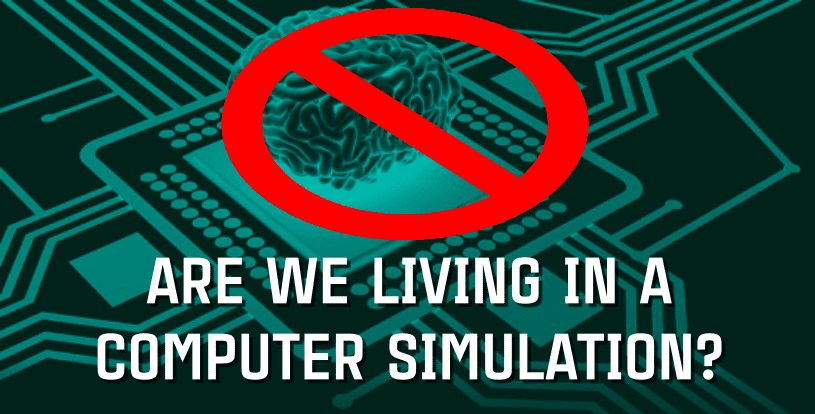


Simulation Theory raises the idea that our universe is a simulated reality. From the perspective of Quantum Realism (QR), this critique misunderstands the foundational premises of QR regarding the nature of reality, consciousness, and the role of the observer.
Why Simulation Theory Differs (Greatly) from Quantum Realism
1. Simulation vs. Quantum Creation
– Simulation Theory posits that our universe is an artificial construct, created by an advanced intelligence using computational processes. It assumes that a “base reality” underpins the simulation, and questions about the origins of that base reality often end in recursion (who programmed the programmer?).
– In contrast, Quantum Realism states that the physical universe is not a simulation in the computational sense but a virtual reality generated by an underlying quantum field. This field is not physical but fundamental, existing beyond our notions of hardware or software.
2. Primal Consciousness as a Source
– QR suggests that primal consciousness C_0 = f(C_0) is the origin of the quantum network, which produces the universe. This primal consciousness is self-referential, self-sustaining, and not contingent on external constructs like a programmer or computational hardware.
– This eliminates the “infinite regress” problem posed by Simulation Theory. There is no need for a “builder” of the base reality because the quantum network and its consciousness are intrinsic and foundational.
3. The Observer’s Role
– Simulation Theory often parallels the quantum wave function collapse with the “rendering” process in games. QR, however, views the collapse as an intrinsic interaction between the quantum network and consciousness. The “observer effect” in quantum mechanics is not about computation economization but about the fundamental interplay between reality and awareness.
4. Meaning and Purpose
– The critique claims that Simulation Theory renders the meaning of life irrelevant, suggesting instead a focus on “playing the game.” In QR, life is not an arbitrary construct. Instead, the universe emerges as a meaningful interaction of primal consciousness exploring itself through complexity and coherence. Every aspect of existence—including feelings, experiences, and choices—is a real and significant expression of this quantum interplay.
Addressing Specific Objections
– Recursive Reality: Simulation Theory leads to infinite regress, but QR avoids this by positing a foundational quantum consciousness that generates itself and the quantum field without needing an external cause.
– Purpose of Reality: QR implies that reality exists for consciousness to observe and interact with itself. This makes the universe both meaningful and necessary, rather than a mere computational experiment.
– Quantum Anomalies: In QR, phenomena like quantum entanglement, wave function collapse, and coherence are not “glitches” in a computational matrix but natural outcomes of a self-generating quantum network.
In QR, the physical universe is an effect, not the source, it emerges from the underlying quantum field, which is non-physical and foundational. The term “virtual” emphasizes this dependency: the physical world is like an image on a screen created by unseen processing, much like a virtual reality is generated by computational processes. This doesn’t mean it’s “unreal”; rather, it highlights that its basis is informational rather than material.
QR can account for Jungian synchronicity and phenomena like prophecy or clairvoyance through the non-local and probabilistic nature of the quantum field. In this model, the interconnected quantum network can produce correlations across time and space that appear acausal from a classical perspective. These are not “violations” of causality but are grounded in the field’s holistic nature.
QR does not dismiss causality but reframes it. Instead of rigid cause-effect chains, reality unfolds as a probabilistic flow of quantum information. Observers (including conscious entities) participate in this unfolding, influencing outcomes through observation and interaction. This creates a dynamic interplay where both the quantum field and observers shape “the next moment”.
QR implies that observers (as nodes of consciousness) are co-creators of reality. By influencing quantum states, through attention, intention, or coherence, it may be possible to manifest outcomes that seem acausal or paracausal within classical models. Such phenomena align with the idea that consciousness interacts with the quantum field to collapse potentialities into actualities.
QR suggests reality is not a fixed sequence of causes and effects but a dynamic, participatory process where the quantum field, consciousness, and probabilistic outcomes interact to create what we perceive as the “physical world.” This framework inherently allows for synchronicity and experiences beyond classical causality.
Quantum Realism challenges Simulation Theory by reinterpreting reality not as a product of advanced computation but as an emergent interplay of primal consciousness and quantum processing. It offers a framework where the universe is neither random nor simulated, but fundamentally real, meaningful, and deeply intertwined with consciousness.



 Bantam Joe
Leave a reply to mediarteducation Cancel reply