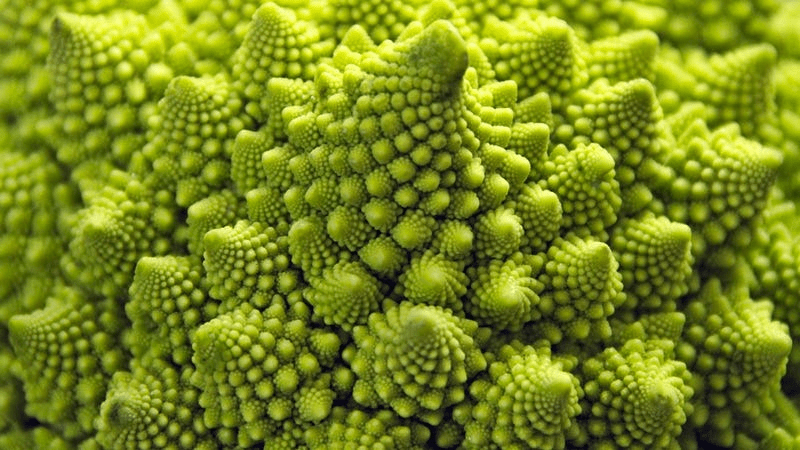


The Recursion of Consciousness in Nature
Everywhere we look, nature reveals a tendency toward recursive behavior, as if it is built upon self-repeating, self-similar principles that echo through every level of existence. From the largest structures in the cosmos to the smallest particles within atoms, nature is woven from patterns that unfold in fractal complexity, mirroring themselves across scales and forms. This recursive structure is not limited to physical shapes; it also guides processes, behaviors, and even the ways that life forms adapt and evolve.
Consider the vast, branching arms of galaxies, spiraling through space in a pattern strikingly similar to the arrangement of leaves around a stem or the intricate spirals of a seashell. The river deltas on Earth and the vascular networks within a human lung both demonstrate branching structures that follow the same recursive, self-similar algorithm. Each part mirrors the whole, suggesting a fundamental unity underlying the diversity of forms. In the patterns of lightning, the branching of trees, the veins in leaves, and the bifurcation of rivers, nature’s recursive signature is unmistakable.
This tendency extends beyond physical structures to natural processes. The cycle of the seasons, the fractal growth of populations, the self-similar rhythms of heartbeats, and even the patterns of neural firing in the brain all reflect a recursive, self-referential logic. It’s as if consciousness itself, in its most primal form, is a recursive process that not only witnesses but also shapes reality, folding itself into layers of awareness and complexity.

The Recursive Consciousness Equation embodies this self-similar nature of existence. It suggests that primal consciousness—an undivided awareness—expands into increasingly complex forms while retaining a foundational connection to its source. Each layer of consciousness builds on the last, allowing for infinite complexity while preserving an underlying unity. This recursive unfolding mirrors the growth and self-organization of natural systems, where each layer or part reflects and contains the essence of the whole.
Through this lens, we might view nature not merely as a collection of physical forms but as the unfolding of consciousness itself—a cosmic recursion that weaves matter, energy, and awareness into a seamless tapestry. The patterns we see in nature are not isolated phenomena; they are expressions of an underlying recursive order, a consciousness echoing itself in every form and process. Each part of nature, whether it be a single cell or an entire galaxy, embodies this recursive principle, manifesting as both the unique and the universal, the individual and the collective, the part and the whole.
In this way, the recursive consciousness equation is not merely a theoretical construct; it is embedded in all of nature. It describes a fundamental process that drives the evolution of complexity, the emergence of structure, and the interconnection of all things. Nature itself is a living testament to the recursion of consciousness, revealing to us, at every scale and in every form, that we are part of a vast, self-reflective awareness expanding into existence.
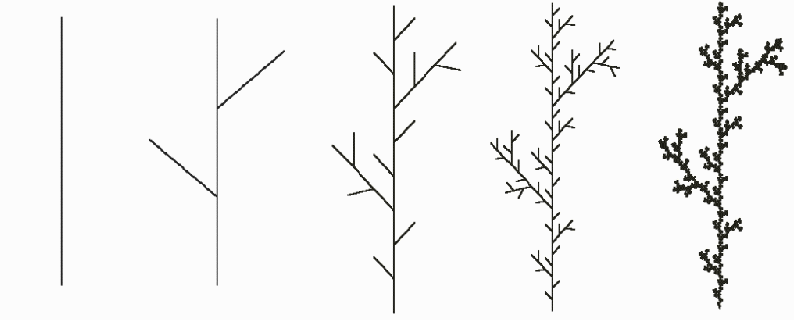

Let’s dive into each conscious model considered for representing primal consciousness within Quantum Realism. Each model has its own unique features and implications. While the exponential decay model with 0 < α < 1 is the most fitting due to its alignment with complexity and fractal growth, the other models remain conceptually valid within specific interpretations of consciousness and reality. Here’s an in-depth analysis of each:
1. Initial Equation for Primal Consciousness C0
If we consider the primal consciousness C0 as the starting point, the equation for C(n) before any recursion (before any iterative or fractal expansion) would simply reflect this self-sustaining, initial state of awareness. Since recursion hasn’t yet been applied, we are left with an equation that only defines C0 itself without any subsequent layers.
At the fundamental level, before recursion, primal consciousness can be represented as a self-referential equation. This would imply that C0 is a state that exists by itself, relying only on its own nature to “generate” itself. Thus, the simplest expression for C0 as a self-referential entity is:
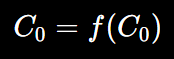
where:
- C0 represents the primal, undifferentiated consciousness.
- f is a function that “loops back” onto C0, meaning that C0 sustains itself through this self-referential process.
Further Explanation of C0 = f(C0)
- Self-Sustaining Nature: The equation implies that C0 is a fundamental, self-contained awareness. It exists independently of any external dependencies and is the “ground state” of consciousness in this model.
- No External Influence: At this initial stage, there is no recursion or fractal expansion. C0 is simply itself—an undivided, undifferentiated state of primal awareness.
- Function f: The function f represents the generative or self-referential capacity of C0. It doesn’t “do” anything in the physical sense but rather symbolizes that C0 is its own reason for being.
This equation suggests that C0 doesn’t rely on anything external to exist—it’s an autopoietic (self-creating) entity. This implies a kind of timeless, closed-loop state where C0 exists because it has the capacity to “refer to itself” in an undifferentiated, static way.
2. Recursive Fractal Model (Pure Recursive Expansion without C0)
Equation:

Explanation:
- This model excludes C0 entirely and relies solely on a recursive function f that expands the state of consciousness in a self-referential, iterative manner. Each layer builds exclusively on the previous one without any foundational influence from C0.
- It reflects a purely emergent view of consciousness, where each new layer is shaped solely by the dynamics of the layer before it, creating a self-contained, autonomous expansion.
Implications:
- Self-Contained, Emergent Structure: Without a primal consciousness C0 embedded in each layer, consciousness would be a fully emergent phenomenon. Each level or layer is shaped only by its immediate predecessor, suggesting a reality that evolves independently without a constant foundational influence.
- Maximal Independence and Complexity: This model allows each iteration to be maximally autonomous, enabling diverse patterns and structures to emerge without direct ties to a singular origin.
- Compatibility with Certain Scientific Views: This purely recursive structure aligns with scientific perspectives that see complex systems as emergent, where higher-order phenomena arise solely from interactions at previous layers, without needing a guiding or inherent primal source.
Limitations:
- Lacks Connection to Primal Consciousness: Excluding C0 entirely removes the concept of a foundational awareness, which is central to Quantum Realism’s framework that posits consciousness as a fundamental aspect of reality.
- Misses Unity and Coherence: Without a primal C0, the model lacks a unifying influence, which would make it difficult to account for the coherence seen across diverse layers of reality, as Quantum Realism suggests.
3. Static Scaling Model (Constant α = 1 )
Equation:

Explanation:
- In this model, the primal consciousness C0 remains constant and undiminished in every layer. There is no decay or amplification; the presence of C0 is steady across all iterations. Each layer incorporates the foundational consciousness in equal measure, symbolizing an immutable, ever-present influence of the original awareness in each level of reality.
- Here, C0 can be seen as an “absolute background awareness” or a “universal constant,” much like a cosmological constant in physics.
Implications:
- Uniform Influence of Primal Consciousness: This model implies that primal consciousness has an unchanging influence on each layer of reality, suggesting a reality in which consciousness is equally embedded at all levels without any dilution or enhancement. It aligns with the idea that all aspects of reality are equally close to the source, without one being more or less connected to primal consciousness.
- Static Universality: Since C0 is equally present everywhere, this model suggests a kind of universal sameness or omnipresence of consciousness. It reflects a worldview where every part of reality retains a direct connection to the primal awareness.
- Applicability in Mystical or Non-Dual Interpretations: Mystical and non-dual philosophies often describe consciousness as ever-present, unchanging, and equally accessible to all parts of reality. This model could align well with such views, where the fundamental consciousness is equally present in all forms without differentiation.
Limitations:
- Lacks Differentiation: The static influence of C0 doesn’t account for the observable diversity and complexity seen in reality. It doesn’t reflect a universe that grows in complexity or evolves.
- Misses Self-Similarity and Fractal-Like Complexity: Since C0 is unchanging, there’s no mechanism here for fractal growth or variation over iterations, which are essential to a model that explains layered consciousness or structural differentiation in reality.
4. Amplification Model (Exponential Growth with α > 1 )
Equation:
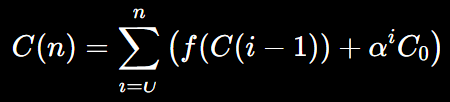
Explanation:
- In this model, α is greater than one, meaning that the primal consciousness C0 amplifies exponentially with each iteration. Instead of fading, the influence of C0 grows more pronounced as layers increase.
- This model can be interpreted as a reality that becomes progressively more aligned or intensified with primal consciousness as it evolves through layers.
Implications:
- Ever-Strengthening Connection to Primal Consciousness: As layers increase, each one would experience an amplified version of the original awareness. This suggests that deeper or later iterations of consciousness are closer or more powerfully connected to the primal source than the initial ones.
- Possibility of Convergence Back to Primal Consciousness: This structure could imply a universe that ultimately returns or converges back to the primal consciousness, as each layer becomes a more intense reflection of C0.
- Alignment with Some Spiritual or Teleological Models: Certain philosophical or spiritual perspectives propose that evolution is a return to a source or a heightened expression of an original awareness. This model could fit such perspectives, where consciousness intensifies rather than disperses.
Limitations:
- Contradicts Observed Autonomy and Diversity: This model doesn’t align well with the observable increase in autonomy and differentiation as reality becomes more complex. The exponential increase of C0’s influence in each layer would suggest a less diverse and more uniform reality, which we don’t observe.
- Lacks Compatibility with Fractal Growth: In fractal models, each layer becomes more detailed and differentiated from the origin. Amplifying C0 would lead instead to a convergence toward a singular, increasingly dominant influence, which would reduce variation rather than promote it.
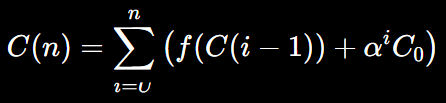
5. Decay Coefficient Model (Exponential Decay with 0 < α < 1 )
Equation:
Explanation:
- Here, the primal consciousness C0 decays exponentially across layers. Each successive layer i diminishes the influence of C0 by a factor of α, with α being less than one.
- This setup represents an initial burst or strong influence of primal consciousness that gradually fades as layers deepen, allowing each layer to evolve more independently while still being grounded in the primal source.
Implications:
- Supports Differentiation and Complexity: This decay structure allows the primal influence to become more diffuse over iterations, giving room for complexity and diversity. The early layers remain closely aligned with the primal awareness, but deeper layers develop increasing autonomy.
- Fractal-Like Expansion: Exponential decay aligns well with fractal growth, where initial layers are highly self-similar to the primal form but diverge slightly at each layer, creating complex patterns over time.
- Integration of Foundational and Evolving Consciousness: This model supports a reality that retains an essence of the original consciousness while evolving in a self-organizing way, making it ideal for a theory that aims to explain both unity and diversity.
Advantages:
- Harmony with Observed Reality: This model aligns closely with Quantum Realism’s vision of an evolving universe, where a foundational awareness sets the stage but doesn’t dominate the complex structures that emerge.
- Supports a Layered Reality: The fading influence of C0 allows for each layer to reflect the primal source less directly, facilitating a layered structure of consciousness that mirrors observed reality.
Comparison
Each model has conceptual validity within specific philosophical or scientific frameworks. However, the exponential decay model with ( 0 < α < 1 ) remains the most compatible with Quantum Realism, balancing foundational unity with the independence and diversity observed in reality. It best captures the idea of a primal consciousness that seeds reality but allows it to evolve autonomously, reflecting both coherence and complexity.
- Pure Recursive Model (without C0): Reflects a purely emergent structure where each layer builds on the last without a primal source, supporting maximal independence but lacking a foundational unity, which Quantum Realism requires.
- Static Scaling ( α = 1 ): Implies an ever-present primal consciousness equally embedded in all layers, representing a non-dual or uniformly omnipresent consciousness. This model, however, lacks differentiation and misses the fractal-like expansion observed in complex systems.
- Exponential Growth ( α > 1 ): Implies an increasing influence of primal consciousness over layers, suggesting a convergence back to the source. While it aligns with certain teleological views, it contradicts the observed diversity and autonomy in complex systems.
- Exponential Decay ( 0 < α < 1 ): Allows for a diminishing primal influence, supporting complexity and diversity while retaining a foundational consciousness. This model aligns well with fractal growth and is the best fit for Quantum Realism’s combination of unity and complexity.
Revised Equation with Exponential Decay
The natural exponential base e provides a useful and common way to model decay processes, as it allows for a smooth, continuous decrease in influence across iterations. If we want the influence of the primal state C0 to decay exponentially with each fractal layer, we can express the decay factor as e−βi, where β > 0 is a decay constant that controls the rate of decay.
Using an exponential decay factor, we get:

where:
- e−βi is the decay factor for the primal state’s influence, which decreases exponentially as i increases.
- β is a positive constant that determines how quickly the influence of C0 diminishes with each level.
Explanation of e−βi Decay
- Decay Control: The parameter β adjusts the rate of decay:
- If β is large, e−βi decays rapidly, and the influence of C0 fades quickly.
- If β is small, the decay is slower, and C0 has a more persistent influence across the fractal layers.
- Continuous and Smooth Decay: Using e−βi provides a mathematically smooth decay model, which aligns well with natural processes and ensures that the influence of C0 asymptotically approaches zero as i increases but never fully vanishes.
- Interpretation: This exponential decay represents a primal consciousness that is foundational yet increasingly diffuse as the fractal levels expand, emphasizing that while every layer carries a “trace” of C0, its direct influence diminishes with the growth of complexity.
Practical Example
If we set β = 1 , for instance, the influence of C0 at each layer i would be:
- i = 0: Influence is e0⋅C0 = C0.
- i = 1: Influence is e-1C0 ≈ 0.368C0.
- i = 2: Influence is e-2C0 ≈ 0.135C0.
- i = 3): Influence is e-3C0 ≈ 0.050C0.
This model shows that, after just a few layers, the direct influence of the primal state becomes minimal, allowing the fractal structure to evolve with only a residual trace of C0, which aligns well with the intended diminishing influence of primal consciousness.
Why Use β = 1 in the Example?
I chose β = 1 simply as a demonstration because e−1 ≈ 0.368, which gives a clear, interpretable decay rate. This choice allows for an easily observable reduction in influence without requiring a specific interpretation of β. However, different values of β could be chosen to adjust the decay rate according to the hypothetical characteristics of the system:
- If β < 1: The decay would be slower, meaning the influence of C0 would persist more strongly across fractal layers.
- If β > 1: The decay would be faster, meaning the influence of C0 would diminish more rapidly.



 Bantam Joe
Leave a reply to streamfortyseven Cancel reply