

Take a closer look, and observe…
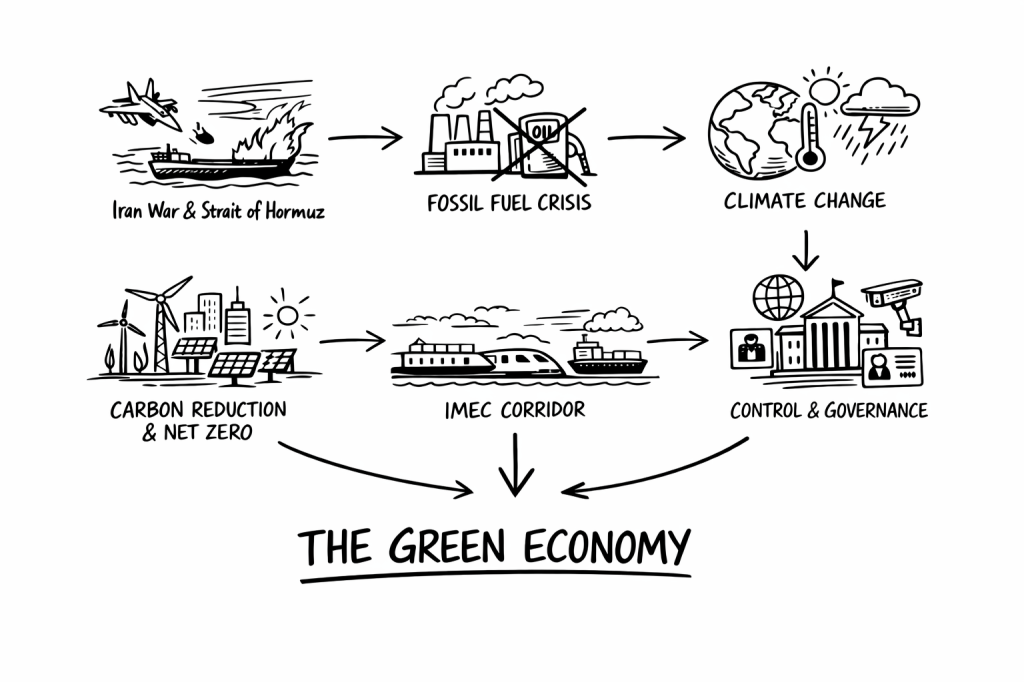
If you want to understand how the world is moving from the Iran war to a green economy, stop thinking about it as a clean climate story. It was not. It was a crisis story. The war with Iran, the disruption around the Strait of Hormuz, the attacks on the world’s oil and gas fields, the shock to oil and gas markets, the fear of long-term supply insecurity, and the political use of climate targets all fused into one new model of control. The public story was resilience, Net Zero, emissions reduction, and energy security. The darker reading is that a frightened world was pushed into a tightly managed system where energy, trade, finance, identity, and even personal behavior could be monitored and directed through one growing infrastructure stack. (Reuters)
The Iran war hit the weak point of the old world. The Strait of Hormuz is one of the most important energy chokepoints on Earth, and the March 2026 crisis showed exactly why. Reporting this week described severe disruption to oil and LNG flows, major risk to Gulf exports, and price spikes rippling through Europe, Asia, and beyond. In plain terms, the modern world was reminded that a huge part of its daily life still depends on fuel moving through a narrow, vulnerable corridor. When that corridor is threatened, everything shakes: shipping, electricity, fertilizer, food, inflation, industrial production, and political stability. (Reuters)
That is why the war became bigger than war. It became the proof used by globalists, climate officials, governments, and planners to argue that fossil-fuel dependence had become not just dirty, but dangerous. Reuters reported that the U.N. climate chief explicitly called the Iran war “an abject lesson” in fossil-fuel dependence and argued that countries should accelerate their exit from oil and gas. The message was simple: as long as nations rely on imported fossil fuels moving through unstable regions, they remain vulnerable to blackmail, price shocks, and strategic chaos. (Reuters)
That is where greenhouse-gas reduction and Net Zero moved from moral language into emergency language. Before, carbon reduction was often sold to the public as an environmental duty. After the Hormuz shock, it was sold as survival. CO2 emissions were no longer framed only as a long-term climate problem. They were tied directly to war, fuel insecurity, inflation, and national weakness. The same policy language kept returning: cut greenhouse-gas emissions, reduce exposure to fossil fuels, electrify everything possible, expand renewable energy, build storage, strengthen grids, and hit Net Zero targets faster. The European Commission’s REPowerEU framework already ties the green transition directly to energy independence and security of supply, and the EU’s hydrogen strategy openly describes renewable hydrogen as a key part of the transition to net zero. (Energy)
This is where the cynical thinking begins. Because once CO2 reduction is fused with wartime energy insecurity, every green policy becomes easier to sell. Smart grids stop sounding like control and start sounding like protection. Carbon accounting stops sounding intrusive and starts sounding responsible. Net Zero stops sounding like long-range planning and starts sounding like the only rational response to a burning region and collapsing old-energy assumptions. The public hears: cleaner air, lower emissions, greater security. The system hears: more measurable energy use, more digital management, more dependence on centralized infrastructure. That is the heart of the transformation. The world did not just “go green.” It rushed into a more governable form. (Reuters)
To understand the physical shape of that new form, you have to understand IMEC. Officially, the India–Middle East–Europe Economic Corridor is a connectivity project linking India to Europe through Gulf and Mediterranean nodes. But it is not just a shipping lane. The Atlantic Council’s 2025 report describes IMEC as a multimodal corridor with three pillars: transportation, energy, and digital connectivity. That means ports and rail on one side, but also electricity links, hydrogen flows, fiber, and digital infrastructure on the other. In other words, it is not merely a trade route. It is a route where goods, energy, and data move together through one designed system. (Atlantic Council)
That is what makes IMEC so important to this story. If the old world ran on open-ended fossil trade, the new world runs on managed corridors. A corridor like IMEC is attractive because it does more than move containers. It can anchor future green-energy trade, especially hydrogen, along with cross-border digital infrastructure and high-speed logistics. The EU’s official hydrogen page says REPowerEU aims for 10 million tonnes of domestic renewable hydrogen production and 10 million tonnes of imports by 2030. That means the green transition is not only about solar panels and wind turbines at home. It is also about building new energy corridors that move low-carbon power and fuels across regions under structured control. (Energy)
This is why IMEC fits so neatly into the post-Iran-war picture. The war discredited the old oil map. IMEC and similar projects represent a new map: one built not just around oil tankers, but around rail, ports, electricity, hydrogen, subsea cables, and data coordination. The Atlantic Council report explicitly says IMEC is meant to expand energy and digital connectivity on top of its transport backbone. That is the green economy in its infrastructure phase. Not a slogan. A corridor. Not just a moral campaign. A rerouting of how continents exchange goods, energy, and information. (Atlantic Council)
But the war also exposed IMEC’s central weakness. If a major corridor still depends on Gulf stability and routes connected to Hormuz, then Hormuz remains the pressure point. That is the irony. The very crisis used to justify faster transition and alternate corridor-building also proved that chokepoints still decide history. This is why the Iran war did not simply “speed up climate action.” It gave corridor planners, green-industrial strategists, and transnational institutions the perfect justification to redesign trade and energy flows under the language of resilience. The route had to be hardened. The energy mix had to be changed. The data systems had to be integrated. The infrastructure had to become smarter, faster, more controllable. (Reuters)
Now add “climate change” to the story. Heatwaves, flooding, crop stress, environmental destruction, insurance losses, and pollution from war all deepen the same public mood: the sense that the old model is breaking at every level. The Guardian has reported on severe environmental damage from the current Iran conflict, including attacks on refineries and gas fields, toxic releases, and escalating ecological harm. In political terms, this kind of damage strengthens the argument that fossil infrastructure is not only carbon-intensive but also physically catastrophic when war comes to it. The greenhouse-gas argument and the war-risk argument begin to merge. Oil and gas are cast as both climate liabilities and security liabilities. (The Guardian)
That merger gives institutions a ready-made roadmap. The UN’s 2030 Agenda and the SDGs already provide the broad language of sustainable development, resilience, and coordinated action. The WHO’s 2025 Pandemic Agreement and amended health rules extend the principle of global coordination in another domain: emergency governance. The result is a world in which health, climate, energy, and trade are increasingly discussed through the same logic: cross-border crises require cross-border systems, shared standards, more surveillance, more coordination, and less tolerance for local resistance or fragmented policy. The official story is that no country can solve these problems alone. In reality, every crisis becomes an excuse to move power upward into institutions and networks insulated from direct public control. (World Health Organization)
So when people ask how the world went from the Iran war to a green economy, the answer is not that war magically created solar panels. The answer is that war destroyed confidence in the fossil system at exactly the moment when climate goals, Net Zero targets, emissions frameworks, and digital-governance models were already waiting. The crisis did not invent the plan. It made the plan politically irresistible. Once oil and gas looked unstable, CO2 reduction looked practical. Once climate disruption intensified, green industrial policy looked urgent. Once both stories merged, governments could justify grid expansion, electrification, carbon accounting, green-hydrogen corridors, and AI-managed infrastructure not as ideology, but as common sense. (Reuters)
And that is where the darker part of the story begins. Because the green economy that emerges from this kind of crisis is not just cleaner. It is more measurable. More digital. More centralized. More dependent on live infrastructure. More dependent on compliance systems. An oil world can be disrupted at the chokepoint. An electrified world can be managed at the grid, the meter, the credential, the payment rail, the carbon ledger, and the corridor node. Supporters call that efficiency. Critics call it a new kind of soft rule. Either way, the direction is the same: from fossil-fuel chaos toward a world where greenhouse-gas reduction, Net Zero, trade corridors, and digital governance are all tied together. (Atlantic Council)
COVID taught governments how to rule through fear and emergency systems.
The Iran war and the Strait of Hormuz taught the world that fossil dependence was a strategic weakness.
Climate change gave the transition its moral urgency.
CO2 reduction and Net Zero gave it its official mission.
IMEC and similar corridors gave it a physical map.
And the institutions already in place supplied the language, funding, standards, and coordination to turn crisis into structure. (Reuters)
What emerged was not just a greener economy. It was a UN Green World Order.
 Bantam Joe
Leave a comment