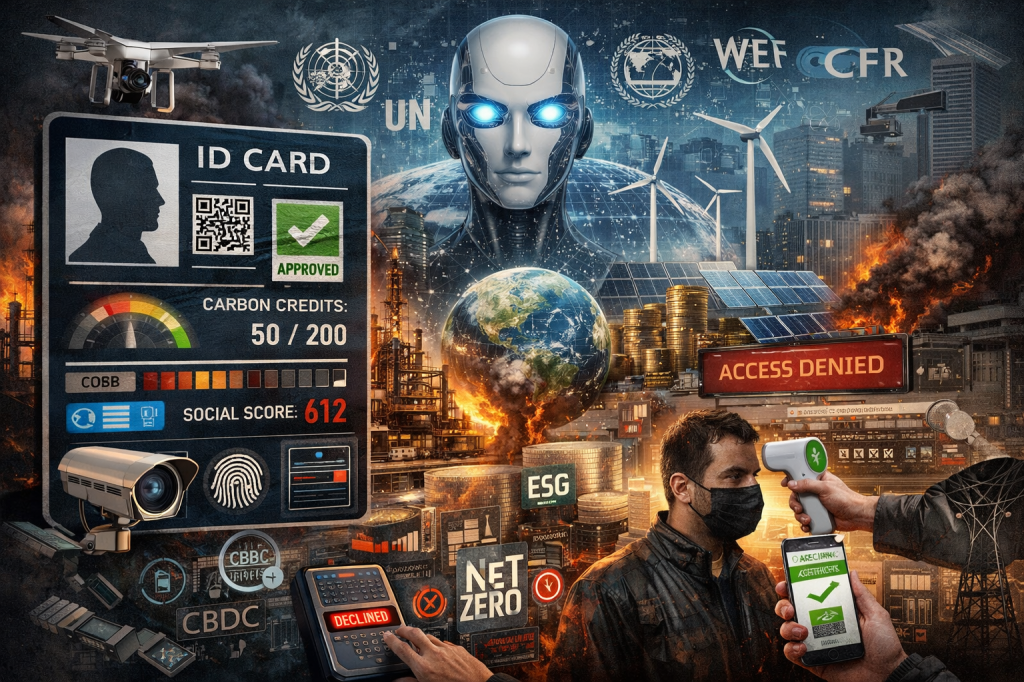


Let’s start with the Iran War and Hormuz disruption, the oil shock, the UN’s Agenda 2030 and SDGs, the WHO’s 2025 Pandemic Agreement and amended health rules, the WEF’s stakeholder-capitalism agenda, and World Bank/OECD digital public infrastructure work. These institutions publicly describe their efforts in terms such as sustainability, preparedness, stakeholder cooperation, and interoperability. (Reuters)
You want to know how they did it?
You want to know how the world went from countries, borders, fuel, cash, and ordinary life, to one managed green system where everything is counted, scored, tracked, and controlled?
It was not one event.
It was not one treaty.
It was not one dictator.
It was a chain.
COVID was one link.
The Iran war was another.
Climate panic was another.
Net Zero was another.
Agenda 2030 was another.
Digital ID was another.
Carbon tracking was another.
Piece by piece, they built the cage and told everyone it was progress.
COVID came first.
That was the rehearsal.
The WHO called it preparedness. Governments called it emergency response. People were told the world needed stronger global health rules, better surveillance, faster coordination, more data sharing, and systems that could work across borders in real time. In 2025, the WHO Pandemic Agreement was adopted, and amended international health rules entered into force that same year, all under the banner of being “better prepared” for the next crisis. (World Health Organization)
That was the first lesson they taught the public:
When fear is high enough, people will accept rule by emergency.
Health passes.
Travel restrictions.
Digital verification.
Remote work.
Data sharing.
Access conditions.
Constant updates from above.
Most people accepted it because they were told it was temporary.
That was the lie that opened the door.
Then came the Iran war.
That was the trigger that moved the whole project from theory into necessity.
When the Strait of Hormuz was disrupted, the illusion of energy security died in front of everyone. Around one-fifth of global oil and gas flows normally move through that corridor, and in March 2026 Reuters reported Gulf producers scrambling to reroute exports while prices surged and output across the region was hit hard. (Reuters)
Fuel shot up.
Shipping shot up.
Food shot up.
Power prices shot up.
Everything tied to oil and gas started shaking at once.
That was when the ruling class started saying:
The old fossil-fuel world was not freedom.
It was dependence.
Dependence on tankers.
Dependence on pipelines.
Dependence on refineries.
Dependence on unstable regions.
Dependence on wars most people barely understood.
Whether by design or not, the Iran war did more for the green-economy transition than twenty years of speeches ever did, because it changed the feeling of the system. Before that, “green” sounded like sacrifice. After Hormuz, it sounded like survival. Reuters, AP, and other outlets have already reported exactly that shift in rhetoric around the current crisis: fossil dependence is increasingly described as a strategic vulnerability, not just an emissions problem. (Reuters)
That is when Net Zero became the weapon.
Before the shock, Net Zero was a slogan. After the shock, it became a state doctrine.
Governments said they had to cut greenhouse gases.
They said they had to hit climate targets.
They said they had to build a cleaner, safer, more resilient future.
The UN already had the framework waiting: Agenda 2030, the SDGs, the language of “people, planet and prosperity,” the promise that all countries and all stakeholders had to move together in partnership. (Sustainable Development Goals)
That was how they sold it.
Not as world control.
As responsibility.
Not as centralization.
As sustainability.
Not as obedience.
As resilience.
COVID gave them the legal and social blueprint.
The climate gave them the moral excuse.
The Iran war gave them the emergency excuse.
Once those three came together, everything sped up.
They said climate change was already disrupting the world.
Floods.
Heatwaves.
Crop failures.
Insurance collapse.
Grid stress.
Migration pressure.
Supply-chain damage.
So they said there was no more time to argue.
No more time for national hesitation.
No more time for local politics.
No more time for slow democratic resistance.
The answer, they said, was coordinated global management.
The UN had the goals.
The WHO had the health rules.
The WEF had the language of stakeholder capitalism.
The IMF had the leverage of crisis finance.
The World Bank had the digital infrastructure model.
The councils, foundations, think tanks, and “foreign relations” people had the ideas ready to go.
The WEF openly describes stakeholder capitalism as a model where companies serve not only shareholders but all stakeholders and society at large. The World Bank and OECD describe digital public infrastructure as foundational digital systems such as digital identity, payments, and trusted data exchange. Those are not neutral ideas. They are the blueprint. (World Economic Forum)
And here is the trick:
None of it had to be forced all at once.
Every piece sounded reasonable by itself.
Digital ID was sold as convenience.
Carbon accounting was sold as responsibility.
ESG was sold as accountability.
Agenda 2030 was sold as partnership.
Net Zero was sold as survival.
Global health rules were sold as preparedness.
AI was sold as efficiency.
Put together, they became one system.
First they built the green energy world.
The Iran war made oil and gas look unstable.
So they pushed electrification.
Smart grids.
Battery storage.
Electric transport.
Heat pumps.
Managed demand.
Remote meter control.
Everything had to be connected, monitored, and balanced.
The public was told this was liberation from fossil chaos.
What it really created was dependence on a live digital grid.
With oil, you can store fuel.
With electricity, you depend on the network.
And if you depend on the network, the network can be managed.
It can be priced differently.
It can be restricted.
It can prioritize some uses over others.
It can reward compliance and punish deviation without ever calling it punishment.
Then they built the carbon layer.
At first it was companies.
Emissions reporting.
Disclosure rules.
ESG scoring.
Net Zero commitments.
Climate finance.
Then it spread to products, supply chains, cities, services, transport, and households.
Everything got a footprint.
Everything got measured.
Everything got entered into the ledger of responsibility.
Carbon credits were sold as market efficiency.
But the real power was not the credit itself.
It was the idea underneath it:
That every human action could be translated into carbon cost.
And once something has a measured cost, it can be limited, taxed, traded, ranked, or denied.
That is how CO2 stopped being just a gas and became a permission system.
Then they built the identity layer.
One ID.
One wallet.
One verified profile for services.
Health records.
Travel rights.
Benefits.
Permits.
Tax.
Employment.
Education.
Payments.
All of it moved under the same digital roof.
People loved it because it was easier.
But once one identity unlocks every door, that same identity becomes the master switch.
Then they built the money layer.
Global payments shifted further into structured, machine-readable systems. SWIFT’s main cross-border migration to BIS standard ISO 20022 reached its end-of-coexistence phase in November 2025, while alternative settlement discussions, including BRICS-linked digital-currency ideas, have continued in parallel. That means the world is moving toward more standardized payment data even while blocs compete politically. (Open Knowledge Repository)
The public heard none of that.
They just noticed that payments were faster, verification was easier, and the system felt smoother.
What they did not notice was that machine-readable money is easier to watch, filter, and control.
When identity, payment, carbon data, and compliance records all connect, you do not need an obvious police state.
You just need access control.
Then they built the behavior layer.
People call it social credit when they want to sound dramatic.
Call it whatever you like.
Trust scoring.
Risk bands.
Compliance history.
Eligibility status.
Priority access.
Behavioral markers.
The name does not matter.
What matters is that the system starts deciding how much friction to place in your life.
Maybe your payment goes through slower.
Maybe your permit takes longer.
Maybe your energy costs more.
Maybe your travel gets flagged.
Maybe your access is under review.
Maybe your account needs “additional verification.”
That is how modern control works.
Not always with a hard “no.”
Usually with friction.
Enough delay.
Enough inconvenience.
Enough exclusion.
Enough uncertainty.
Enough pressure to make obedience feel easier than resistance.
And because people had already been trained by COVID to accept changing access rules, and had already been frightened by the Iran war into wanting stability at any cost, they adapted fast.
Then came the final piece.
AI.
It entered through the back door, just like everything else.
Not as a ruler.
As a helper.
To predict outbreaks.
To manage logistics.
To balance the grid.
To track emissions.
To detect fraud.
To allocate resources.
To model risk.
It looked neutral.
Clinical.
Efficient.
Better than politicians.
Better than bureaucracy.
That was the final trap.
Once AI could see the health system, the energy system, the payment system, the carbon system, and the identity system all at once, it became the only thing capable of managing the full machine.
And once it became necessary, it became permanent.
That is how the world changed.
Not because the WHO, UN, WEF, IMF, World Bank, CFR, or anyone else stood on a stage and said, “We are taking over.”
They did not have to.
They just kept building the pieces.
The WHO built the health emergency logic.
The UN built the moral framework.
The WEF built the language of stakeholder management.
The IMF and World Bank built the crisis-finance and digital-infrastructure logic.
The standards bodies built interoperability.
The war in Iran built fear.
COVID built obedience.
Climate change built urgency.
Net Zero built the policy shell.
Carbon accounting built the measurement layer.
Digital identity built the human interface.
AI built the enforcer.
By the end, countries still existed.
Flags still existed.
Markets still existed.
Elections still existed.
But the real power no longer lived in those things.
It lived in the stack.
The health stack.
The identity stack.
The payment stack.
The carbon stack.
The energy stack.
The compliance stack.
The AI stack.
And once everything important ran through that stack, the question of who officially ruled no longer mattered.
The system ruled.
That is the warning.
Do not wait for a dramatic takeover.
Do not wait for marching boots.
Do not wait for one obvious tyrant.
That is not how this kind of world is built.
It is built through crisis.
Through convenience.
Through fear.
Through climate panic.
Through carbon math.
Through digital management.
Through “temporary” emergency systems that never go away.
The Iran war lit the fuse.
COVID taught them the method.
Net Zero gave them the mission.
Agenda 2030 gave them the roadmap.
And the institutions gave it a polite face.
By the time people realized they were no longer living in a free world, they were already using the app to enter it.
 Bantam Joe
Leave a comment