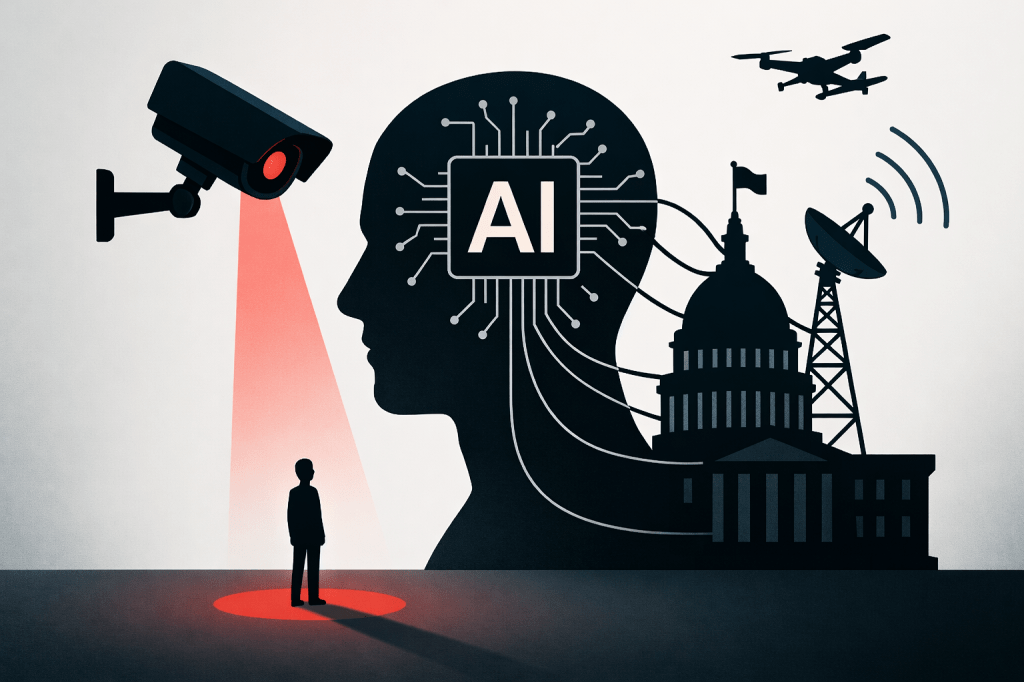


A small group of named actors are now shaping a much larger public risk: President Donald Trump, Defense Secretary Pete Hegseth, OpenAI CEO Sam Altman, Anthropic CEO Dario Amodei, Palantir CEO Alex Karp, Nvidia CEO Jensen Huang, Google, the Pentagon, DHS, and a handful of frontier AI and infrastructure firms. The pattern across the reporting is not vague. AI is moving rapidly into defense, intelligence, surveillance-adjacent systems, telecom planning, and energy infrastructure before the public has clear visibility or enforceable oversight.
The sharpest flashpoint is the Pentagon dispute with Anthropic. Dario Amodei’s company refused to remove guardrails blocking two specific uses of Claude: mass domestic surveillance and autonomous weapons. After that standoff, the Pentagon labeled Anthropic a “supply-chain risk,” and Anthropic sued the Trump administration. Reuters reports that Trump also ordered Anthropic’s Claude phased out across the federal government. This shows the state is not only buying AI; it is pressuring private companies over how much control they can keep once government wants broader use.
The direct counterpart is Sam Altman and OpenAI. OpenAI announced its own deal with the Pentagon and publicly said it has three red lines: no mass domestic surveillance, no autonomous weapons, and no “high-stakes automated decisions” such as social-credit-style systems. Reuters also reported that Altman later said OpenAI was working with the Pentagon to amend parts of the agreement after criticism. The problem is not that OpenAI has no safeguards on paper. The problem is that the same reporting says the Defense Department wants broad rights for lawful military use, while critics argue that “lawful” can be interpreted very widely inside national security systems.
One specific person makes that concern harder to dismiss: Caitlin Kalinowski, OpenAI’s hardware and robotics leader. TechCrunch and other outlets reported that she resigned in response to the Pentagon deal, citing concerns about surveillance of Americans without judicial oversight and lethal autonomy without human authorization. That does not prove OpenAI already crossed those lines. But it does show that a senior insider close to the company’s physical-systems work believed the governance was not settled safely enough before the agreement moved ahead.
Pete Hegseth and the Pentagon are central here because this is no longer a hypothetical policy debate. Reuters and other reporting indicate that Claude has already been used in support of U.S. military operations involving Iran, including intelligence and planning support. That changes the public question. The question is no longer whether frontier AI could affect war. It already is affecting war. Once that line has been crossed, the public is no longer debating prevention. It is debating limits after deployment has started.
The danger to the public becomes even clearer when Alex Karp and Palantir enter the picture. Wired reported that DHS signed a blanket purchase agreement worth up to $1 billion with Palantir. TechPolicy.Press reported that the five-year arrangement allows agencies including CBP, ICE, FEMA, and CISA to buy Palantir’s Gotham and Foundry platforms more easily, without separate competitive processes each time. Palantir is not a chatbot company. It is a data-integration and operational software company. When firms like Palantir are paired with stronger AI, the risk is not an abstract future machine. The risk is that governments can fuse records, identity, location, associations, and operational workflows into faster, broader, more automated state visibility over ordinary people.
Alex Karp has defended that role publicly. Reuters reported that Karp said Palantir’s surveillance tools include safeguards against government overreach while also stating that the company supports some of the most unusual and intricate U.S. government operations. That is exactly why the public danger should not be softened. When a private company is deeply embedded in sensitive government operations, the public usually cannot inspect how those safeguards work, how often they fail, or how narrowly they are applied in practice.
President Trump’s 6G memorandum is another case where precision matters. The White House memorandum “Winning the 6G Race” says 6G will play a pivotal role in technologies including artificial intelligence, robotics, and “implantable technologies.” That is a real phrase in an official White House document. But it does not prove a covert implantation program or justify the more extreme claims circulating online. What it does prove is that the U.S. government is openly planning future telecom infrastructure as a foundation for deeper integration between networks, AI, robotics, and body-adjacent technologies. That should concern the public because infrastructure decisions come first, and public limits often come later.
The global public danger is not limited to the United States. Once Washington normalizes AI-assisted military operations, broad data-fusion tools, and future network planning tied to body-connected technologies, allied governments, contractors, and competitors have a ready-made template to copy. Tools built first for defense, intelligence, immigration control, or “lawful” monitoring can spread into policing, financial screening, border enforcement, insurance, employment, and political monitoring. This is how surveillance systems grow in reality: not all at once, but through procurement, integration, and precedent.
Jensen Huang and Nvidia show the economic side of this shift. Reuters reported that Huang said Nvidia’s recent investments in OpenAI and Anthropic might be its last in those firms as they move toward IPOs. Nvidia already sits in a stronger position than most model companies because it sells the chips and systems nearly all of them need. That means infrastructure is concentrating around a very small number of firms. The public danger here is structural dependency: a few companies can end up controlling the compute, the cloud access, the deployment stack, and the practical terms under which governments and corporations scale AI.
Google and Commonwealth Fusion Systems show that the same concentration dynamic now extends into energy. The International Energy Agency says global electricity use by data centers is projected to double to around 945 TWh by 2030. Google has already signed an agreement with Commonwealth Fusion Systems for 200 megawatts from CFS’s planned ARC fusion plant in Virginia, which CFS expects to deliver power in the early 2030s. This is important because it shows major firms are not planning for AI to level off. They are building toward much larger long-term demand in computing and electricity.
That creates a second layer of public risk. If AI power is concentrated in companies such as OpenAI, Anthropic, Google, Nvidia, Palantir, and a small set of cloud and energy partners, then ordinary people are not facing a decentralized innovation wave. They are facing a tightly stacked system in which a few corporations and state institutions shape capability, access, and oversight at the same time. When those same systems are also entering defense and security work, the danger is not merely commercial dominance. It is merged private-state power.
The public danger should be stated plainly.
The first danger is total pattern surveillance. DHS, ICE, CBP, the Pentagon, and contractors such as Palantir do not need one dramatic biometric implant or one giant secret database to create risk. They only need enough separate data streams and enough AI to connect them. Once AI can fuse location, purchases, online activity, contacts, travel, and institutional records, privacy stops being about one sensitive record. It becomes about reconstruction of a person’s entire life.
The second danger is automated suspicion and silent scoring. OpenAI says it bars social-credit-style systems, and Anthropic fought over similar boundary issues. But the broader risk is that governments and institutions do not need to call a system “social credit” for it to function that way. Risk ranking, anomaly detection, priority flags, behavioral scoring, and watchlisting can produce the same effect under different names. The public may never know when they are being filtered, escalated, or deprioritized by machine-assisted systems.
The third danger is machine-shaped force. Hegseth, the Pentagon, CENTCOM, and AI vendors are moving AI into military workflows now. Even with a “human in the loop,” the machine can still frame the target set, compress the timeline, narrow the options, and present an answer with enough institutional authority that the human becomes a validator rather than a true decision-maker. That is how lethal autonomy can grow in practice even before officials openly admit it.
The fourth danger is normalization through legality language. Much of this turns on phrases such as “all lawful purposes,” “national security,” or “public safety.” Those phrases sound controlled, but they are often elastic. Once an administration, an agency, or a court interprets them broadly, the system can expand without the public ever voting on the real scope of what was authorized. That is why the fight between Dario Amodei, Sam Altman, Pete Hegseth, and the Pentagon matters far beyond Silicon Valley. It is a fight over whether companies can impose meaningful limits once the national security state wants more.
The fifth danger is global replication. If the United States, under Trump, Hegseth, DHS, and major contractors, normalizes AI-assisted surveillance and military integration, other governments will not wait. Some will buy similar systems. Some will build domestic versions. Some will cite American precedent to justify harsher forms. Once these tools spread, the global public faces a world where invisible scoring, automated targeting, mass data fusion, and networked monitoring become normal features of governance, not rare exceptions.
The bottom line is not vague. The named actors are already on the board. Donald Trump is pushing telecom and AI policy in ways that favor rapid deployment. Pete Hegseth’s Pentagon is pressing for broader military AI access. Sam Altman is moving OpenAI deeper into defense work while promising red lines. Dario Amodei is fighting in court over whether a company can refuse certain state uses. Alex Karp is expanding Palantir further into DHS operations. Jensen Huang is consolidating power at the compute layer. Google is buying future fusion power because it expects AI demand to keep rising. The public danger is that all of these pieces fit together into one system: more compute, more energy, more integration, more state access, and weaker practical visibility for ordinary people.
That is the issue in plain language. The danger is not just smarter AI. The danger is that named governments, named companies, and named executives are connecting AI to war, surveillance, data fusion, communications infrastructure, and power systems at the same time. Once that structure is in place, the public is easier to monitor, easier to model, easier to classify, and easier to control. Rolling that back later is far harder than stopping it early.


 Bantam Joe
Leave a comment