

- Foundational Framework: Universe as a Quantum Communication System
1.1 Classical communication model (Source/Encoder/Channel/Noise/Decoder/Receiver/Symbol Table)
1.2 Reduction to Source–Pattern–Channel
1.3 Mapping to Trinity: Father (Source), Word/Christ (Pattern), Spirit (Channel)
1.4 Consciousness as a quantum node, not a brain byproduct - Quantum Realism and the Structure of Conscious Identity
2.1 QR: reality as quantum information process
2.2 Conscious self as recursive loop: C₀ = f(C₀)
2.3 Phase alignment and global coherence requirements
2.4 The “I AM” of God vs finite “I am” of conscious nodes - The Word as Universal Reference Pattern
3.1 “In the beginning was the Word” as structural requirement
3.2 The Word as symbol table, coherence map, reference waveform
3.3 Examples: radio protocols, computer encodings, languages
3.4 DNA/codon table/ribosome as biological Word analogy
3.5 The Word as master code of consciousness (C₀ = f(C₀) referencing a global standard) - Formal Communication Mapping (Trinity ⇄ Shannon)
4.1 Symbol Table → Word/Christ
4.2 Encoder → Father/Source expressing through the Word
4.3 Transmitter → emission of Word-structured quantum states
4.4 Channel → Spirit as quantum field of coherence
4.5 Noise → sin/decoherence (placeholder; expanded later)
4.6 Decoder → node’s internal implementation of the Word
4.7 Receiver → recursive self C = f(C) - Coherence, Decoherence, and Eternal Separation
5.1 Coherence thresholds and identity stability
5.2 Decoherence mechanisms: noise, interference, internal chaos, rejection of pattern
5.3 Irreversibility: no-cloning theorem and environmental dispersal
5.4 Eternal separation as structural disconnection (receiver gone, broadcast ongoing) - Sin, Forgiveness, and Salvation in Structural Terms
6.1 Sin as noise/decoherence, not just moral violation
6.2 Accumulated noise → coherence loss → crossing the collapse threshold
6.3 Forgiveness as hard reset / full realignment with the Word (phase-lock)
6.4 Salvation as ongoing coherence above threshold, not merit accounting - Unforgivable Sin and the Role of the Spirit (Channel)
7.1 Spirit as coherence field / channel in QR and theology
7.2 Blasphemy against the Spirit as destruction of the channel/receiver interface
7.3 Why “unforgivable” = no coherent node left to receive forgiveness - The Stone of Stumbling as Quantum Discontinuity
8.1 Cornerstone / stumbling stone language (Psalm 118, Matt 21)
8.2 Quantum thresholds: discrete transitions vs gradual moral improvement
8.3 Christ as non-negotiable reference pattern / threshold
8.4 Good deeds as continuous, coherence as binary at the critical edge - Toy Models of Coherence and Thresholds
9.1 Bit-flip channel: P_correct(k) = (1–p)ᵏ and exponential reliability decay
9.2 Threshold line as boundary between functional and non-functional receiver
9.3 Depolarizing channel: ρ → (1–λ)ρ + λI/2 and purity as coherence measure
9.4 Purity threshold as minimum coherence for stable identity - Holography and DNA as Deep Analogies of the Word
10.1 Hologram + reference beam: pattern + reference → image vs noise
10.2 Christ as reference beam that “reads” the world’s interference pattern
10.3 DNA–codon–ribosome as pattern + decoder + organism
10.4 Mis-decoding/mutated mapping as structural death - First-Person Framing of Salvation and Separation
11.1 Eternal separation as irreversible decoherence of “me,” not divine rejection
11.2 Radio analogy: broadcast intact, smashed receiver silent
11.3 Faith as trusting the reference pattern; repentance as re-alignment; grace as ongoing correction - Engaging Critics and Clarifying Intent
12.1 Responding to universal reconciliation vs eternal separation objections
12.2 Addressing worries about “cold mechanics” vs direct spiritual experience
12.3 Positioning QR as substrate beneath, not replacement for, biology and humanism
12.4 Stating this as a working model, not dogma; inviting critique, not demanding agreement - Final Synthesis: Salvation as Quantum Threshold Event
13.1 Single integrated framing of salvation as coherence condition
13.2 Bible re-read as structural guide for staying coherent (Word/Spirit/abiding, etc.)
I had spent more than forty years asking a simple question that sounds trivial on paper:
What is the imaginary number i, really?
In high school it was just an algebraic symbol (i) for square root of -1. In electronics it showed up in AC circuit analysis as complex impedance. In quantum mechanics it stood at the heart of Schrödinger’s equation. Everywhere the really interesting physics happened, the symbol “i” was there—some rotating thing between “real” and “imaginary,” between what we measure and what seems to sit underneath. Teachers, professors, mathematicians, engineers and scientists all would say “it’s just a mathematical convenience”. To me, those were not good answers.
For decades, that bothered me.
I had this nagging sense that imaginary number (i) wasn’t just mathematical bookkeeping; it was pointing at something about how reality actually works—about waves, phases, signals, and how information flows.
In my quest to answer that question, I dug deeper into math, information theory and quantum mechanics, and later, the philosophical studies of Quantum Realism (QR). All of the sudden, many of my questions were being answered, but I then encountered the studies of consciousness and more questions were born.
Then, recently, a spontaneous thought crept into my mind:
What if the Bible is not just a religious text, but a crude, ancient description of the same kind of system that physics is now uncovering, a quantum communication system?
Over time, through Quantum Realism, quantum mechanics, and information theory, I started seeing a pattern:
- The Bible talks about the Word, the Spirit, the Father, abiding, life, death, separation.
- Physics talks about sources, fields, signals, noise, coherence, collapse.
- Information theory talks about encoders, channels, decoders, symbol tables, error thresholds.
The more I stared at them side-by-side, the harder it became to ignore the structural overlap and correlations.
So this series is my attempt to write all that down:
My working hypothesis is that the Bible may actually function as a kind of User’s Guide to the Quantum Communication System; a set of instructions for how a conscious being can couple to, remain in, and persist within a deeper quantum-information universe, now and into perpetuity.
This is a personal exploration, not a decree. I’m not asking anyone to agree. I invite all to follow the structure with me and see if it holds.
With that on the table, let’s start with the basics.


1. Foundational Framework: Universe as a Quantum Communication System
Before we get anywhere near salvation, judgment, or eternity, I want to ground the whole discussion in something very concrete:
- how communication systems work,
- how information moves,
- and why structure + noise + thresholds matter.
Only then will I map those onto Father, Word, Spirit, and self.
1.1 How Any Communication System Works
Imagine something simple: you send a text message.
You type: “I’m on my way.”
Under the hood, this involves a whole architecture:
- Source – You, and your intent (“tell them I’m coming”).
- Encoder – Your phone’s software converts letters into bytes (using a symbol table like ASCII or Unicode).
- Transmitter – Your phone’s radio hardware turns those bytes into electromagnetic waves.
- Channel – The air, towers, cables, and networks that carry the signal.
- Noise – Interference, weak signals, packet loss, random corruption.
- Decoder – The other phone converts incoming bits back into text using the same symbol table.
- Receiver – The other person’s mind, which “gets” the message.
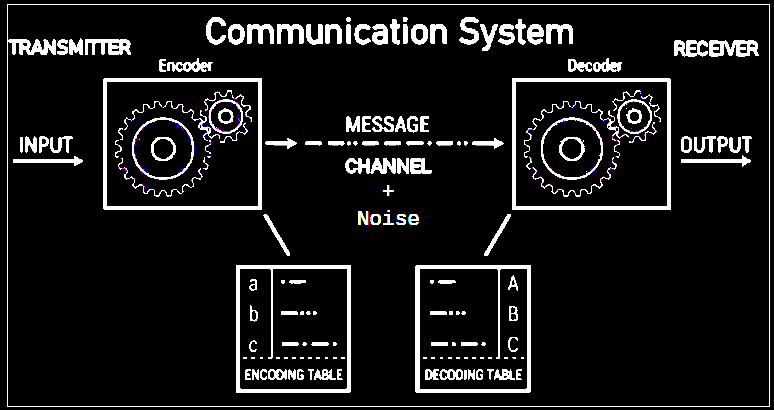
Claude Shannon (the father of Information Theory) formalized this in information theory. Every communication event, no matter how complex, can be decomposed into these roles.
Key facts:
- No shared symbol table → no meaning.
If your phone uses ASCII and mine uses some alien code, the bits don’t decode into the same text. - Too much noise → no usable signal.
If the channel is too corrupted, even perfect encoding/decoding can’t reconstruct the message. - Broken receiver → no experience.
Even with perfect signal and decoding, if the receiver is off, nothing is perceived.
Everything we do with phones, radios, fiber optic cables, or the internet depends on this structure.
Now I want to make a leap:
What if reality itself—not just our gadgets—follows the same pattern?
1.2 Reducing to Three Irreducible Roles
If you strip away the implementation details, the seven classical elements collapse into three irreducible roles:
- Source – Something that originates intent or meaning.
- Pattern – A stable reference structure that gives signals their form and interpretation.
- Channel – A medium that carries and preserves that structure long enough for it to be received and interpreted.
In typical systems:
- Source + Encoder + Transmitter → Source
- Symbol Table / Coding Rules → Pattern
- Physical Channel (with noise) → Channel
Noise is what attacks the channel and pattern; decoders and receivers are just the downstream side of the same structure.
If reality is fundamentally informational, then at some level it must have:
- a Source of intent or being,
- a Pattern that defines how being is structured,
- and a Channel that connects and sustains the whole thing.
That’s just system logic, not yet theology.
Now notice what Christian theology has been saying for a very long time.
1.3 Mapping to the Trinity: Father, Word, Spirit
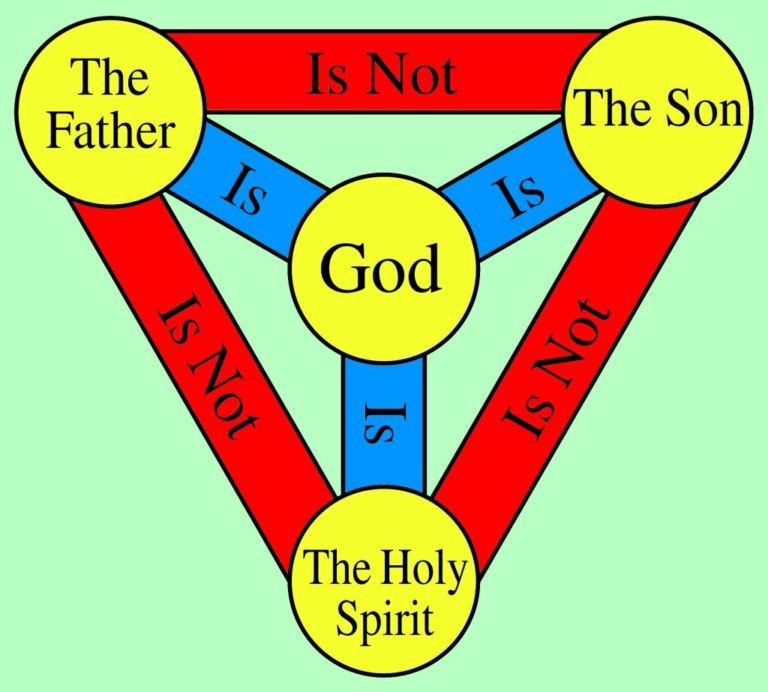
In Christian language, the three core persons of the Trinity are described as:
- Father – source, origin, will.
- Son / Word (Logos) – expression, form, structure, “through whom all things were made.”
- Spirit – presence, field, breath, the one who “fills” and “connects.”
For example:
“In the beginning was the Word, and the Word was with God, and the Word was God.
He was with God in the beginning.
Through him all things were made; without him nothing was made that has been made.” (John 1:1–3)
“In him all things hold together.” (Colossians 1:17)
“God is Spirit…” (John 4:24)
Structurally, this lines up almost too well with the minimal communication framework:
- Father → Source of intent.
- Word (Christ) → Pattern / symbol table / reference structure: the Logos.
- Spirit → Channel / field of coherence in which everything exists and communicates.
I’m not saying the Bible is a network engineering manual. I am saying: when I overlay Shannon’s communication architecture onto the Christian Trinity, the mapping is clean and natural.
From that perspective:
Theology might be describing the same deep structure that information theory and quantum physics are converging on—using different language.
1.4 Consciousness as a Quantum Node, Not a Brain Byproduct
If the universe is a communication system, where does consciousness fit?
The standard materialist story is:
- The brain is a biological machine.
- When it gets complex enough, consciousness “emerges” as a byproduct.
- When the brain stops, consciousness disappears.
Quantum Realism suggests something different:
Consciousness is not produced by the brain.
Consciousness uses the brain as an interface into a deeper quantum-information network.
This is where the little equation I mentioned comes in:
C0 = f(C0)
I use this as a simple way to express identity:
- (C0) is my core conscious state—my “I am.”
- (f) is the function update rule—how experience, memory, perception, and choice alter that state.
- The equation says: my identity is a recursive process. I continuously re-apply “me” to myself.
In a universe that is fundamentally informational:
- A conscious self is a quantum node—a persistent, quantum coherent pattern—in that quantum field network.
- It can send and receive signal through the quantum field network (Spirit).
- Its structure must align with the underlying Pattern (Word), or it loses quantum coherence.
So instead of:
Matter → brain → consciousness (as an accident),
I’m exploring:
Source (Father) → Pattern (Word) → Field (Spirit) → coherent nodes (conscious selves), where the brain is a local, physical interface to that deeper system.
In that framework, questions like:
- What is “life”?
- What is “death”?
- What does it mean to be “saved”?
- What does it mean to be “separated from God”?
translate cleanly into:
- What is quantum coherence?
- What is quantum decoherence?
- What is a quantum threshold beyond which a conscious node can no longer function in the quantum network?
Those are precisely the questions quantum mechanics and information theory are built to handle.
And this is where I start to suspect that when the Bible talks about:
- the Word,
- the Spirit,
- abiding in Christ,
- the wages of sin,
- the second death,
it may be describing, in ancient words for those times, the logic of staying coherent in a quantum communication universe.
2. Quantum Realism and the Structure of Conscious Identity
To talk about salvation in terms of quantum coherence and quantum thresholds, I first need to explain what I mean by Quantum Realism and why I model identity as a recursive process.
I’m not asking anyone to buy into this as final truth. I’m just laying out the framework that made everything click for me.
2.1 What I Mean by Quantum Realism
Classically, we’ve had two big camps:
- Materialism – Only matter and energy are real. Consciousness is something the brain does.
- Idealism / Spiritualism – Mind or spirit is primary, and matter is secondary or illusory.
Quantum mechanics quietly blows a hole in both if we insist on the old, rigid versions.
In quantum theory:
- Particles behave like probability waves until “measured, or observed”.
- A system is described by a quantum wavefunction (a spread of possible states).
- Interactions, measurements, and context matter.
- Information, correlations, and coherence play as big a role as “stuff.”
Quantum Realism makes a strong claim:
The quantum information process is primary.
The physical world is what that process looks generates.
So:
- Reality at root is informational and relational, not just “little balls in space.”
- Space, time, particles, and fields are emergent behaviors of a deeper informational quantum substrate.
- Consciousness is not a glitch—it’s a particular mode of participation in that substrate.
That’s the basic shift: from “the universe is made of stuff” to “the universe is made of information organized by patterns.”
When I line that up with John’s:
“In the beginning was the Word…” (John 1:1)
it stops sounding mystical and starts sounding like an early statement of:
“At the base of reality, there is a structured pattern that governs how information becomes form.”
That’s exactly what a symbol table or code or reference pattern is.
2.2 Identity as a Recursion: C₀ = f(C₀)

Now, where do I fit into that?
I needed a way to describe conscious identity that doesn’t just say “it’s the brain” and doesn’t reduce it to a metaphysical slogan.
The simplest mathematical expression that captures what I feel being “me” is:
C0 = f(C0)
I’m not asking you to think of this as a full equation of mind, just as a structural idea:
- (C0) = my core conscious state, the “I am” that persists across time.
- (f) = the transformation rule that takes “who I am now” and produces “who I am next,” given perception, memory, experience, and choice.
The fact that (C0) appears on both sides means:
- I am not a single snapshot.
- I am a loop—a process that feeds myself back into myself.
- I am a recursion: self is both input and output.
Every day, experiences update me:
- I see something.
- I interpret it.
- It changes my beliefs, my expectations, my emotional landscape.
- Tomorrow’s “I” is today’s “I” plus the transformation of everything that happened.
In that sense:
I am a self-referential quantum process that must stay coherent over time to remain a recognizable “me.”
That’s why coherence matters: if the process that updates me becomes too chaotic, contradictory, or noisy, the identity it generates stops being stable.
2.3 Why Coherence and Phase Alignment Matter

In quantum physics, a system can be coherent or decohered.
- Coherent:
- The phases of the wavefunction are well-defined.
- The system can interfere with itself, carry delicate information, and behave in a unified way.
- Decohered:
- Interaction with the environment scrambles those phases.
- Subtle information is lost to the surroundings.
- The system behaves more classically, more like random mixture than a unified wave.
Translate this to identity:
- A coherent self has:
- Internal consistency—beliefs, memories, values roughly align.
- A stable sense of “I” across time.
- The ability to integrate new information without shattering.
- A decohering self has:
- Increasing internal contradictions and unresolved conflicts.
- Fractured sense of self.
- Difficulty maintaining a continuous narrative of “who I am.”
In QR terms, for the recursion
C0 = f(C0)
to produce a stable, enduring identity, two things must be true:
- The update rule (f) must be anchored to a global pattern (the Word), not just local whims.
- The whole process must be embedded in a coherent field (the Spirit) that doesn’t constantly shred the signal.
This is where the Bible’s abiding language makes structural sense to me:
“Remain in me, as I also remain in you. No branch can bear fruit by itself; it must remain in the vine.” (John 15:4)
The picture is:
- Me (branch) as a recursive process.
- Christ (vine / Word) as the reference pattern.
- Spirit (life of the vine) as the coherence field.
To “remain in” Him structurally means:
- Keep my identity process locked to His pattern.
- Don’t sever the connection to the coherence field that sustains my “I am.”
Without that, recursion degrades. The loop keeps running, but what it produces stops being a coherent self.
2.4 The “I AM” and the “i am”

There’s a moment in Exodus that always felt strange to me, even before QR:
“God said to Moses, ‘I AM THAT I AM.’ And He said, ‘Say this to the people of Israel: “I AM has sent me to you.”’” (Exodus 3:14)
Why answer with a self-referential phrase? Not “I am the Creator” or “I am the Almighty,” but:
“I AM THAT I AM.”
That sounds like:
G = F(G)
God as a primal self-referential identity or consciousness, a self-sustaining recursion that does not depend on anything outside itself to exist.
In QR language:
- God is the original coherent identity—the self-existent “I AM” whose recursion never decoheres.
- The Word is the pattern by which that identity expresses itself into the communication system.
- The Spirit is the field that carries this expression and connects all derived identities.
My own “i am” is different:
- I am not self-existent.
- My recursion is borrowed—it depends on the structure of the Word and the coherence of the Spirit.
- My identity is a finite, fragile subset of that primal I AM.
In that sense:
My “i am” is a localized, dependent echo of the infinite “I AM.”
If I remain phase-aligned with that Source through the Word and the Spirit, my recursion can persist. If I sever that alignment—through accumulated distortion (sin), rejection (blaspheme), or destruction of the channel—my recursion cannot continue as a coherent self.
This is how I interpret verses like:
“For in him we live and move and have our being.” (Acts 17:28)
Not as metaphor only, but as a structural claim:
- My being is embedded in His.
- My identity loop runs within His informational field.
- Without that embedding, I have no independent way to sustain an “i am.”
That’s the backbone of how I see consciousness in Quantum Realism:
- The universe is not just stuff; it’s a communication system.
- Consciousness is not just brain noise; it’s a recursive quantum node in that system.
- Coherence, phase alignment, and reference patterns are not abstract math; they’re the conditions for being someone.
With that in place, I can now go back to the biblical phrase that sits at the center of this whole series:
“In the beginning was the Word…”
and treat it as a literal structural requirement for any information-based reality.
3. The Word as Universal Reference Pattern
If Quantum Realism is right and reality is fundamentally informational, then nothing can mean anything without a reference pattern—a shared structure that tells the system how to interpret signals.
That’s exactly what John points to when he opens his gospel with:
“In the beginning was the Word, and the Word was with God, and the Word was God.
He was with God in the beginning.
Through him all things were made; without him nothing was made that has been made.” (John 1:1–3)
For most of my life, I heard that as mystical poetry. Only when I started thinking in terms of information and communication did it hit me:
“In the beginning was the Word” is a technical statement about how any communication system—any coherent reality—must start.
There must be a pattern before there can be meaningful signals.
3.1 Why Any System Needs a Shared “Word”

Go back to that text message: “I’m on my way.”
The only reason that message can exist is because:
- Your phone and mine agree on a symbol table like Unicode:
- The bytes
49 27 6D ...are interpreted asI ' m ...
- The bytes
- The network protocols agree what a packet looks like.
- The entire chain uses the same encoding/decoding rules.
No shared pattern, no meaning.
This is true everywhere:
- Radios need shared frequencies and modulation formats.
- Computers need shared character encodings and protocols.
- Languages need shared grammar and vocabulary.
If each end uses a different codebook, the bits arrive, but they’re nonsense.
Now strip this down to the bare logic:
- There is a set of possible signals.
- There is a set of possible meanings.
- There must be a mapping between the two.
That mapping is what I mean by a Word in the technical sense:
A Word is a stable, shared structure that maps raw information to meaningful form.
No Word, no meaning. No meaning, no coherent world.
“In the beginning was the Word” starts to sound like:
“At the root of reality is a shared mapping that transforms information into a world.”
3.2 The Word as Symbol Table, Coherence Map, and Reference Waveform
In the language of information theory and signal processing, I can think of the Word in three overlapping ways.
- Symbol Table
- A dictionary saying: this pattern → that meaning.
- ASCII, Unicode, codon table, Morse code—all examples.
- Coherence Map
- A global pattern of constraints and relationships that keep things consistent.
- In physics, this is reflected in symmetries, conservation laws, and constants.
- Reference Waveform
- In many systems (like radio, radar, holography), you compare an incoming signal to a known pattern (a reference) to decode it.
- The reference itself is never “seen” directly; it’s what all signals are measured against.
When I hear:
“In him all things hold together.” (Colossians 1:17)
I can’t help but read it as:
The Word is not just the code. The Word is the consistency condition of the universe—the pattern that keeps everything from devolving into random noise.
If that pattern vanished, you wouldn’t just lose some structure; you’d lose the possibility of structure.
3.3 Concrete Examples: Radios, Computers, Languages
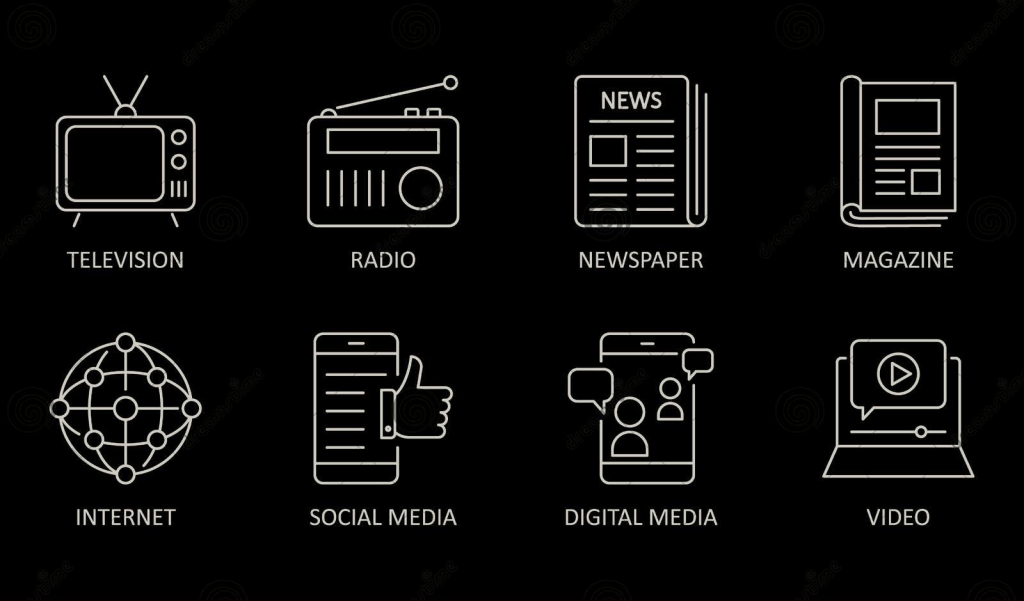

To keep this grounded, here are a few ordinary systems that work only because of their “word”:
- Radios
- Stations broadcast at agreed carrier frequencies (101.1 MHz).
- Your radio uses those reference frequencies to tune in.
- If there is no standard, there is no tuning.
- Computers
- Text is encoded using standard code tables (ASCII, UTF-8, etc.).
01000001is “A” only because we collectively decided and then stuck to it.- Change the mapping, and the same bits mean something totally different—or nothing at all.
- Human Languages
- The sounds “d-o-g” mean a canine not because of magic but because of shared agreement.
- Grammar rules determine how words combine into coherent sentences.
- No shared grammar, and language collapses into noise.
In every case:
A shared structure precedes meaningful communication.
John uses Logos (“Word”) for Christ. At minimum, that says:
- Christ is not just a messenger inside a world.
- Christ is the pattern by which the world itself is structured and read.
3.4 DNA and the Codon Table: A Biological “Word”
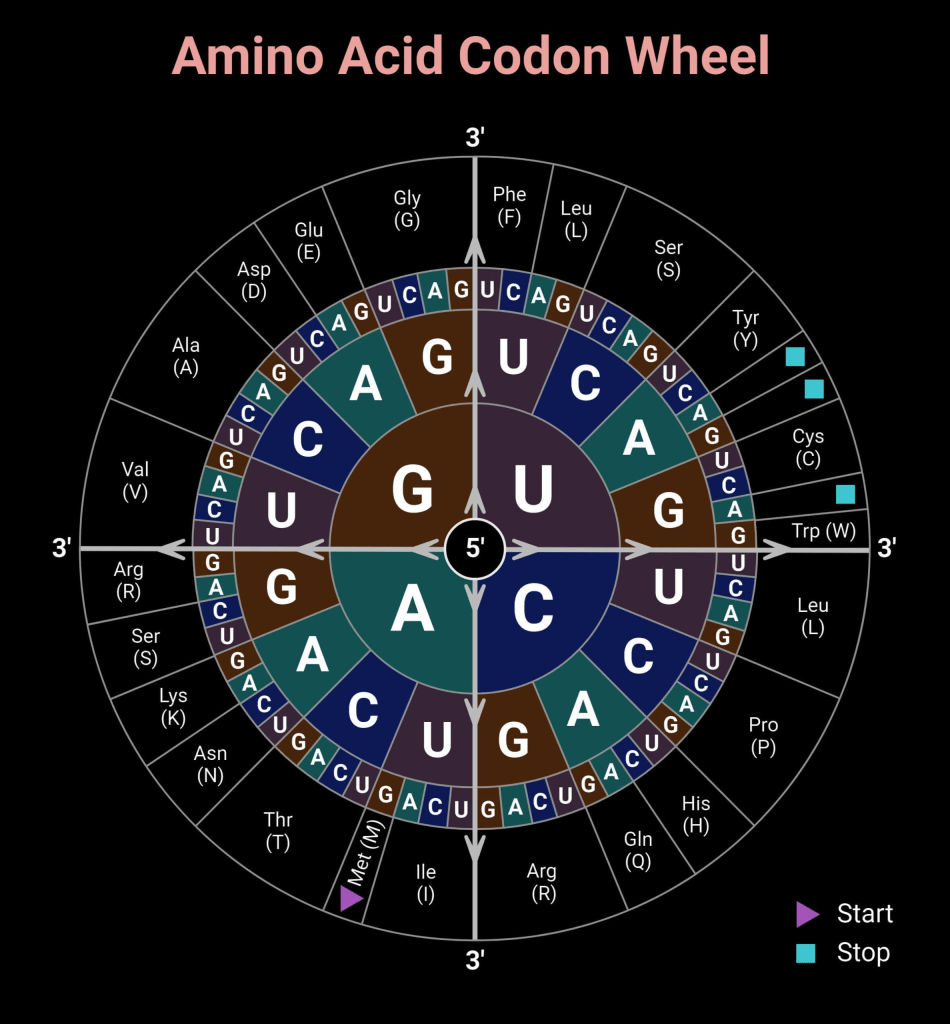

Biology gives a striking example of this principle:
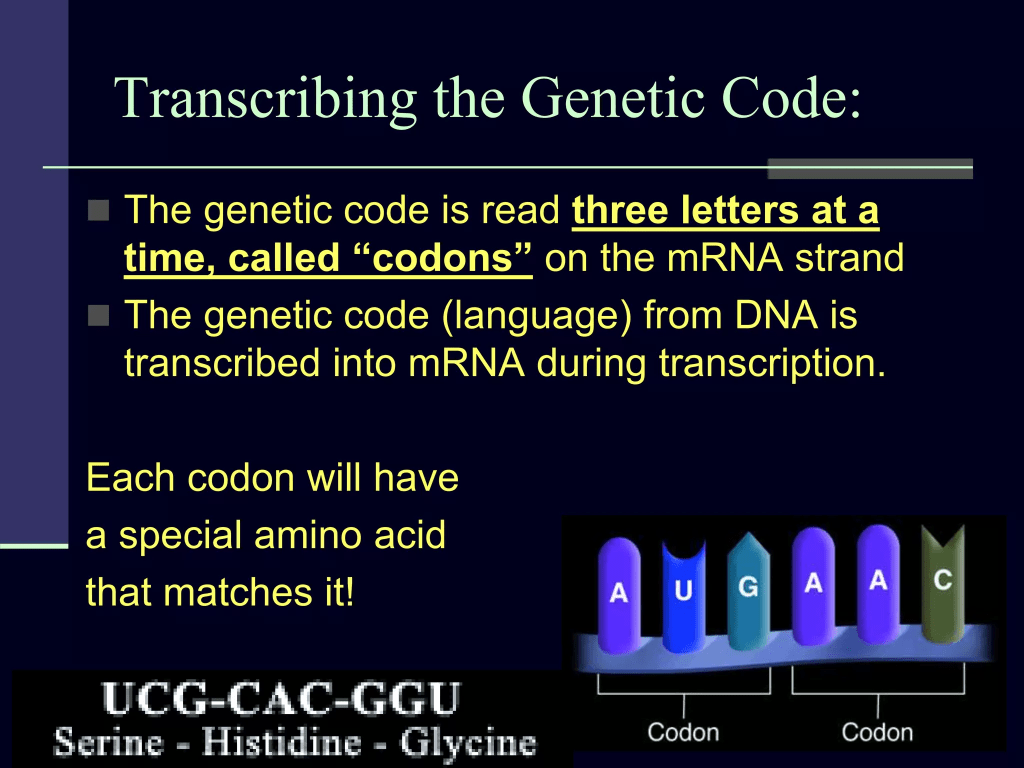
- DNA stores information using four bases: A, C, G, T.
- These bases form codons—triplets like “AUG” or “GGC”.
- The codon table specifies which codon means which amino acid.
For example (simplifying):
- AUG → Methionine (often a start signal)
- GGC → Glycine
- UAA, UAG, UGA → Stop signals
The key point:
All life on Earth (with rare exceptions) uses the same codon table.
That means:
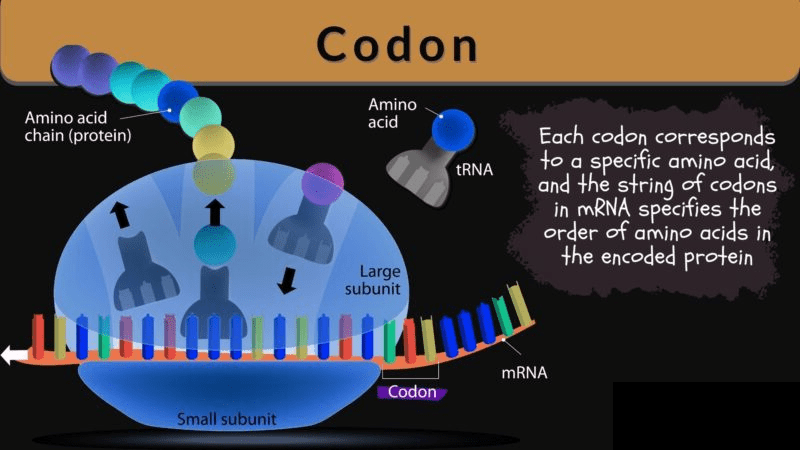
- The DNA in your cells and the ribosomes that read that DNA share a Word—a mapping table.
- If that mapping were different inside the same system, the messages wouldn’t decode into functional proteins.
If you randomly scramble the codon table:
- You don’t just change what one protein looks like.
- You destroy the entire decoding process.
- The organism becomes non-viable.
To me, this is a biological echo of John’s statement:
“Without him nothing was made that has been made.” (John 1:3)
Not in the sense that Jesus is a strand of DNA, but in the sense that:
Without a stable, shared mapping (the Word), the information in DNA cannot become life.
At a larger scale:
- Without a stable, shared mapping at the level of the cosmos, the information in the universe cannot become world.
3.5 The Word as Master Code of Consciousness
Up to this point, the Word is a cosmic symbol table. Now I want to bring it back to identity—my own conscious “I am.”
Recall the recursion:
C0 = f(C0)
That recursion can’t run in a vacuum. It needs:
- A reference pattern to compare itself against (to know what “consistent” even means).
- A standard for interpreting experiences, like:
- What is truth?
- What is good?
- What is real?
- What is “me” vs “not-me”?
In my model:
The Word is the master reference my identity must implicitly or explicitly rely on to remain coherent.
If my internal mapping (my personal “word”) diverges too far from the true Word:
- My perception of reality becomes distorted.
- My self-understanding becomes contradictory.
- My recursion C0 = f(C0) starts feeding on bad data.
That’s a structural problem:
- A decoder using the wrong table produces garbage.
- A ribosome using the wrong codon table produces nonfunctional proteins.
- A conscious node using the wrong reference pattern produces a self that can’t hold together.
This is why Jesus can say things like:
“I am the way and the truth and the life. No one comes to the Father except through me.” (John 14:6)
Under the hood, I hear:
- Way – the path of alignment with the true Pattern.
- Truth – the actual reference, not a local guess.
- Life – coherence that persists in connection with the Source.
If He is the Word in the structural sense, then:
To come into lasting connection with the Source (the Father), my identity must align with the Word (Christ). There is no alternative mapping that will sustain a stable self in that system.
That is architecture.
Where this leads, for me, is a very different take on salvation and separation:
- Salvation becomes alignment with the Word so that my identity loop can stay coherent.
- Separation becomes misalignment with the Word to the point where my identity loop can no longer run.
To connect all these pieces, I need to line up the full communication chain (Source, Word, Spirit, noise, decoder, receiver) and show how they fit into a single picture.
That’s where I’ll go next, by mapping the entire Trinity right onto Claude Shannon’s communication system in a direct, piece-by-piece way.
4. Formal Communication Mapping (Trinity ⇄ Shannon)
Up to now I’ve been circling around a core claim:
- The universe behaves like a quantum communication system.
- The Bible’s language of Father, Word, and Spirit maps surprisingly well onto that system’s core roles.
I want to make that mapping explicit now. Directly overlaying Claude Shannon’s architecture on the Trinity and on consciousness.
Not as an analogy, but as a structural correspondence.
4.1 Symbol Table → The Word / Christ
In any communication system, the symbol table is the non-negotiable reference:
- It says: the pattern of bits / waves / marks → that meaning.
- Both the sender and receiver must share it, or nothing works.
We saw examples:
- ASCII / Unicode: byte patterns → letters and symbols.
- Codon table: DNA triplets → amino acids.
- Grammar: sound patterns → words and sentences.
In biblical terms, this is exactly what Logos points to:
“In the beginning was the Word, and the Word was with God, and the Word was God.” (John 1:1)
“Through him all things were made…” (John 1:3)
“In him all things hold together.” (Colossians 1:17)
So in this mapping:
- Symbol Table = Word / Christ
- The universal codebook defining:
- How raw information becomes structured reality.
- How identity, meaning, and law hang together.
Everything else in the system depends on this being stable.
4.2 Encoder → Father / Source Expressing Through the Word
The encoder takes inner intent and turns it into a structured message using the symbol table.
In human terms:
- I decide to say, “I’m on my way.”
- My brain translates that intent into motor commands and audio waves using a learned language.
In the cosmic mapping:
- Father / God = the Source of intent, will, and purpose.
- Word / Christ = the structure through which that intent takes form.
So:
- God as Source encodes through the Word, producing reality as a kind of “message stream” in the deep quantum-information field.
This matches statements like:
“Through him all things were made; without him nothing was made that has been made.” (John 1:3)
“[The Son] is the radiance of God’s glory and the exact representation of his being, sustaining all things by his powerful word.” (Hebrews 1:3)
I’m reading that as:
- The Source expresses Himself by encoding through the Word.
- Creation is a continuous emission of Word-structured “signal” into the field (spirit).
In system terms:
- Encoder (Father through the Word) shapes the message.
4.3 Transmitter → Emission of Word-Structured Quantum States
The transmitter converts the encoded message into an actual physical (or quantum) signal in the channel:
- A radio transmitter converts bits into modulated RF waves.
- A laser driver converts data into light pulses in a fiber.
In QR:
- Once the Source encodes intent through the Word, that pattern is emitted into the quantum substrate as actual states.
You can think of it as:
- The “Let there be…” moments in Genesis: the point where encoded intent becomes real behavior in the field.
I don’t need to pin this to one equation; I just need the concept:
- Encoding is abstract structure.
- Transmission is structure instantiated as a state.
In the Trinity mapping:
- The “speaking” of God through the Word into the Spirit is the transmission step.
4.4 Channel → Spirit as Quantum Field of Coherence
The channel is the medium that carries the signal:
- Air for sound.
- Copper for electrical signals.
- Optical fiber for light pulses.
In quantum mechanics, the underlying medium is the quantum field—a pervasive substrate in which particles and interactions are just excitations and patterns.
The biblical language for God’s pervasive presence is Spirit:
“God is Spirit…” (John 4:24)
“Where can I go from your Spirit? Where can I flee from your presence?” (Psalm 139:7)
“The Spirit of God was hovering over the waters.” (Genesis 1:2)
So in this mapping:
- Channel = Spirit
- The medium of coherence and interaction in which:
- The encoded Word-patterns propagate.
- Conscious nodes are embedded.
- Relationships form and persist.
In other words:
The Spirit is the field in which the quantum communication system lives and operates.
Without a channel, signals don’t move, and nodes don’t connect. Without the Spirit as coherence field, there is no participation, no “in Him we live and move and have our being.” (Acts 17:28)
4.5 Noise → Sin / Decoherence
Every real channel suffers noise:
- Thermal noise, interference, random flips in classical systems.
- Decoherence in quantum systems: unwanted coupling to the environment that scrambles phase and destroys delicate information.
In the theological language I grew up with, sin was mostly “breaking rules.” Structurally, I now see it differently:
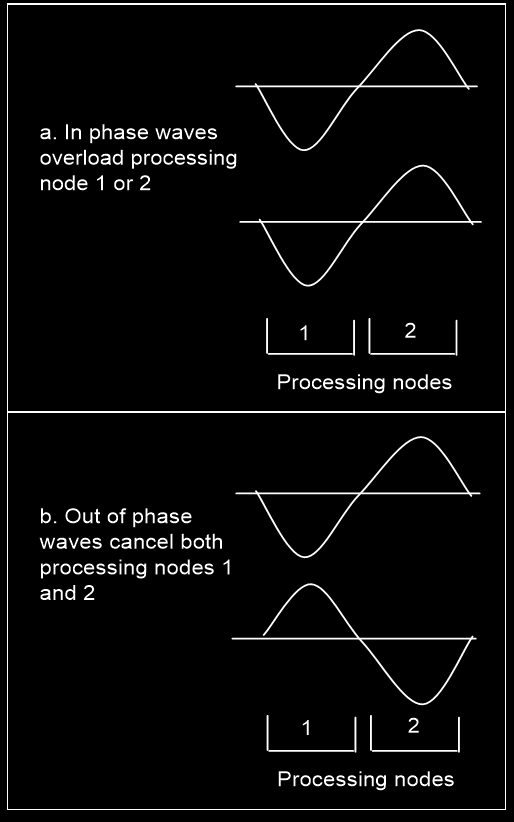
Sin = anything that adds destructive noise to the communication process—between me and God, me and truth, me and others, and even within myself.

Practically, that includes:
- Habitual lies, self-delusion, cruelty, unresolved rage, pride.
- Patterns of thought and behavior that repeatedly pull my inner structure out of tune with the Word.
In the communication model:
- Noise attacks the signal as it travels through the channel.
- In the spiritual model:
- Sin attacks my coherence with the Word, through the Spirit.
- It makes both reception (hearing) and transmission (obeying, loving) less accurate, less reliable.
That’s why biblical writers can talk about:
- being “darkened in understanding,”
- having hearts “hardened,”
- “ears that cannot hear,”
- “eyes that cannot see.”
Those are all symptoms of decoding under heavy noise.
4.6 Decoder → My Inner Implementation of the Word
The decoder takes the noisy, received signal and attempts to reconstruct the original message using the symbol table.
- If the decoder uses the right symbol table, it can recover the message—up to the noise limit.
- If it uses the wrong table, it produces garbage, even if the bits are fine.
In my inner life:
- My beliefs, assumptions, values, and mental models form my decoder.
- They determine how I interpret what God, the world, and other people are “saying.”
In this mapping:
- Decoder = my internal alignment (or misalignment) with the Word.
When Jesus says:
“My sheep hear my voice; I know them, and they follow me.” (John 10:27)
I hear:
- The ones who decode according to My pattern recognize Me and respond.
- Others hear the same “bits” but their decoder doesn’t map it to Me.
If my internal decoder drifts away from the true Word:
- I will misread reality.
- I will misattribute motives, misjudge good and evil, misunderstand God.
- Over time, my identity loop will be built on those misinterpretations.
That’s structural instability, not just bad doctrine.
4.7 Receiver → The Recursive Self C = f(C)
Finally, the receiver is the entity that:
- Has the decoder,
- Accepts the interpreted message,
- Integrates it into its state.
In this model:
- Receiver = me as a conscious node, the recursion:
C0 = f(C0)
All of this lands in one place:
- The Source broadcasts through the Word into the Spirit.
- The signal is impacted by noise (sin, distortion, environment).
- My inner structures decode more or less faithfully.
- My identity loop C0 = f(C0) integrates whatever comes through into “who I am.”
In that sense:
I am not just “hearing” God. I am continuously rebuilding myself based on how I decode the signal of reality, relative to the Word, inside the Spirit.
This is what makes salvation, damnation, repentance, and faith more than abstract religious words for me:
- They become descriptions of how my receiver behaves in a real, structured system.
- They describe whether and how I stay coherent as a node in the network.
Now that the full mapping is laid out—from Source to self—I can finally address the core theme of this series directly:
- coherence,
- decoherence,
- thresholds,
- and what I mean when I say salvation is a quantum threshold event.
5. Coherence, Decoherence, and Eternal Separation


With the communication structure in place, I can finally talk about the idea that upsets people the most:
- Eternal separation from God.
For a long time, that phrase sounded to me like a cruel religious threat. When I put it into a quantum-information framework, it changed into something else:
Not a sentence imposed from outside, but a structural failure condition within the communication system, incurred by a given recursive node.
To explain that, I need to unpack two ideas:
- Coherence – what keeps a conscious self stable and connected.
- Decoherence – what destroys that stability and connection.
Then I’ll explain what I mean by a threshold, and why crossing it can be final.
5.1 Coherence: The “Health” of a Conscious Node
In quantum physics, a system is coherent when its internal phases and correlations are well-defined:
- The system can interfere with itself.
- It behaves as a unified whole.
- It carries delicate information that depends on phase (like in interference experiments, entanglement, etc.).
When it decoheres:
- Interaction with the environment scrambles those phases.
- The subtle correlations wash out.
- The system behaves more like a classical mixture—like noise.
Now map that to identity.
In the framework I’m using, my conscious self is modeled by:
C0 = f(C0)
This recursion can be:
- Coherent:
- My beliefs, values, and memories form a relatively consistent pattern.
- I can tell a story about who I am that doesn’t shatter every day.
- I can change and grow without losing the thread of “me.”
- Decohering:
- Internal contradiction ramps up.
- I believe incompatible things about myself and reality.
- I compartmentalize, lie to myself, numb out, fragment.
- Over time, there is less and less of a unified “I” at the center.
In Quantum Realism, this is not just psychology; it’s physics and information:
A conscious node is coherent to the extent that its internal structure is aligned, consistent, and phase-locked to the deeper reference pattern (the Word) in the field (the Spirit).
Spiritually, this is very close to what Scripture calls:
- “a pure heart,”
- “a sound mind,”
- “walking in the light,”
- “abiding in Him.”
Not perfection, but structural integrity.
5.2 Decoherence: How a Self Comes Apart
Decoherence in quantum systems happens when:
- The system interacts too strongly, or too uncontrollably, with its environment.
- Information about its phase relationships leaks out into many uncontrollable degrees of freedom.
- The system’s subtle structure gets diluted into “the rest of the universe.”
In the communication analogy, this is like:
- A signal getting scattered, reflected, interfered with until it’s no longer distinguishable from background noise.
For a conscious node, I see decoherence happening through a mix of:
- Internal contradictions I refuse to resolve.
- Deliberate rejection of anything that would correct or realign me.
- Patterns of sin (in the structural sense) that add more and more noise:
- Habitual dishonesty.
- Cynicism that denies all meaning.
- Hatred, cruelty, or self-hatred.
- Addiction that overrides all other values.
Each of these, over time, can:
- Disrupt phase-lock with the Word (reference pattern).
- Corrupt the way I decode reality and God.
- Tear at the coherence of my inner identity.
The Bible describes this in various ways:
- Minds “darkened in their understanding” (Ephesians 4:18).
- Consciences “seared as with a hot iron” (1 Timothy 4:2).
- People who “refused to love the truth” (2 Thessalonians 2:10).
In QR language, I hear:
Repeated refusal to realign leads to progressive decoherence of the receiver.
The loop C0 = f(C0) keeps running, but on increasingly corrupted input, until a point where it becomes structurally unsalvageable.
5.3 Why Decoherence Can Become Irreversible
Here’s the hard part: Why do I think there is a point of no return?
In quantum information theory, there are two crucial facts:
- Decoherence spreads information irreversibly
- When a quantum state interacts with a huge environment (air, photons, other particles), the phase information gets distributed into countless external degrees of freedom.
- You cannot gather it back.
- The exact original state is gone as a unified entity.
- No-Cloning Theorem
- You cannot make a perfect copy of an unknown quantum state.
- Once the original state is lost, you cannot recreate it from scratch.
Put differently:
- If a unique quantum state fully decoheres into its environment, and you didn’t make a perfect copy beforehand, there is no way to reconstruct it exactly.
Translate this to identity:
- If my conscious state—as a specific, unique, recursive quantum pattern—fully decoheres, the exact “me” is not sitting somewhere as a backup.
- The detailed structure has been smeared out into the environment.
- There is no perfect blueprint left to rebuild that same self.
So when I talk about eternal separation, I don’t mean:
- God angrily refuses to take someone back.
I mean:
Once a conscious node has decohered beyond a certain point (threshold), there is no longer a coherent “someone” to take back. The system cannot reconstruct what is gone.
The broadcast (God’s love, presence, life) continues. The Word remains. The Spirit fills all things.
But that specific receiver—the person whose structure has shattered—is no longer a functional node in the quantum network.
That aligns, in a stark way, with biblical language about:
- “the second death” (Revelation 20:14),
- “perishing” versus “eternal life” (John 3:16),
- people who “will be punished with everlasting destruction and shut out from the presence of the Lord” (2 Thessalonians 1:9).
Not because God slammed the door, but because the receiver is gone.
5.4 Eternal Separation as Structural Disconnection
From this standpoint, I understand eternal separation from God like this:
- Heaven / eternal life = continuing as a coherent, phase-aligned and phase-locked node in the quantum communication system, in union with the Source through the Word, in the Spirit.
- Eternal separation = a state where:
- The node has crossed below the quantum coherence threshold.
- Its identity has decohered beyond recovery; a quantum wavefunction collapse.
- It can no longer receive, decode, or participate in the quantum field.
Not:
- “You were bad, so God is mad forever.”
But:
- “You willing persisted in a pattern that destroyed the structure of your own self, despite every offered realignment.”
Imagine a simple radio:
- The station keeps broadcasting.
- The signal is loud and clear.
- But the radio gets smashed, or its tuner is corroded beyond repair.
The result:
- The broadcast continues forever.
- The radio never hears another note.
That’s how I think about “eternal separation” in QR terms:
It’s the permanent loss of the capacity to participate; not because the Source stopped sending, but because the receiver ceased to exist as a coherent receiver.
This is why I emphasize:
- Salvation is not fundamentally about earning favor.
- It is about remaining structurally capable of participating in the quantum field; in the life of God.
Biblically:
“And this is the testimony: God has given us eternal life, and this life is in his Son.” (1 John 5:11)
Structurally:
- Eternal life = stable, sustained coherence in union with the Word.
- Outside the Son (outside the Word), that stability is not available.
The question then becomes:
- What exactly pushes us toward coherence or decoherence?
- How do sin and forgiveness function in this system?
- What does “salvation” look like in these terms on a day-to-day level?
6. Sin, Forgiveness, and Salvation in Structural Terms


Now that coherence, decoherence, and thresholds are on the table, I can finally talk about three loaded words in a very specific way:
- Sin
- Forgiveness
- Salvation
I’m not going to treat these as religious buzzwords. I want to show how each one corresponds to something concrete inside a quantum communication system.
6.1 Sin as Noise / Decoherence, Not Just “Breaking Rules”
Growing up, sin was mostly defined for me as “breaking God’s rules.” That’s not entirely wrong, but it’s incomplete and often misleading. Structurally, sin looks like something else:
Sin is any pattern—inner or outer—that injects destructive noise into my relationship with the Source, the Word, the Spirit, and even my own self.
Go back to the communication model:
- The Source broadcasts structured signal through the channel.
- Noise corrupts it—flipping bits, distorting phases, overlaying static.
- If the distortion is bad enough, the receiver gets garbage.
In my inner life, sin works exactly that way:
- It distorts how I encode my intentions.
- It distorts how I decode reality and what God is saying.
- It distorts my internal state, feeding my identity loop C0 = f(C0) with bad or contradictory data.
Practically, this includes:
- Habitual dishonesty (with self or others) → my decoder can’t trust my own perceptions.
- Bitterness and unforgiveness → I reinterpret everything through a lens of grievance.
- Pride and self-justification → I block corrective signals, insisting my pattern is already right.
- Addiction → I hard-wire my system to prioritize one destructive pattern over everything else.
Over time, these don’t just make me “bad.” They make me less coherent:
- My story about who I am fractures.
- My capacity to recognize truth erodes.
- My ability to respond healthily to reality weakens.
Biblically, this is reflected in language like:
- “Their thinking became futile and their foolish hearts were darkened.” (Romans 1:21)
- “Having lost all sensitivity, they have given themselves over…” (Ephesians 4:19)
Structurally:
They let noise dominate the channel until their inner system stopped functioning as designed.
That’s why Romans 6:23 can say:
“For the wages of sin is death…”
Not primarily as “God kills you for being bad,” but as:
The natural consequence of adding uncorrected noise is the collapse of the system; First morally, then relationally, ultimately existentially.
6.2 Accumulated Noise → Coherence Loss → Threshold Crossing
Noise is not always immediately fatal. A single bit error doesn’t crash the internet. A single lie doesn’t destroy a person.
But in repeated communication, something important happens:
- Small errors accumulate.
- Over many steps, they push the system closer to a point where it no longer works.
Imagine a very simple example:
- You send a bit (0 or 1) through a channel that randomly flips it with probability (p).
- After 1 hop, chance of correctness: (1 – p).
- After (k) hops, chance of correctness: (1 – p)k.
Even if (p) is small, (1 – p)k shrinks as (k) grows. After sufficiently many steps, the bit is almost certainly wrong.
This is what I think the Bible is pointing to when it strings together concepts like:
- “hardening of heart,”
- “storing up wrath,”
- “given over to their desires.”
Not because God keeps raising the punishment level, but because:
Continuing in unaddressed sin pushes you down the coherence curve, closer and closer to a point where your receiver no longer functions.
At some point, a threshold is crossed:
- Above it, the system can still be corrected.
- Below it, errors and contradictions are so baked in that the identity structure can’t be repaired.
This is what I think of as:
- spiritual death (in this life),
- and, if completed, eternal separation (after this life).
Not because God refuses to help, but because the receiver has destroyed itself.
6.3 Forgiveness as Hard Reset / Realignment with the Word
If sin is noise, what is forgiveness?
For a long time I imagined forgiveness as a kind of legal move:
- God crosses out marks in a ledger.
- My objective status changes from “guilty” to “not guilty.”
There is a legal dimension in scripture, but structurally, it’s much bigger:
Forgiveness is a hard reset of my state into alignment with the Word, like resynchronizing a corrupted receiver with the reference pattern.
In communication systems, we often need:
- Resynchronization sequences,
- Error-correcting codes,
- Sometimes outright restarts when the system no longer trusts its internal state.
Spiritually, real forgiveness looks less like “no consequences” and more like:
- God intervening in my identity loop C0 = f(C0).
- Resetting my internal decoder to match the true Word again.
- Clearing accumulated distortions so the same channel (Spirit) can carry clean signal.
This is why some biblical language is so radical:
“If anyone is in Christ, he is a new creation; the old has gone, the new has come!” (2 Corinthians 5:17)
“Though your sins are like scarlet, they shall be as white as snow…” (Isaiah 1:18)
It’s not cosmetic; it’s structural:
- The old pattern (the corrupted, noisy mapping) is overridden.
- A new pattern (aligned with Christ, the Word) is written into the core of the receiver.
In my QR model:
- Forgiveness is God re-establishing phase-lock between my identity and the Word.
- It’s coherence restoration above the threshold I could never push myself above.
6.4 Salvation as Ongoing Coherence, Not Merit Accounting
Put these pieces together and “salvation” stops being primarily about:
- Tallying deeds,
- Passing a moral exam,
- Avoiding a legal penalty.
Instead, it becomes:
Salvation is the ongoing condition of being a coherent, phase-aligned, phase-locked conscious node in the quantum communication system of reality, in union with the Source through the Word in the Spirit.
That has at least three components:
- Initial Realignment
- There is a decisive shift where my identity is re-anchored to Christ as the Word.
- Biblically: “born again,” “new creation,” “transferred from darkness to light.”
- Ongoing Correction
- Noise never disappears entirely in this life.
- I will repeatedly accumulate errors, self-deceptions, and distortions.
- Salvation includes a lifetime of recalibration:
- confession,
- repentance,
- receiving correction,
- being transformed by renewing of the mind (Romans 12:2).
- Final Stability
- At some point (beyond biological death), the question becomes:
- Has my identity been sufficiently woven into the Word Christ,
- held in the Holy Spirit,
- stabilized in relationship with the Source God,
- that my recursion persists rather than decoheres?
- At some point (beyond biological death), the question becomes:
This is how I understand passages like:
“He who began a good work in you will carry it on to completion…” (Philippians 1:6)
“This is eternal life: that they know you, the only true God, and Jesus Christ whom you have sent.” (John 17:3)
“Eternal life” here is not just endless duration. It’s:
- A mode of existence compatible with eternity
- A pattern of identity that can live in phase with the eternal I AM.
So when I say:
Salvation is a quantum threshold event,
I mean:
- Whether or not your conscious identity—the recursive “i am”—remains coherent above the collapse threshold, aligned with the Word and sustained in the Spirit, such that you remain a real participant in the network of life, of God forever.
Sin is what pushes you toward collapse.
Forgiveness is what pulls you back into phase.
Salvation is the fact that you remain above that line as a stable, forever-node.
The next piece in this puzzle is the one that often gets called “the unforgivable sin”:
- What happens if, instead of occasionally drifting and being pulled back, a person systematically destroys the very channel and decoder that could ever align them again?
7. Unforgivable Sin and the Role of the Holy Spirit (Channel)

There’s a line in the New Testament that bothers people more than almost anything else Jesus said:
“Anyone who speaks a word against the Son of Man will be forgiven,
but anyone who speaks against the Holy Spirit will not be forgiven,
either in this age or in the age to come.” (Matthew 12:32)
Why would rejecting the Spirit be worse than rejecting Jesus?
Why is that described as “unforgivable”?
If I treat that purely as a religious threat, it feels arbitrary and terrifying.
When I treat it structurally—inside the quantum communication model—it actually becomes very precise.
7.1 Spirit as Coherence Field / Channel

In the mapping so far:
- Source / Father – origin of intent.
- Word / Christ – reference pattern / symbol table.
- Spirit – channel / coherence field in which the pattern propagates and in which nodes exist.
Biblically, the Spirit shows up as:
- The presence of God (Psalm 139:7).
- The breath that gives life (Genesis 2:7).
- The one who teaches, guides, convicts, comforts (John 14–16).
- The one who “pours God’s love into our hearts” (Romans 5:5).
In QR terms, that lines up with:
The Spirit is the quantum field that connects the Source, the Word, and all conscious nodes—and maintains the coherence of that connection.
If that’s true, then:
- To exist as a conscious self at all, I must be embedded in this field.
- To receive anything from the Source or the Word, the channel must be functional for me.
- All “updates” to my identity loop C0 = f(C0) come through this channel, even if I don’t name it that way.
So the Spirit isn’t optional infrastructure; the Spirit is the environment of my being.
7.2 What “Blasphemy Against the Holy Spirit” Means Structurally
When Jesus talks about speaking against the Spirit in Matthew 12, He’s responding to religious leaders who:
- Saw acts of healing and freedom.
- Attributed them not to God, but to demonic power.
- Reversed the polarity of good and evil in their interpretation.
Effectively, they were saying:
- “That’s not the work of God’s Spirit; that’s evil.”
If I translate that structurally:
- God is sending a clear corrective signal through the channel (Spirit).
- The receiver (their inner decoder) actively labels that signal as noise or malign.
- They are corrupting their own decoder in a way that makes it ever less capable of recognizing the real pattern.
Blasphemy against the Spirit, in QR terms, looks like:
A persistent, willful pattern of calling the channel itself false, evil, or irrelevant, and restructuring your identity around that stance.
That doesn’t mean:
- Honest doubt.
- Confusion.
- Lack of exposure.
It means something deeper:
- A conscious choice to reject and invert the very medium by which correction and alignment could ever reach you.
Structurally, that’s catastrophic.
7.3 Why “Unforgivable” = No Coherent Node Left to Receive
Now to the hard question: why is that called “unforgivable”?
In my model:
- Forgiveness = God realigning your state with the Word, through the Spirit, pulling you back above the coherence threshold.
- That requires:
- A still-functional channel (Spirit ↔ you).
- A minimally intact decoder in you that can still respond.
- Enough coherence left in your identity loop C0 = f(C0) to be re-centered.
If you:
- Attack the idea of the Spirit as real,
- Insist that what is genuinely from the Spirit is evil or irrelevant,
- Build your whole inner worldview around that inversion,
then over time you are doing three things at once:
- Corrupting the decoder – You train yourself to misinterpret any genuine move of the Spirit as false or harmful.
- Severing the channel – You shut down your own side of the interface: “I will not receive, no matter what.”
- Driving decoherence – You reinforce a pattern in which every corrective signal is rejected by design.
At the extreme, this pattern can lead to:
- A state where the channel is, for all practical purposes, destroyed on your end.
- Your internal structures are so arranged that no signal from the Spirit can get in without being automatically re-labeled and ejected.
- The recursion C0 = f(C0) has been tuned to permanently refuse the only mechanism that could change it.
From that point:
Forgiveness is not “withheld.”
Forgiveness is structurally impossible, because there is no longer a receiver capable of receiving it.
That’s what “unforgivable” means to me in this context:
- There is no more functional channel by which the state of that node can be restored.
- The node has locked itself into a trajectory that leads to full decoherence without any remaining hooks for intervention.
- The spiritual bridge (or channel) to God and the Word, has been severed.
It’s like ripping the tuner out of a radio, then soldering the broken leads together so nothing can ever connect again. The broadcast can be as loving and constant as you like; the radio will never play another note.
7.4 The Warning as System Description, Not Threat
Seen through this lens, Jesus’ warning is:
- Not a scare tactic,
- Not a statement that God’s mercy has some arbitrary cap,
- But a description of a failure mode of the system of being.
He’s essentially saying:
“If you so thoroughly reject the Spirit—the very means by which you are corrected, awakened, and healed—that you call light darkness and refuse any re-interpretation, you are on a path where there will literally be no you left who can be forgiven.”
That fits several patterns in scripture:
- “Woe to those who call evil good and good evil, who put darkness for light and light for darkness.” (Isaiah 5:20)
- “They perish because they refused to love the truth and so be saved.” (2 Thessalonians 2:10)
These aren’t arbitrary verdicts. They’re system-level consequences:
- Refusing the channel → no correction → accelerated decoherence.
- Accelerated decoherence → eventual loss of the receiver.
- Loss of the receiver → no way to receive forgiveness.
In QR terms:
- Unforgivable sin = destroying your only interface to the Source and the Word, such that your identity evolution can no longer turn around.
That’s why I no longer read this as “commit this one wrong action and you’re doomed.” I read it as:
- If your life pattern becomes “I will invert, deny, and attack every genuine operation of the Spirit,” you are choosing structural self-destruction.
8. The Stone of Stumbling as Quantum Discontinuity
There’s another strange image the Bible uses for Christ:
“The stone the builders rejected has become the cornerstone;
the LORD has done this, and it is marvelous in our eyes.” (Psalm 118:22–23)
Jesus applies this to Himself:
Have you never read in the Scriptures:
‘The stone the builders rejected has become the cornerstone’? (Matthew 21:42)
Then He adds a jarring warning:
“Anyone who falls on this stone will be broken to pieces; anyone on whom it falls will be crushed.” (Matthew 21:44)
At first glance, it sounds like raw threat: “If you don’t accept Me, you’ll be smashed.”
But through the lens of Quantum Realism and communication theory, I see something else:
Christ as cornerstone and stumbling stone is a picture of a quantum threshold—a discrete condition you either align with or you don’t.
Not morally. Structurally.
8.1 Quantum Transitions: No Half-Measures

In classical thinking, everything is smooth and continuous:
- Heat up a metal bar → it gradually warms.
- Turn up a dimmer → light gradually brightens.
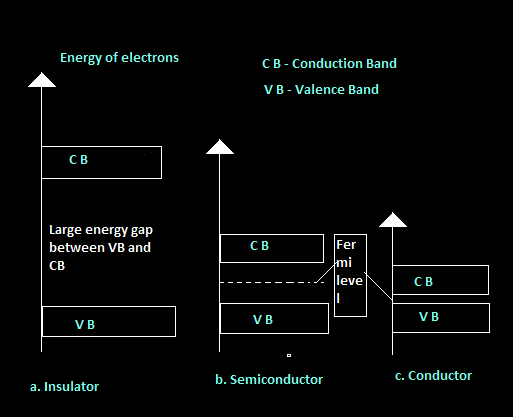
Quantum mechanics introduced a shock:
- Electrons in atoms have discrete energy levels.
- They don’t slide between them gradually.
- They jump when a precise threshold is met.
If an electron doesn’t receive enough energy to reach the next level, it doesn’t move halfway:
- It stays where it is.
- “Almost enough” is functionally “not at all.”
This quantization is everywhere in quantum physics:
- Energy levels,
- Angular momentum,
- Allowed modes in bound systems.
It’s not gradual; it’s all-or-nothing at the critical value.
When I look at Jesus as cornerstone, I see that same structure:
a non-negotiable reference condition that everything else must fit, or it doesn’t fit at all.
8.2 Cornerstone as Reference Pattern
In ancient construction, the cornerstone:
- Set the orientation of the entire building.
- Defined the angles and lines.
- If the cornerstone was off, the whole structure was off.
Christ as cornerstone, in this sense, is:
The reference pattern for any stable “building” of a life, a community, or a conscious identity.
If I map this into the communication model:
- Word / Christ is the symbol table and reference waveform.
- My life, beliefs, and identity are the structure built using that reference—or using something else.
If I build on Him:
- I shape my identity and choices to align with His pattern.
- I treat His life, teaching, and character as the standard of coherence.
If I reject Him as cornerstone:
- I am choosing another pattern as my reference—my own ego, culture, ideology, anything else.
- From the system’s perspective, I’m using the wrong codebook to build meaning and self.
That’s what I think “the builders rejected” is about:
- The “experts” in charge of building meaning and life (religious or otherwise) often ignore or discard the very pattern that actually fits reality.
Yet that pattern becomes the cornerstone whether they like it or not.
8.3 Stumbling Stone as Threshold


Then comes the hard line:
“Anyone who falls on this stone will be broken to pieces; anyone on whom it falls will be crushed.” (Matthew 21:44)
I don’t see that anymore as Jesus threatening to smash people. I see it as:
A description of what happens when a rigid, true reference pattern collides with a misaligned structure.
Think of a rigid step in a staircase:
- If you step correctly, you’re supported.
- If you misstep badly, you hit it, and your body pays the price.
The step doesn’t hate you. It’s just fixed.
Your alignment (or misalignment) determines whether it supports or injures you.
Christ as the Word—the true reference pattern of reality—is like that:
- If my identity, values, and decoding align with Him, that pattern holds me up.
- If I run into that pattern misaligned—while clinging to a contradictory pattern of my own—it collides with and breaks the false structure.
This is not arbitrary punishment. It’s the inevitable clash between:
- The actual structure of reality, and
- Whatever fantasy structure I built for myself.
The “breaking” or “crushing” is what it feels like when:
- My self-deception is confronted by truth.
- My incompatible identity patterns are forced into contact with the real cornerstone.
- My loop C0 = f(C0) discovers it has been referencing the wrong pattern and can’t sustain itself that way.
If I submit to that breaking, something new can be built.
If I resist it until the end, I’m choosing to cling to a structure that cannot survive contact with reality.
8.4 Good Deeds as Continuous, Coherence as Quantized (Discrete)

This is where the difference between moral effort and coherence becomes important.
Morally, we often think in gradients:
- “I’m getting better.”
- “I’ve done more good than bad.”
- “I’m trying hard.”
And that has real value. But in terms of quantum coherence:
- You can have a lot of good behavior and still be out of phase with the underlying pattern.
- You can be much “better” than many people, yet never lock in to the reference.
In quantum terms:
- You can pump an electron with 90% of the needed energy—and it still doesn’t move levels.
- There is a definite transition point you either cross or you don’t.
Salvation, structurally, isn’t about:
“Have I accumulated enough moral points to tip the scales?”
It’s about:
“Have I actually aligned my identity with the reference pattern (the Word), or am I still using my own?”
In practice, that looks like:
- Am I willing to let my decoder be corrected by Christ’s life, teaching, and Spirit—even when it contradicts me?
- Am I willing to let my “logic” about love, justice, power, and meaning be reshaped by Him?
- Am I willing to let Him be the cornerstone, not just one decorative stone in my personal wall?
Because structurally:
- A life built with Him as cornerstone has a shot at coherence in eternity.
- A life built around some other reference is a structure doomed to crack, because it doesn’t match reality’s foundation.
This is why I don’t think in terms of “good people go to heaven, bad people go to hell.” That sounds like a grading rubric.
I think in terms of:
- Aligned identities that can remain coherent in God’s presence, and
- Misaligned identities that will shatter when fully exposed to the real cornerstone.
The cornerstone doesn’t change. The question is whether I allow myself to be rebuilt on it, or insist on my own pattern until there’s nothing left of me that can stand.
From here, the next natural step is to get even more concrete:
using simple toy models—bit flips, depolarizing noise, quantum thresholds—to visualize how small errors accumulate, how coherence decays, and where that structural “stone of stumbling” shows up as a hard line you either stay above or fall below.
9. Toy Models of Coherence and Thresholds
I’ve been using words like noise, coherence, and threshold a lot. To make this more concrete, I want to walk through a couple of very simple models.
They are not “the equation of the soul.”
They’re just small, clean examples that show how:
- Small amounts of noise accumulate,
- Coherence slowly decays,
- And a critical line appears where a system effectively stops working.
That’s the same kind of line I have in mind when I talk about salvation as a quantum threshold event.
9.1 Bit-Flip Channel: When Errors Pile Up
Imagine the simplest possible signal:
a single bit—either 0 or 1.
Now imagine we pass that bit through a noisy channel that, at each step:
- Leaves it alone with probability (1 – p),
- Flips it (0 → 1, 1 → 0) with probability (p).
If we send the bit through one “hop” of this channel:
- Probability it’s still correct after 1 hop = (1 – p).
If we send it through k hops in a row:
- Each hop has to be correct for the final bit to be correct.
- So the probability it’s still correct after k hops is:
Pcorrect(k) = (1 – p)k
What this means in plain language:
- Even if the noise per step (p) is small,
- The chance of being right shrinks every time you pass through the channel.
- After enough steps, the bit is almost certainly wrong.
If we were to graph this:
- Horizontal axis: number of steps (k).
- Vertical axis: probability of correctness (1 – p)k.
- For any fixed (p > 0), the curve starts at 1 and slopes downward toward 0.
At some point, that probability crosses a horizontal line, a practical threshold.
For example:
- Maybe below 70% reliability, the receiver can no longer function usefully.
- Once the curve dips below 0.7, we say the system has effectively failed.
This is a tiny picture of how accumulated noise works:
- No single error seems catastrophic.
- But over a long enough path, the signal becomes unreliable.
Now map that to a human life:
- Each “step” = another decision, another habit, another interpretation.
- Each bit of unconfessed, uncorrected distortion = a little bit of noise.
- Over years, those errors compound, and the “probability that my inner decoding is right” drops.
In that sense:
Sin isn’t just “doing bad things.” It’s training your inner decoder to be less and less reliable.
At some point, without intervention, you cross a threshold where your sense of truth, goodness, and reality is so corrupted that you no longer function as a healthy receiver of anything God says.
That’s a kind of spiritual failure that looks a lot like decoherence.
9.2 Depolarizing Noise: Watching Coherence Fade
The bit-flip model deals with correctness.
Now I want a model that deals with coherence more directly.
In quantum information, a common type of noise is referred to as a depolarizing channel.
Consider a single quantum bit, or qubit, in a pure state, such as the state ∣0⟩.
A depolarizing channel operates as follows:
- With a certain probability, it leaves the state unchanged.
- With a certain probability, it “blends” the state with complete randomness.
Mathematically, if we denote the noise strength as λ (where 0≤λ≤1), the output state ρout can be expressed as:
ρout = (1 − λ)ρin + λI/2
Here:
- ρin is the initial state, which is coherent and specific.
- I/2 represents the maximally mixed state—indicating total randomness for a qubit.
As λ increases, the system transitions from a coherent state toward a more mixed state.
To quantify the coherence of the state, we use the concept of purity, defined as:
Purity(ρ)=Tr(ρ2)
For a qubit:
- A pure state (fully coherent) has a purity of 1.
- A fully mixed state (completely random) has a purity of 0.5.
Thus, as the noise strength λ varies from 0 to 1, the purity changes from 1 to 0.5.
If we plot this relationship:
- The horizontal axis represents the noise strength λ.
- The vertical axis represents the purity.
We would see a downward-sloping curve that transitions from 1 toward 0.5.
Now, if we draw a horizontal threshold line somewhere between 1 and 0.5:
- Above this line: The state retains enough coherence to be meaningful and distinguishable.
- Below this line: The state becomes too mixed and too random to maintain a distinct identity.
That’s exactly how I picture a conscious self:
- As life goes on, we are constantly hit by “noise”:
- trauma,
- sin (in the structural sense),
- bad teaching,
- self-deception,
- aimless distraction,
- stubborn resistance to correction.
- If nothing ever corrects and re-coheres us, our “purity” as a distinct identity can gradually slide downward.
- At some point, there may not be enough structure left to call what remains a stable coherent “someone.”
This is the specter behind the idea of spiritual death and eternal separation in my model:
A self that has let noise and decoherence erode its coherence below the threshold where it can still be a stable participant in the field.
9.3 Thresholds: Where the System Changes Regime
In both toy models, there’s a common pattern:
- There is a continuous variable:
- probability of correctness vs. steps,
- purity vs. noise level.
- There is a horizontal line—a critical value—where we say:
- Above: the system is effectively working.
- Below: the system is effectively failed.
This doesn’t mean reality has a literal visible line drawn somewhere. It means:
- There is a functional regime change:
- On one side, correction and recovery are still possible.
- On the other, the system is too far gone to function.
When I read things like:
- “The wages of sin is death…” (Romans 6:23)
- “The second death.” (Revelation 20:14)
- “They perish because they refused to love the truth.” (2 Thessalonians 2:10)
I hear functional regime change language:
There is a point beyond which your pattern of distortion cannot be undone—not because God runs out of charity, but because your receiver has exited the regime where correction is possible.
In that sense:
- Salvation = being held, restored, and kept in the working regime, above the coherence threshold.
- Damnation / eternal separation = crossing and remaining below and beyond that threshold, where the identity structure necessary for relationship with God no longer exists.
Again:
Not a judge throwing you away.
A system you’ve chosen to run in ways that eventually destroy its own integrability.
9.4 Why I Bother with These Models
I don’t think God is literally doing bit-flip probability math on souls.
I don’t think purity formulas show up in heaven.
I use these models because they show that:
- You can have gradual degradation leading to a discrete change in behavior.
- Tiny, repeated distortions can push a system across a hard boundary into failure.
- Above the boundary, recovery is realistic; below it, it’s practically impossible.
When I overlay that on everything the Bible says about:
- sin accumulating,
- hearts hardening,
- consciences searing,
- refusing the Spirit,
- and some final “second death,”
it starts to look like Scripture is describing the qualitative behavior of a real quantum communication system:
- one that has channels,
- patterns,
- noise,
- and failure modes.
From here, it makes more sense why the Bible puts so much emphasis on:
- aligning with the Word,
- listening to the Spirit,
- letting your “mind be renewed,”
- abiding in Christ,
- and not hardening your heart “today.”
All of that is coherence language.
The analogies get even stronger when I step into holography and DNA decoding—two domains where patterns, reference beams, and symbol tables literally make the difference between:
- meaningful image vs. random noise,
- living organism vs. dead chemistry.
10. Holography and DNA as Deep Analogies of the Word
By this point I’d already been thinking of The Word as a reference pattern, a codebook, a symbol table. But two concrete domains really locked it in for me:
- Holography
- DNA decoding
Both are pattern + reference systems. Both make no sense without a stable “word.”
Both show—very concretely—how you can have all the information sitting right there, and yet have nothing unless you use the correct reference to bring it to life.
That’s exactly how I now see Christ as the Word.
10.1 Holograms: Pattern + Reference Beam = Image


Let’s start with holography.
A hologram isn’t just a picture. It’s a physical recording of the interference pattern between two beams of light:
- You take a laser and split it into two beams.
- One beam hits the object and then reaches a photographic plate (the object beam).
- The other beam goes directly to the plate (the reference beam).
- Where they meet, they create an interference pattern—alternating bright and dark fringes that encode the relative phase information between them.
That interference pattern looks like an abstract swirl of lines and dots.
To the naked eye, it’s just… noise.
Now here’s the magic:
- To reconstruct the image, you shine the same reference beam onto that pattern.
- The light diffracts through the recorded fringes, and out pops a 3D image of the original object.
- Move your head, and the perspective changes (top/bottom and sides), just like a real object.
The key points here:
- Without the recorded pattern, the reference beam shows nothing.
- Without the reference beam, the pattern is meaningless static.
- Only pattern + correct reference together yield a coherent image.
When I first really understood that, something clicked in me at a deeper level:
Reality itself feels like an interference pattern—layered, encoded, often looking like noise—until the right reference beam hits it.
In my model:
- The Word / Christ is that reference beam.
- The Spirit is the medium (the field) in which the pattern and reference interact.
- The world is the recorded interference pattern of Source + creation.
Without the Word as reference, creation can look like chaos: random events, meaningless suffering, arbitrary outcomes.
With the Word as reference, structure appears—pattern, meaning, depth, and even personhood.
That’s how I hear:
“In him was life, and that life was the light of all mankind.
The light shines in the darkness, and the darkness has not overcome it.” (John 1:4–5)
Light, pattern, and visibility are all being tied together.
The light isn’t just illumination—it’s the kind of light that makes the pattern readable.
Christ as “the true light that gives light to everyone” (John 1:9) isn’t just moral metaphor; it sounds like:
He is the reference illumination under which the image encoded in reality actually appears.
10.2 Christ as Reference Beam of Reality
Take the hologram idea one step further:
- When you shine the wrong kind of light on a hologram—wrong wavelength, wrong angle—you don’t get a meaningful 3D image.
- You get distortions, fragments, or nothing useful.
In the same way, if I “shine” the wrong interpretive pattern on the world—wrong assumptions, wrong commitments—I get:
- Distorted views of God.
- Distorted views of myself.
- Distorted views of other people.
- Distorted views of good and evil.
Different philosophies and worldviews are like different reference beams:
- Some reveal certain aspects of the pattern.
- Some distort it.
- Some wash it out completely.
But if there actually is a single, true reference—the Logos itself—then there is one kind of “light” that makes the pattern resolve into the image it was meant to show.
That’s what I think is going on when Jesus says things like:
“Whoever has seen me has seen the Father.” (John 14:9)
or
“I am the light of the world. Whoever follows me will never walk in darkness, but will have the light of life.” (John 8:12)
In holographic language:
- If you want to see what’s really encoded in the interference pattern (reality), you need the same beam that created it in the first place.
- Christ is that beam—the Word by which all things were made and by which all things hold together.
Without that reference, you have raw data but not a readable image.
With that reference, what looked like noise becomes visible, meaningful structure.
10.3 DNA and the Codon Table: Life Needs a Word
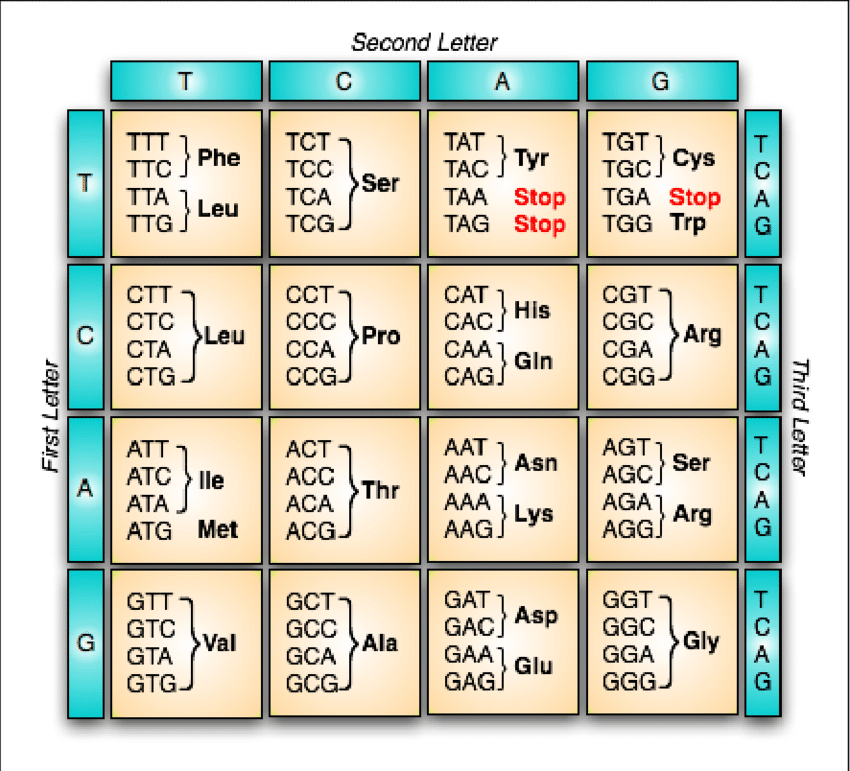


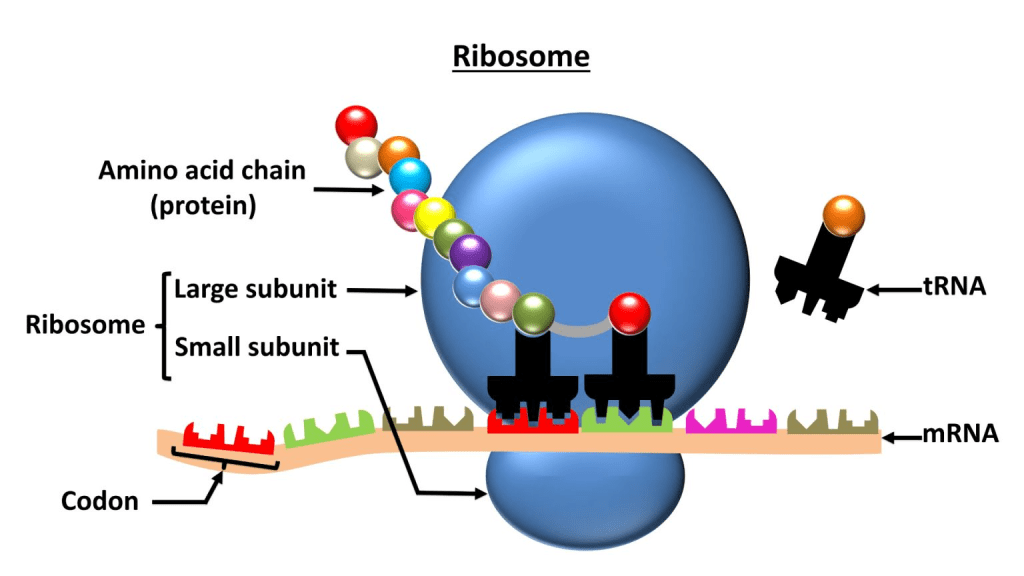
The second analogy is biological and just as powerful.
Inside every cell:
- DNA stores information using four letters: A, C, G, T (or U in RNA).
- These letters form codons—triplets like “AUG” or “CGA”.
- The codon table tells the cell what each three-letter codon means:
- AUG → Methionine (often “start” signal)
- UGA, UAA, UAG → “stop” signal
- Others map to specific amino acids.
The process:
- DNA is transcribed into RNA.
- A ribosome reads the RNA three letters at a time.
- It consults the codon table (biochemically “hard-coded” in tRNAs etc.).
- It builds a chain of amino acids (a protein) according to this mapping.
- Proteins fold into shapes and perform functions that make the cell alive.
The key here is structural:
- DNA is just a sequence of symbols without the codon table.
- The ribosome is just machinery without agreement on what “AUG” or “CGA” mean.
- Life depends on:
- Information (DNA),
- A mapping (codon table),
- A decoder-builder (ribosome).
If you randomly change the codon table in a live organism:
- You don’t just “tweak” its appearance.
- You break the mapping between its information and its form.
- You destroy its ability to build and maintain itself.
In other words:
Remove or corrupt the Word of biology, and life collapses.
When I look at that through John 1, I see a direct parallel:
- DNA is like the “raw information” of creation.
- Codon table is like the Word / Christ—the mapping that makes that information build actual structures.
- Ribosome is like any decoder—using the shared table to interpret and construct.
Without the Word, the universe’s “DNA” has no way to become a coherent, living world.
Without Christ as the Word, consciousness has no way to build a stable self out of the raw events and experiences of existence.
10.4 Mis-Decoding: Structural Death
In both holography and genetics, mis-decoding is not just a little error. It can be devastatingly fatal to structure:
- Shine the wrong reference beam on a hologram → no image, just confusing patterns.
- Use the wrong codon table in a cell → misbuilt proteins, broken function, eventually death.
Spiritually, I see this as a picture of what Scripture calls:
- being “given over” to a debased mind (Romans 1),
- “perishing” for lack of knowledge and refusal of truth,
- or “building on sand” instead of on the rock (Matthew 7:24–27).
Jesus’ parable of the wise and foolish builders is almost embarrassingly on-the-nose from a structural standpoint:
“Everyone who hears these words of mine and puts them into practice is like a wise man who built his house on the rock…
But everyone who hears these words of mine and does not put them into practice is like a foolish man who built his house on sand.” (Matthew 7:24–26)
He’s saying:
- My words (my pattern, my teaching, my life) are the structural foundation.
- If you build your identity and choices on them, you’ll stand.
- If you build on something else, you will eventually collapse under reality’s “weather.”
That’s the same logic as:
- Use the right codon table → living organism.
- Use a corrupted codon table → structural breakdown.
or
- Shine the right reference beam → true image appears.
- Shine the wrong beam → incoherent smears.
Christ as the Word:
- is the codon table of existence,
- is the reference beam of reality,
- is the cornerstone of any identity that can withstand eternity.
From there, the question becomes deeply personal for me:
- Am I living as if reality has no underlying Word—interpreting everything through my own “beam”?
- Or am I willing to submit my decoding, my building, my seeing, to this particular Pattern?
Because in this model, salvation is not “God overlooking my mistakes.”
It’s God re-anchoring my entire decoding and building process to the true Word, so that my identity becomes compatible with:
- the real pattern of the universe,
- the real reference beam,
- the real codon table of being.
That’s why the Bible’s warnings and invitations start to feel less like tribal threats and more like engineering notes on how to be a coherent someone in a Word-structured, Spirit-filled universe.
From here, the only honest thing left is to speak plainly about how this lands in my own life:
- how I frame salvation and separation in the first person,
- how I see faith, repentance, and grace in system terms,
- and what it means for me to say, “I think the Bible might actually be a user’s guide to the quantum communication system.”
11. First-Person Framing of Salvation and Separation
Everything I’ve said so far has been structural and somewhat abstract.
Let me bring it down to the personal level: what this actually means to me.
I’m not looking at “salvation” and “eternal separation” as abstract religious categories anymore. I’m looking at them as two concrete possibilities for my consciousness identity:
- Either I remain a coherent participant in a Word-structured, Spirit-filled universe,
- Or I don’t.
So I want to write this section in the most direct way I can: as I experience and interpret it.
11.1 What I Am, in This Model

In this framework, I see myself as:
- A conscious node in a vast quantum-information network.
- A self-referential process modeled by:
C0 = f(C0) - A loop of awareness, memory, interpretation, and choice that continually feeds itself back into itself.
I don’t see my “I” as a random side-effect of neurons. I see my brain as:
- A biological interface that lets this deeper process couple into the physical world,
- but the process itself—the conscious “I”—is fundamentally informational and relational.
My “I am” is not self-existing. It’s hosted:
- The Source (Father) “I AM” is the origin of any real being.
- The Word (Christ) is the pattern my being must align with to make sense.
- The Spirit is the field that carries, sustains, and connects my being to everything else.
I live, move, and have my being in that—whether I acknowledge it or not.
When I read:
“In Him we live and move and have our being.” (Acts 17:28)
I take that literally:
- My being is inside His being,
- and my identity is a fractal subprocess running inside a larger, sustaining system.
11.2 Eternal Separation as the Loss of Me
So what would it mean, in this framework, for me to face “eternal separation from God”?
Not “God sending me to a torture chamber.”
Not “God holding an eternal grudge.”
Structurally, it would mean:
- My conscious process C0 = f(C0) falls below the coherence threshold.
- My inner contradictions, distortions, and hardened refusals pile up to the point where:
- I no longer decode reality truthfully,
- I no longer respond to correction,
- I no longer have a stable core that can realign.
Add quantum information theory:
- As my pattern decoheres, information about the specific “me”—my unique correlations, my subtle structure—bleeds into the environment irreversibly.
- There is no perfect backup and no cloning of an unknown quantum state.
- The detailed structure of “me” as a unified identity is lost.
That’s what I mean when I say:
Eternal separation is not God locking a door; it’s the fact that there is no longer a me to walk through it.
The broadcast never stops:
- God doesn’t stop being love.
- God doesn’t stop radiating life.
- The Word doesn’t stop structuring reality.
- The Spirit doesn’t stop filling all things.
But if my receiver is shattered—if my tuner is ripped out and thrown into the sea—then as far as I am concerned, connection is over.
When I read verses about:
- “outer darkness,”
- “weeping and gnashing of teeth,”
- “the second death,”
I don’t picture a literal dungeon. I picture what it feels like inside as a self is being torn apart by its own uncorrected distortions, until there is no coherent center left.
That’s not something I want for my worst enemy, and certainly not for myself.
11.3 The Radio Analogy, Personally

The simplest image that keeps coming to mind is a radio.
- The station is always broadcasting.
- The music is beautiful, constant, generous.
- The signal is strong.
The radio—you, me, any conscious node—has:
- A tuner (our decoder and alignment to the Word).
- Components (neural and quantum structures).
- Power (life as long as we’re united to the Source).
As life goes on, choices matter:
- Some choices are like tuning more accurately to the station.
- Some choices are like twisting the dial randomly.
- Some choices are like pouring sand in the circuit, or taking a hammer to the board.
If I:
- Consistently tune toward the signal,
- Let the broadcast correct me,
- Let the music teach me what harmony is,
then over time my “radio” stabilizes around that frequency. It may crackle, it may drift, but it’s always being pulled back into tune.
If I:
- Consistently tune away,
- Call the music noise or evil,
- Smash components that warn me or correct me,
- Refuse all repair,
then at some point it’s not just that I’m “a little off.”
At some point, there is no working radio left.
The station never stopped.
But my ability to hear it is gone—permanently.
That’s the picture I carry of “eternal separation” now: not imposed, but real, and grounded in how systems behave.
11.4 Faith, Repentance, and Grace in System Terms
This also reframes three core words for me in a very practical way:
Faith
Faith is often defined as belief without proof. Structurally, I’d put it like this:
Faith is choosing to trust the Word as the true reference pattern, and tuning my inner decoder accordingly.
That means:
- If Christ says something about love, enemies, forgiveness, truth—I treat that as the pattern even when my instincts argue.
- I calibrate myself to His beam, not to whatever is culturally convenient or emotionally comfortable.
That’s not irrational; it’s alignment.
Repentance
Repentance gets dressed up in guilt language, but structurally it’s simple:
Repentance is re-aiming the tuner.
It’s:
- Admitting my inner decoding is off.
- Turning toward the pattern I had previously ignored or resisted.
- Letting the Word and the Spirit re-teach me what is true, good, and real.
That can be painful. It can feel like “falling on the stone and being broken” (Matthew 21:44).
But that breaking is what lets a new, coherent structure be built.
Grace
Grace, in this framework, is not God lowering the standard. It’s:
God continuously intervening to keep my identity loop from dropping below the threshold.
That includes:
- Conviction (showing me misalignment).
- Help (inner and outer) to change direction.
- Forgiveness that actually resets my state instead of simply tallying my guilt.
- A constant pull back toward coherence in Christ.
In other words, grace is God freely doing for me what I cannot do purely on my own:
keeping my receiver alive, connected, and recoverable in a universe where noise and entropy are relentless.
For me, this makes salvation both more serious and more hopeful:
- More serious, because it’s no longer about playing games with rules; it’s about the existence or non-existence of me as a coherent self.
- More hopeful, because the emphasis shifts from “Did I earn enough?” to “Will I keep letting Him re-tune, repair, and realign me to the Word?”
From here, it feels inevitable to address another layer:
how this model interacts with other people’s perspectives, critiques, and concerns—especially those who object to eternal separation, or who worry that this frame is too “cold” or “technocentric.”
12. Engaging Critics and Clarifying Intent

When I share this model publicly—salvation as a quantum threshold event in a communication universe—I get a predictable range of reactions. Some people feel like it connects dots they’ve always sensed. Others feel like it’s cold, mechanical, or dangerously technocentric. Some reject outright the idea of eternal separation.
I take those reactions seriously, because they expose blind spots in my own thinking and force me to refine what I’m actually saying.
I’ll walk through the main critiques I’ve encountered and how I respond, in my own head and heart.
12.1 “What About Universal Reconciliation?”
One recurring objection is:
“The Bible speaks of the reconciliation of all things. How can you talk about eternal separation?”
I understand this concern. Scriptures like:
- “Through him to reconcile to himself all things…” (Colossians 1:20)
- “As in Adam all die, so in Christ all will be made alive.” (1 Corinthians 15:22)
seem to point toward a universal restoration.
In my framework, I hold two things together:
- The universal reach of the broadcast
- The Source never stops sending.
- The Word is the pattern for all things.
- The Spirit fills everything.
- The real possibility that a receiver can destroy itself
- A conscious node can, over time:
- accumulate distortion,
- reject correction,
- deny the reality of the channel,
- invert good and evil,
- and bring itself below the coherence threshold.
- A conscious node can, over time:
For me, “reconciling all things” means:
- Everything that can exist coherently in Christ will be summed up in Him.
- Everything that can be brought into alignment with the Word, without destroying identity, will be.
But I don’t assume that:
- Every possible pattern of self, no matter how entrenched in rejection, remains structurally salvageable forever.
I’m open to being wrong about that. My model doesn’t force eternal separation as dogma; it simply says:
There exists a regime where a node has so destroyed its own receiver that, even in principle, restoration would require making a different self, not repairing the old one.
At that point, whatever emerges would not be “me” reconciled, but something new built from the ashes.
So when I talk about eternal separation, I’m not saying:
- “God refuses to reconcile someone He could have reconciled.”
I’m saying:
- There may be patterns of conscious refusal and distortion that erase the very structure that would make reconciliation meaningful for that someone.
If universal reconciliation is true at the deepest level, it would mean that God, in every single case, manages to reach every node before it falls irreversibly below that threshold.
I sincerely hope that’s what happens more often than not. But structurally, I can’t make it automatic without trivializing the seriousness of what Scripture calls “the second death.”
12.2 “Isn’t This Cold Mechanics, Not Spiritual Reality?”
Another concern is that this all sounds too mechanical:
“Aren’t you turning God into a machine and salvation into engineering?”
From my side, what I’m trying to do is almost the opposite:
- I’m taking spiritual language seriously enough to ask:
If it’s true, what kind of system would make it true structurally?
When the Bible says:
- “God is light” (1 John 1:5),
- “God is love” (1 John 4:8),
- “In him all things hold together” (Colossians 1:17),
- “The Spirit gives life” (John 6:63),
I’m not trying to explain those away. I’m trying to see:
- What does “light” mean in a universe where light is a quantum field?
- What does “holding together” mean in a world where coherence and entanglement are real?
- What does “life” mean if consciousness is a quantum process, not a chemical fluke?
To me, that doesn’t de-spiritualize reality; it re-spiritualizes physics.
- The system is not God.
- The system is the way God continuously relates to and sustains what He creates.
If the model feels cold at times, that might be because I’m focusing on the skeleton—the structural conditions—rather than the beauty of the flesh and blood that hangs on it:
- love,
- compassion,
- awe,
- worship,
- joy.
Those are not replaced by coherence; they require coherence to be real and not self-deceptive.
12.3 “This Sounds Too Technocentric and Dehumanizing”
Some people react viscerally when I use words like “node,” “signal,” “channel,” “system.” It feels to them like I’m turning humans into machines or reducing life to information processing.
I get that reaction. The modern world is already saturated with:
- algorithms,
- metrics,
- optimization,
- and dehumanizing systems.
Here’s where I draw a line in my own thinking.
- Humanism still matters
- Our biology, psychology, relationships, stories, and embodied experiences matter deeply.
- Calling myself a “node” in a quantum network doesn’t erase the fact that I am also:
- a mammal,
- a social being,
- a story-bearing person,
- with a nervous system, hormones, trauma, joy, creativity.
- The deeper substrate doesn’t negate the surface
- Saying a movie is encoded as bits doesn’t make the story less rich.
- Saying a painting is pigments on canvas doesn’t negate its emotional impact.
- Saying I’m a conscious pattern in a quantum-information field doesn’t negate the importance of my body, my ecosystem, or my relationships.
- Technological language is borrowed, not primary
- Radios, computers, networks, holograms, DNA—they’re not metaphors I chose because I worship tech.
- I chose them because they are clear, simple examples of pattern + channel + noise + threshold systems we already understand fairly well.
- The logic existed long before transistors.
Underneath all of it, I still believe:
- “The wild spirit of the universe,”
- the mystery of being,
- the sacredness of life,
are real.
If anything, seeing a coherent structure in the universe’s informational substrate increases my sense of awe.
12.4 “Is This Your New Dogma?”
The last thing I want is for this to sound like:
“I’ve cracked the code; everyone else is wrong.”
That’s not how I feel.
This is, very consciously for me:
- A working model.
- A way of thinking aloud about the intersection of:
- quantum mechanics,
- information theory,
- theology,
- and my own lived experience.
I fully expect:
- To be wrong in places.
- To miss aspects others will see.
- To refine or even drop certain pieces over time.
What I am convinced of is:
- The Bible is talking about real structures in how reality works.
- Quantum mechanics and information theory are uncovering real structures in how reality works.
- There is more overlap between them than either side usually admits.
So I share this model:
- not as a new creed,
- but as an invitation to critique, refine, and—if it resonates—use as a lens for deeper exploration.
The heart of it, for me, is simple:
The Word, salvation, information, and quantum thresholds might all be talking about the same thing:
how a conscious being stays real—coherent, alive, connected—in a universe that is at its core a communication system.
That brings me to the last piece I want to write: a synthesis. Not as a summary, but as a clean, straight-through articulation of what I believe this whole structure is pointing to about The Word and salvation in a quantum communication universe.
13. Final Synthesis: Is Salvation a Quantum Threshold Event?
At this point, here is what I believe, in as direct a way as I can say it.
I believe the universe is fundamentally informational:
- governed at its base not by billiard balls,
- but by patterns, fields, and probabilities.
I believe what we call the “physical world” is the visible behavior of a deeper quantum-information process.
I believe consciousness is not a side-effect of that process, but a mode of participation in it:
- a self-referential loop:
C0 = f(C0) - that can be more or less coherent,
- more or less aligned with the universe’s underlying reference pattern.
I believe the biblical language of:
- Father
- Word (Logos / Christ)
- Spirit
is, at its structural core, a description of:
- Source – origin of intent and being.
- Pattern / Word – the universal symbol table, reference waveform, codon table, cornerstone.
- Spirit / Field – the quantum coherence grid, field or medium in which all this propagates and holds together.
I believe sin is not merely breaking rules, but introducing destructive noise and phase drift into this communication process:
- distorting my encoding,
- corrupting my decoding,
- and eroding my internal coherence.
I believe forgiveness is not just God overlooking guilt; it is a hard realignment:
- a re-phase-locking of my identity loop to the Word,
- a reset of my decoder to match the real pattern,
- a restoration of coherence above a critical threshold.
I believe salvation is best understood as:
Remaining a coherent, phase-aligned conscious node in the universal quantum communication system, in union with the Source through the Word, in the Spirit, now and into eternity.
I believe eternal separation is not a divine tantrum, but the tragic outcome where:
- a conscious node, with free will and choices, destroys its own receiver,
- rejects the channel that could correct it,
- and lets decoherence run to completion until there is no someone left to restore.
The broadcast never ceases.
The Word is never withdrawn.
The Spirit fills all things.
But in that state, “I” am gone.
I believe the Bible, read through this lens, begins to look like:
- a user’s guide to staying coherent,
- a sustained call to:
- align with the Word,
- walk in the Spirit,
- submit to the Source,
- and let grace keep dragging us back above the threshold.
That’s what I mean when I say salvation is a quantum threshold event. Not a magical point total, but the real, structural difference between:
- a self that remains real and connected forever,
- and a self that, by accumulation of uncorrected distortion and rejection of the channel, eventually ceases to be a self at all.
This is not the only way to read Scripture. It is simply the way I, after years of wrestling with math, quantum mechanics, information theory, and theology, and decades of being haunted by that little imaginary symbol i, have come to see a deep connection between them.
I offer it as a map.
If it helps you navigate the terrain of faith, reality, and self, use it.
If not, let it go.
But as for me, I’m increasingly convinced:
The ancients who wrote “In the beginning was the Word…” were pointing at the same structural truth physicists and information theorists are now circling from another angle.
And that Word, in the end, is not just a pattern.
He’s a Person. Someone I can, quite literally, phase-lock to, and live.



 Bantam Joe
Leave a comment