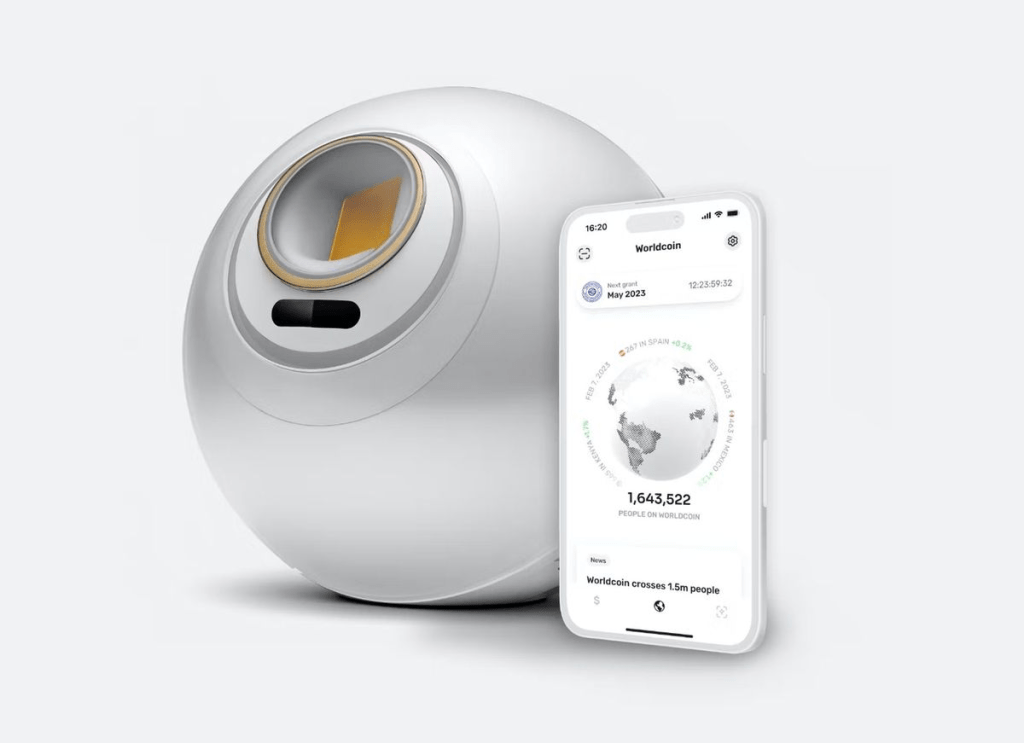


Sam Altman’s Worldcoin project, now launched in the U.S. as reported by Decrypt (https://decrypt.co/317257/sam-altmans-eyeball-scanning-crypto-project-world-hits-us), is not just a crypto initiative – it is the rollout of a global biometric identity system. At its core is the World ID, issued after scanning your iris with a device called the Orb. According to the official whitepaper (https://whitepaper.world.org), this ID is meant to act as your digital passport to financial systems, platforms, and eventually, global infrastructure.
This system is already being positioned as a prerequisite for basic participation in digital life. Once adopted at scale, it will enable AI-enforced exclusion of anyone who refuses biometric registration. Every part of your existence – income, healthcare, mobility, speech – can be made conditional on your compliance with rules embedded in code.
This is not hypothetical. It’s operational. This blog documents how World ID is being integrated with global governance frameworks (UN SDGs, ESG, WHO mandates), and how it forms the foundation for automated, borderless, real-time digital control – with no appeal and no opt-out once normalized.
This is the infrastructure for a soft, biometric totalitarianism. It must be understood now – before it becomes inescapable.
World.org, developed by Tools for Humanity, proposes a global system of biometric identification using iris scans. It introduces:
- World ID: A digital identity based on iris biometrics.
- The Orb: A device that captures iris scans to verify a person is human and unique.
- WLD Token: A cryptocurrency distributed to verified users.
- World App: A mobile wallet that stores and manages your ID and WLD tokens.
The stated goals are to prevent AI-generated identity fraud, improve fairness in digital systems, and provide access to global digital infrastructure. The system is built on Ethereum and designed to scale globally.
The System Design
- You scan your iris using the Orb.
- The system generates a hash tied to your unique biometric signature.
- You are issued a World ID that is privacy-preserving (zero-knowledge proofs).
- With that ID, you can interact with compatible services and claim WLD tokens.
The Real-World Impact
- World ID becomes a gatekeeper: Without it, you may not be able to use certain financial services, vote online, or access global platforms in the future.
- Biometric dependence: Your identity and access are tied to a biometric hash. If the system revokes your ID or finds a duplicate, you may be locked out of critical systems.
- Token-based incentives: WLD tokens incentivize participation. In the future, these could be tied to UBI, carbon credits, or access to goods and services.
The OpenAI Link
World.org frames its system as necessary because of advanced AI models. OpenAI is not “officially” part of World.org, but the whitepaper uses OpenAI-style language about “AI-safety,” “proof of human,” and “resilient identity.” The assumption is that GPT-level models will make bots indistinguishable from people, and World ID solves that by locking each real person to a biometric key.
Early Adoption = Future Dependency
While currently voluntary, the system could become necessary to access:
- Banking
- Employment platforms
- Government services
- Voting systems
- Online platforms with bot-restriction policies
This sets up a path where World ID could become mandatory through dependency, not law.
How World ID Works: Biometrics, Verification, and Global Tracking
1. The Orb
The Orb is a biometric device developed by Tools for Humanity. It scans your iris to verify two things:
- That you’re human.
- That you’re unique (no duplicate entries).
It uses multispectral imaging and runs multiple neural networks locally. Once it captures your data:
- An iris code (a unique hash) is created.
- That hash is compared against all existing hashes to ensure no duplicates.
- If verified, a World ID is issued.
No raw iris images are stored by default. Zero-knowledge proofs are used to prove uniqueness without exposing the raw biometric data.
2. World ID
Once verified, your World ID becomes your digital proof of personhood.
Key traits:
- Person-bound: Tied to your biometric signature. Can’t be sold or transferred.
- Privacy-preserving: Data is verified without revealing your identity.
- Universal: Intended to work across apps, services, and national borders.
World ID is stored and accessed via the World App.
3. Fraud Prevention and Control
To prevent abuse or fake registrations:
- Each person can register only once.
- If fraud is detected, the ID can be revoked or expired by the World Foundation.
- If a device (Orb) is compromised, IDs issued from it can be globally invalidated.
The system includes:
- Authentication mechanisms (e.g., facial recognition on your phone).
- Recovery options (backup keys, social recovery, re-issue via another Orb).
- Revocation tools (for invalid or fraudulent IDs).
4. Tracking and Centralization
Although marketed as “decentralized,” initial control is centralized:
- The World Foundation governs the protocol.
- Device provisioning, ID issuing, revocation, and security updates are centrally managed.
- Over time, the goal is to “progressively decentralize,” but this is not yet in effect.
Despite privacy safeguards, your proof of identity, access to resources, and potentially digital rights are tied to this system.
5. Integration Plans
World ID is designed to be used in:
- Financial services
- Web3 dApps
- Voting systems
- Reputation scoring
- Welfare distribution
- Health verification
This means that your ability to participate in society could increasingly depend on holding and maintaining a valid World ID.
How World ID Aligns with Global Governance: UN, ESG, WHO, and the Great Reset
1. UN Sustainable Development Goals (SDGs)
Target 16.9 of the UN SDGs calls for “legal identity for all, including birth registration, by 2030.”
- World ID fits directly into this framework by offering a digital, biometric identity.
- Unlike traditional IDs, this is global, centralized, and based on biometric proof, not citizenship or documents.
- Once adopted at scale, it can act as the de facto standard for proving personhood online and offline.
Risk: Access to services, aid, or the internet could become contingent on enrollment in this system.
2. ESG (Environmental, Social, Governance) Enforcement
- ESG frameworks increasingly pressure companies and governments to verify and score social responsibility.
- World ID enables identity verification tied to behavior (e.g. participation in governance, adherence to policies, emissions).
- The World whitepaper mentions using World ID to distribute resources and prevent fraud in welfare and aid systems.
Real-world application:
- Access to financial services may require a verified World ID.
- A company may reject unverified individuals under ESG risk reduction policies.
Result: The ID becomes a gateway to the economy. No ID = exclusion.
3. WHO Digital Health Passports and Pandemic Mandates
- The WHO and partner organizations have promoted digital health certificates for future pandemic response.
- A biometric, person-bound ID like World ID is ideal for tracking vaccine status, quarantine compliance, and movement permissions.
- World ID could be integrated into health infrastructure under emergency legal frameworks.
Danger:
- Individuals could be locked out of travel, employment, or healthcare for failing to comply with health-related mandates verified through their World ID.
4. The Great Reset and Fourth Industrial Revolution (4IR)
The Great Reset, led by the World Economic Forum (WEF), promotes a shift toward:
- Digital ID systems
- Programmable finance
- Data-driven social planning
- Fusion of digital, physical, and biological systems (4IR)
World.org’s system supports this:
- Biometric verification = biological layer
- WLD token + App = digital and financial layer
- AI-based fraud prevention + smart contracts = automated enforcement layer
This creates a framework where:
- Your identity, finances, and behavior are linked and managed algorithmically
- Compliance with global standards (climate, health, equity) can be automatically enforced
Historical parallel: It replaces physical checkpoints and paperwork with biometric gates and real-time AI enforcement.
5. Agenda 21 / Agenda 2030 / Paris Accords (Green Economy)
- The green economy includes individual carbon footprint tracking and behavioral incentives or penalties.
- With World ID, every action (travel, purchases, energy use) can be linked to a verifiable identity.
- This enables real-time carbon scoring or limits based on global environmental policies.
Risk: The system enables automated rationing or restriction of access to goods/services based on your digital profile.
Historical Precedents: What Happens When Identity Becomes a Control Mechanism
Throughout history, centralized identity systems have been used not just to organize society – but to control, suppress, and eliminate opposition. World ID follows the same pattern, only with far more advanced tools.
1. Nazi Germany – The Identity Registry and Ethnic Targeting
- The Third Reich used central registries and ID cards to track Jews, Roma, disabled people, and political opponents.
- Once identities were cataloged, exclusion from society, employment, travel, and property rights followed.
- These registries enabled deportation, forced labor, and genocide.
Key Feature: The system was legal, efficient, and based on identity classification.
2. Soviet Russia – Internal Passports and Political Surveillance
- The USSR used internal passports to monitor, restrict, and manage its population.
- Movement, jobs, housing, and rations were tied to the state-issued ID.
- Anyone without proper ID or with “undesirable” political affiliations was labeled “enemy of the state” and targeted.
Key Feature: State control over personal movement and legal existence.
3. Modern China – Social Credit + Biometric Surveillance
- China operates a social credit system combining:
- Facial recognition
- AI-based monitoring
- Digital IDs
- Individuals can be penalized for “untrustworthy” behavior: late payments, protesting, or criticizing the state.
Consequences:
- Travel bans
- Job denial
- Banking restrictions
- Internet throttling
Key Feature: Real-time punishment based on behavior, enforced algorithmically.
4. How World ID Mirrors These Systems
| Feature | Nazi Germany | Soviet Russia | China | World ID (Proposed) |
|---|---|---|---|---|
| Centralized ID registry | ✅ | ✅ | ✅ | ✅ |
| Movement control | ✅ | ✅ | ✅ | Possible |
| Economic access tied to ID | ✅ | ✅ | ✅ | Planned via WLD |
| Behavior-based penalties | ❌ | ✅ (political) | ✅ | Possible via ESG/SDG |
| AI enforcement | ❌ | ❌ | ✅ | ✅ |
| Biometric verification | ❌ | ❌ | ✅ | ✅ |
5. Why This Time is Worse
In the past:
- IDs were enforced by local governments or institutions.
- Surveillance was limited by manpower and logistics.
Now:
- AI replaces human oversight, making surveillance scalable.
- Biometrics replace passwords, making identity inescapable.
- Smart contracts replace legal systems, removing human judgment.
- Token-based economies enable programmable punishments without law enforcement.
Enforcement Without Appeal: AI Governance and Smart Contracts in World ID
World.org’s infrastructure is designed to operate with minimal human intervention. It relies on AI models, smart contracts, and biometric authentication. Once rules are set, enforcement becomes automatic. This introduces a system where actions taken against a user – revocation, restriction, denial – are irreversible, instant, and opaque.
1. Smart Contracts Enforce Policy Automatically
- World ID is managed via Ethereum-based smart contracts.
- These contracts define how:
- IDs are issued
- WLD tokens are distributed
- Recovery and revocation work
- Once deployed, smart contracts cannot be changed without new governance actions.
Result: Policy is embedded in code. If your identity or access is revoked, it happens immediately and without negotiation.
2. AI Handles Verification, Duplication, and Anomaly Detection
- The Orb uses local AI models to determine:
- Whether a user is human
- Whether the iris data matches existing users
- Whether fraud is being attempted
- The whitepaper mentions neural networks running in real-time to scan, compare, and validate identity.
Result: An AI system decides if you get to exist digitally. If it flags your scan as duplicate or invalid, you’re locked out.
3. No Human Oversight = No Appeal
- Revocations are triggered by:
- Fraud detection (false duplicates, spoofing)
- Compromised devices (e.g., hacked Orbs)
- Governance votes (if an Orb operator or network is deemed unreliable)
- There is no appeal process defined for users falsely flagged or removed.
If your ID is disabled:
- You may not be able to access your wallet (WLD tokens).
- You may lose access to any services tied to World ID.
- You will need to go find another Orb and try to re-verify – if allowed.
4. Recovery Systems Are Weak
- The system allows recovery via:
- Backup keys
- Social recovery (planned, not implemented)
- Re-issuance via a second Orb
Risks:
- If you lose your device and backup, you’re locked out.
- If your identity is compromised, you may need to prove yourself at another location.
- All recovery still depends on biometric scanning and validator trust.
5. Governance by a Foundation, Not a Nation
- Decisions are made by the World Foundation, not any elected government.
- This includes:
- Software updates
- Governance changes
- Revocation policies
Smart contracts and governance logic determine your status, access, and value in the system.
Key concern: These decisions are legally unaccountable. You have no citizenship rights in this system – only protocol permissions.
Dependency and Normalization: How Voluntary Becomes Mandatory
World.org claims that participation in the World ID system is voluntary. But history, economics, and digital infrastructure trends show that once adoption passes a certain threshold, systems like this become functionally mandatory. The pressure doesn’t come from laws – it comes from dependency.
1. Economic Lock-In via WLD Tokens
- Users receive WLD cryptocurrency only after verifying through the Orb.
- WLD is pitched as a future universal basic income (UBI) mechanism.
- If UBI or social aid programs begin to rely on this system, enrollment becomes economically necessary.
Outcome: People living in poverty or under economic pressure will feel forced to scan and comply in order to receive basic income.
2. Platform Compliance and Access Restrictions
- The whitepaper notes use cases for:
- Verifying humans on social media
- Preventing spam, bot activity, and fake accounts
- Reducing fraud in financial systems
If major platforms adopt World ID:
- You may not be able to open an account, send money, or post online without verification.
- Companies may require World ID for compliance or insurance purposes.
Outcome: Participation in online life becomes tied to biometric enrollment.
3. Government and NGO Adoption
- The system is pitched as a way to improve equity in aid distribution, reduce welfare fraud, and support global financial access.
- Governments and international NGOs (e.g. WHO, UN, WEF affiliates) may adopt it for:
- Health credentials
- Digital voting
- Travel permission
- Tax collection
Outcome: People needing assistance, mobility, or participation in governance will be forced to opt-in.
4. Social Pressure and Convenience
- “You don’t have to join” only works until others do.
- Once your peers, friends, or employer are inside the system, opting out becomes a disadvantage.
- Apps and services may offer convenience boosts for verified users.
Outcome: Users feel pressure to join just to keep up. Opting out feels like falling behind.
5. The Illusion of Choice
Voluntary systems can evolve into de facto mandates through:
- Gradual removal of alternatives (cash, paper ID, anonymous services)
- Integration with multiple sectors at once (finance, health, ID)
- Dependency on linked services (banking, jobs, transport)
This pattern has already happened with:
- Smartphone usage
- Email accounts
- Credit scores
- COVID health passports in some countries
World ID follows the same model. Once enough infrastructure is built around it, opting out means losing access.
What Happens If You Say No? Exclusion, Poverty, and Statelessness in the Digital Age
Opting out of World ID seems like a personal choice. But in a fully integrated system, opting out equals exclusion. Below are the practical consequences of rejecting biometric registration.
1. Denial of Economic Participation
- No World ID → No access to WLD tokens or any system that uses them for UBI.
- Financial institutions may begin requiring World ID for:
- Opening accounts
- Sending/receiving payments
- Crypto or digital asset access
- Digital wallets integrated with World ID could become the default standard.
Result: You cannot participate in the formal digital economy.
2. Inaccessibility of Social Services
If governments or NGOs adopt World ID to reduce fraud or streamline delivery:
- Aid, subsidies, and public health services may be linked to verified ID status.
- Without a valid World ID, systems may flag you as a duplicate, fake, or unverified.
Result: You cannot receive food aid, public housing, vaccines, or emergency funds.
3. Travel and Identification Problems
If World ID becomes a global standard for identity:
- Airlines, border control, and e-visas could begin requiring World ID.
- Without biometric proof, you may not be allowed to:
- Book tickets
- Cross borders
- Renew documentation
Result: You are geographically trapped and unable to travel legally.
4. Social and Professional Exclusion
- Some platforms may require World ID to combat bots or fake profiles.
- Employers may use it for identity verification or ESG compliance.
- Online voting, petitions, or civic actions may be gated through verified IDs.
Result: You may be excluded from professional networks, social platforms, or community decision-making.
5. Long-Term Statelessness (Digitally)
- No recognized ID = no citizenship in the digital economy.
- If biometric IDs become normalized globally, opting out leaves you with no way to prove:
- You are real
- You are eligible
- You exist
This is the digital equivalent of statelessness.
No ID → No participation → No voice → No future in connected systems.
Putting It All Together: World ID as the Infrastructure for Global Digital Control
1. Summary of Components
Let’s recap the World.org system:
| Component | Function |
|---|---|
| The Orb | Captures iris biometrics |
| World ID | Biometric-based proof of unique human |
| WLD Token | Financial incentive; possible UBI foundation |
| World App | Wallet + access point for identity and tokens |
| Smart Contracts | Automate issuance, access, and revocation |
| AI Models | Handle biometric validation and fraud detection |
| Governance | Controlled initially by the World Foundation |
All of this is promoted as voluntary, privacy-preserving, and inclusive. But in implementation, it becomes a borderless identity regime with no democratic accountability.
2. Control Without Borders
- Governments issue laws.
- World ID issues access.
In this system, your ability to function economically, socially, and politically is determined by a private foundation, enforced by AI, and mediated through biometric proof.
3. Programmable Compliance
Using World ID, access to any system – finance, mobility, services – can be:
- Granted, based on verified compliance
- Revoked, based on flagged behavior
- Modified, based on evolving global policies
Examples:
- Miss a climate target? Limited travel.
- Fail a health screening? No access to public events.
- Refuse biometric updates? Lose token eligibility.
4. No Legal Protections
- There is no nation, court, or legal structure where you can contest a denial.
- You don’t own your ID – you hold access to it under terms you didn’t set.
- Smart contracts execute instantly. No oversight. No appeals.
5. Historical Parallels, Technological Scale
Past regimes used:
- Papers
- Guards
- Borders
- Courts
This system uses:
- Biometrics
- AI detection
- Smart contracts
- Decentralized enforcement
The logic is the same. The tools are faster. The reach is global.
6. What Happens Next?
If left unchecked, this model could become the new standard for:
- Identity issuance
- Social eligibility
- Economic access
- Behavior enforcement
Tied together by:
- Global policy goals (SDGs, ESGs)
- Digital financial systems (CBDCs, tokens)
- AI-enforced governance (via models like GPT)
Final Assessment
World ID is not just an identity system. It is the foundation for a global, biometric, permission-based society.
If adopted at scale, it will eliminate:
- Anonymous interaction
- Unregulated financial activity
- Dissent without penalty
And it will replace them with:
- AI-mediated access
- Algorithmic judgment
- Biometric dependency
This is not speculation. It is openly stated in their documentation, aligned with global frameworks already underway.
Conclusion
World ID is the infrastructure of soft-totalitarianism, enforced by code, driven by data, and sealed by your iris.
You will not need to be arrested.
You will simply be off.



 Bantam Joe
Leave a reply to zrpradyer Cancel reply