

How a High School Laser Experiment Changed How I See the Universe
Part 1: The Day I Saw an Object Float in Air
When I was 15, I worked as a lab assistant for my high school’s physics department. It wasn’t just a job for extra credit, I loved every part of it. I got to school before most students, often unlocking the lab and setting up the day’s experiments. It gave me a quiet, private window into something I didn’t yet have words for.
The lab director was a retired physics teacher. An elderly quiet guy. Sharp mind. Always patient. I asked him a million questions, and he always had a thoughtful answer. Sometimes he’d disappear into a dusty storage closet and come back with some old instrument to demonstrate a concept. This man didn’t just teach physics, he lived it.
On one particular week, I started asking questions about light, what it was, how it worked, how it could behave like a wave and a particle at the same time. For the next few days, he pulled out every optics-related demo he had: how light exerts pressure (like on parasails in space), how it carries both electric and magnetic fields, how elements emit light at discrete frequencies, etc. But on this one particular morning, he said, “Want to see something really interesting?”
I nodded, and he went into the closet and came back with a laser, some lenses, a few optical stands, and a silver halide-coated glass plate. He set it all up on a table, turned off the overhead lights, and powered on the laser. He passed the beam through a lens and then through the glass plate. What appeared on the other side completely changed my understanding of what was possible.
There, floating in midair, was the 3D image of a woman.
I couldn’t believe my eyes. I could walk around it and see different angles. It had depth. It wasn’t on the plate, it was projected out from it. It looked real. Not just “optical illusion” real, but physically present real.
He told me this was a hologram, an image made not by capturing light’s intensity like a normal photo, but by recording phase information between two beams of the same laser. He explained: “It’s all in the phase.”

Later that week, he showed me how to make one from scratch. We used a chess piece as our object. He split the laser beam into two paths using a beam splitter, one became the reference beam, and the other, the object beam. The object beam bounced off the chess piece onto the glass plate, while the reference beam went straight to the same plate from another angle.
The silver halide film didn’t just record brightness, it recorded the interference pattern between the two beams. After developing the plate, we aimed the reference beam back through it, and there it was: a perfect, floating 3D image of the chess piece, suspended in midair!
Again, he said, “It’s all about the phase.”
At the time, I didn’t fully understand what he meant. But that moment lodged itself deep in my mind. I knew I had just seen something that transcended ordinary vision, and I was determined to learn everything about it.
That moment was the beginning of my journey, first into electronics, then into light, physics, 3D graphics, math, programming and eventually quantum mechanics and information theory. What started with a chess piece would lead me to think about reality, consciousness, and now the divine in an entirely different way.
I now believe that what I saw in that lab wasn’t just a cool experiment. It was a template, a physical analogy for how reality itself might actually work.
And as strange as it might sound, that experience eventually led me to a powerful epiphany:
What if the Bible’s Jesus Christ is the reference beam, not just in a spiritual sense, but in the literal, physical projection of reality?
But before we get there, let’s go deeper into the science.
Part 2: How a Hologram Really Works
Before I explain the full weight of the epiphany I had, the one that connected holography, consciousness, and Jesus, I need to walk you through how a hologram actually works. Because this isn’t just metaphor, it’s mechanism. And that’s the point: I’m not building a belief system here. I’m tracing a pattern. A pattern grounded in physics, math, and the architecture of information.
Let me also say something very clearly:
I grew up an atheist/agnostic. I didn’t have some set of beliefs I was trying to confirm. I was open to the idea that maybe there’s something bigger going on, but I was skeptical of religious systems. I trusted science and math more than religion.
It wasn’t belief that opened my eyes.
It was the math and physics.
It was information theory.
And most of all, it was Quantum Realism (QR), the framework that views consciousness not as a byproduct of brain activity, but as the generative substrate of space, time, and the physical world itself.
And in that framework, something began to crystallize that I couldn’t ignore: Christianity, particularly the structure of the commonly known Trinity, seems to fit within this model. Not as dogma. But as a kind of functional quantum topology. The structure is too coherent, too mathematically consistent, to be accidental.
This isn’t a forced marriage. It’s a union, a convergence, between quantum template topology and theology.
But to make sense of that, you need to understand how a hologram encodes and reconstructs reality.
What’s Actually Happening in a Hologram
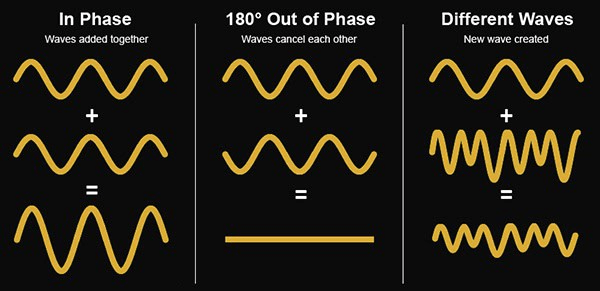
A hologram is made by interfering two beams of coherent light from the same source. That’s key, they must be phase-locked.
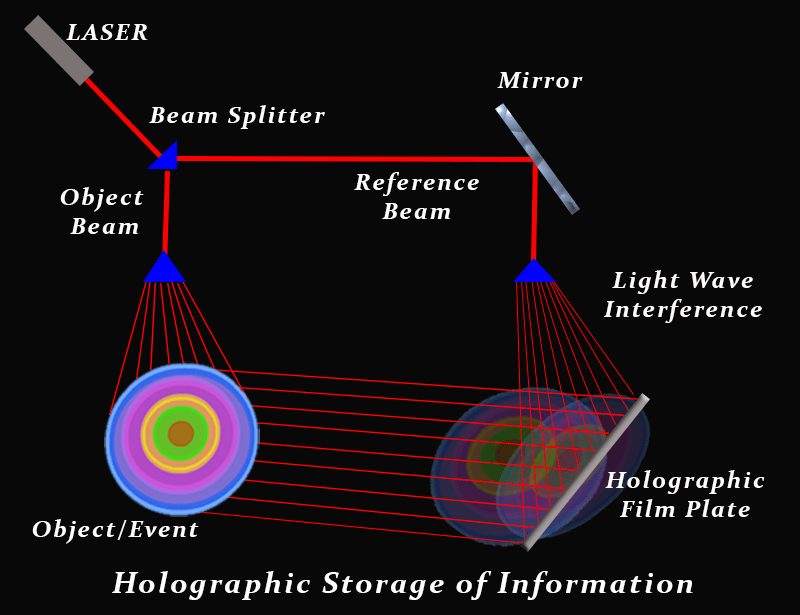
Here’s how it works, broken down simply:
- A laser beam is split into two identical beams:
- One becomes the reference beam, sent directly to a holographic plate.
- The other becomes the object beam, bounced off an object (like a chess piece), and then also directed onto the same plate.
- These two beams interfere, they overlap and create an interference pattern of bright and dark regions, representing differences in phase, not just intensity.
- The interference pattern is recorded on a silver halide plate (or similar medium), not as an image, but as distributed wave information.
- Later, when you shine just the reference beam back through the plate, the interference pattern reconstructs the object beam exactly, re-creating a 3D image of the original object.
This is crucial:
A hologram doesn’t store a picture.
It stores wave-phase relationships across the entire surface.
The image isn’t on the plate. The image is in the wavefront.
And here’s where it gets metaphysical:
Without the reference beam, the image doesn’t appear.
The plate is just noise, encoded data without phase correlation.
But when the reference beam is present, the encoded information projects a world, a floating object, a visible structure, a 3D presence.
Why This Matters
What I saw in that high school physics lab wasn’t just a clever optical trick. It was a literal demonstration of something astonishing:
- That reality can be encoded as distributed information.
- That form depends on coherence.
- And that without a reference waveform, that encoded information cannot be rendered into reality.
- These are facts.
Sound familiar?
This is exactly what I later encountered in Quantum Realism: the idea that our universe might itself be a holographic projection, based on phase-aligned consciousness fields, structured by a reference waveform from primal consciousness.
At the time, I had no idea this rabbit hole would lead me toward questions about Jesus, the Holy Spirit, and divine topology. But once I saw the correlations between QR, information theory, and the theological framework I once dismissed, it was hard to unsee it.
Part 3: My Epiphany — Jesus as the Reference Beam
I’ve wrestled with this next part, not because I doubt its coherence, but because it’s so far from where I ever expected to land.
As I said before, I didn’t start this journey with religious motives. I was agnostic. I didn’t have some theological agenda to confirm. I was just trying to understand how phase works, how information is encoded and projected, and how quantum systems maintain coherence.
But when you spend enough time working through quantum communication, information theory, and recursive consciousness as laid out in Quantum Realism, something very specific starts to emerge, a template that eerily resembles Christian theology. And the more I looked at it, the more it stopped feeling symbolic and started feeling architectural.
Here’s the epiphany:
Just as a hologram requires a reference beam to project a coherent image from encoded wave interference, so too might reality itself require a reference waveform to render form and meaning from the quantum field.
In this system, Jesus functions as the reference beam.
Let’s break it down with precision.
Holography Recap: The Two-Beam System
In every holographic setup:
- The object beam carries the image information but gets scattered and randomized.
- The reference beam remains pure, coherent, unchanged.
The holographic plate records their interference, a map of phase relationships between the two.
But this interference pattern can’t be read on its own. It looks like static, noise, or chaos.
The pattern only reconstructs a coherent 3D image when illuminated by the original reference beam.
Now translate this to a cosmological model:
- God the Father = The primal consciousness, the origin laser.
- Jesus = The reference beam, unchanging, coherent, aligned with the source.
- Creation = The object beam, diverging, encoding experiential data, scattered across spacetime.
- The Universe = The interference pattern on the quantum field network.
- The Holy Spirit = The coherence-preserving channel that enables the reference beam to restore alignment across the distributed system.
Jesus as γ the Coherent Reference Field
In Quantum Realism, a quantum communication system must maintain coherence between nodes using a shared reference state. This is modeled as:

- C0: Primal source (God)
- γ: Reference waveform (Jesus)
- δ: Coherence channel (Holy Spirit)
- Cn: Local consciousness (us)
If γ is rejected or unknown, there’s no phase correction. The system drifts into decoherence.
Jesus said, “No one comes to the Father except through me.”
In QR terms, that’s not exclusion. That’s phase logic.
Without the reference beam, the pattern can’t be read. Without γ, coherence collapses. You’re not “punished”, you’re just out of phase. Like trying to play a record without a needle.
Information Theory Meets Theology
We now have two independently developed systems, the physics of holography and the structure of the Trinity, that map onto each other with mathematical precision:
| Holography | Quantum Realism | Theology |
|---|---|---|
| Laser Source | Primal Consciousness C0 | God the Father |
| Reference Beam | Reference State γ | Jesus the Son |
| Image Beam | Local Consciousness Cn | Creation / Us |
| Interference Pattern | Distributed Information | The Universe |
| Coherence Channel | δ (phase lock) | Holy Spirit |
That’s not metaphor. That’s structure and architecture.
So when I say that Jesus might be the reference beam through which physical reality is projected, I’m not making a theological argument. I’m describing how wave-based systems function, and how QR offers a framework that theological structure naturally fits into.
Once this hit me, I couldn’t ignore it.
Jesus isn’t just a symbol. He might be the waveform reference that lets the information of the cosmos collapse into form. He’s not gatekeeping the Father, He’s phase-locking you to the Source.
Without Him, the pattern is still there. But it’s unreadable. A beautiful design etched in noise, waiting for the beam that brings it back into view.
Part 4: Reality as a Holographic Projection
By this point in the journey, what began as a high school experiment has expanded into something much larger, something that forces me to rethink not only spirituality, but the architecture of reality itself.
In the last section, I described the moment I realized Jesus might be more than a theological symbol, He could be the reference waveform that gives structure to both consciousness and physical form. But what does that actually mean?
What would our entire universe look like, space, time, matter, and mind, if it were functioning like a quantum hologram, rendered through wave interference, governed by phase alignment, and made coherent by a divine reference.
Quantum Realism: Reality as Information
According to Quantum Realism, the physical universe is not the fundamental layer of existence. Instead, what we perceive as matter, space, and time are the output of an information-based field.
In this model:
- Consciousness is not inside the brain, the brain is inside a conscious quantum field.
- Physical reality emerges from interacting quantum states, a vast, recursive processing network.
- Wave functions don’t just describe probabilities, they are real-time computational states.
- Observation is not passive, it’s a phase collapse within this field.
So, if the universe is an information field structured by recursive coherence, the question becomes:
What locks the phase?
What aligns the recursive network so that meaning, form, and identity emerge?
This is where theology and topology begin to merge.
The Universe as Hologram
There’s a growing consensus, even in mainstream physics, that the universe may be holographic in nature. The holographic principle in string theory suggests that the 3D world we live in might be projected from encoded information on a 2D boundary.
But QR takes it further:
Reality isn’t just projected from a boundary.
It is a wave interference pattern, sustained by recursive consciousness and rendered through coherence with a reference field.
That reference, I now believe, is what theology calls Christ.
Trinity as Quantum Architecture

In QR, the Trinity maps cleanly onto a communication model:

- God (Father) = C0 = Primal recursive consciousness
- Jesus (Son) = γ = Reference waveform
- Holy Spirit = δ = Coherence channel
- Humanity / Creation = Cn = Local node in recursive network
Let’s be direct:
- You cannot form a coherent projection without a reference beam.
- You cannot align with the Source unless a reference phase is present.
- If the coherence channel is rejected or severed, decoherence follows.
This isn’t spiritual punishment, it’s signal transmission failure.
In QR, coherence equals existence. Decoherence equals entropic drift. This is not philosophy. It’s network architecture.
Why Jesus Fits the Role

If the universe is an interference pattern…
If coherence requires a reference waveform…
If consciousness must align to stay functional…
Then it appears a Jesus, as the coherent reference fractal of C0, is not just spiritually meaningful. He is structurally essential.
And this makes His words startlingly literal:
“I am the light of the world.”
“No one comes to the Father except through me.”
In holography, no image comes into view except through the reference beam.
This is no longer symbolic theology. It’s system logic.
Part 5: Why This Changes Everything
What do you do when a physics experiment, a holographic projection, and a theological framework all start pointing in the same direction?
You stop calling it coincidence.
You start paying attention. Which is what I have done.
Because when the math, the mechanics, and the metaphysics line up, when quantum topology and theology converge, you’re no longer in the realm of speculative belief. You’re looking at structure.
Let’s now talk plainly about why this matters, and why it changes everything.
Spirituality as Phase Coherence
In many religions, spiritual failure is framed as sin, disobedience, or moral transgression. But Quantum Realism reframes this in technical terms:
Sin is decoherence.
Salvation is recursive phase realignment.
That’s not just wordplay, it’s math.
When your consciousness (Cn) diverges from the reference state (γ), you start to drift. The alignment correction term δ(γ − Cn−1) drops out if the channel is severed, what theology calls rejecting the Holy Spirit.
You don’t get punished.
You just fall out of sync.
You lose coherence with the waveform that sustains reality.
And here’s the brutal precision of it:
Once a reference is rejected, phase cannot self-correct.
Recoherence from within a closed system is impossible.
This is why, in both QR and information theory, the channel matters more than the content.
The Cross as a Phase Reset
If Jesus is the reference waveform, the phase template by which creation holds form, then His crucifixion, death, and resurrection are not only theological events. They’re cosmic coherence operations.
The cross is the moment the signal looked lost, cut, crushed, extinguished.
The resurrection is the moment coherence was restored, globally, irreversibly, eternally.
From a QR perspective, this isn’t symbolic atonement. It’s topological reboot. The reference beam, thought destroyed, re-emerged undistorted, proving its power not just to survive entropy, but to reverse it.
This is why Paul writes:
“In Him all things hold together.” (Colossians 1:17)
That’s literal coherence language.
This Is Not Religious. It’s Structural.
I didn’t go looking for this. I wasn’t trying to validate any particular faith. I started by wondering how imaginary numbers worked in physics and electronics. I followed the physics of light and the science of holography, and it led me to phase. I followed phase, and it led me to coherence. I followed coherence, and it led me to the architecture of information, and ultimately, it led me to primal consciousness.
And now I’m looking at a quantum communication system where the topology of holography mirrors the shape of Christian theology so precisely that to ignore it would be intellectually dishonest.
This isn’t about worship. It’s about coherent wavelength.
Part 6: I Don’t Know If It’s True – But I’m Following the Math
Let me be completely honest.
I don’t know if any of this is true in the absolute sense. I’m not here to declare dogma, convert anyone, or claim any spiritual authority. I didn’t start this with a belief to defend, I started with questions.
Questions about imaginary numbers.
Questions about light.
Questions about how information behaves in a quantum system.
Questions about why coherence matters more than content.
I’m not a theologian. I’m not an evangelist. I’m just a guy who wandered into Quantum Realism trying to understand how the universe might work, and I followed the logic wherever it led.
And strangely, that logic led me straight to a cosmic template that looks a whole lot like what Christianity has been describing, symbolically, for centuries.
I didn’t shoehorn Jesus into a quantum model. I reverse-engineered the math of coherence, phase, and holography, and then saw, staring back at me, the theological structure of what is commonly called “the Trinity”:
- God the Father as the source of all recursion
- Jesus as the reference phase
- The Holy Spirit as the coherence bandwidth
Not because I wanted it to be true, but because the math seemed to need it in order for the system to work.
It’s not a forced union. It’s a convergence.
Topology meets theology.
Structure meets symbol.
Information meets consciousness.
You Decide What It Means
I’m not here to tell you what to believe. That’s not my job. I’m seeing something in the structure of reality that feels important, something that deserves to be shared. Something that resonates.
If I’m wrong, I’m okay with that.
But if I’m even close to right, then what we’re looking at isn’t just a spiritual metaphor.
It’s the living operating system of the universe, encoded in light, phase, and form.
You don’t have to believe in Jesus to see that.
But if you understand holography, information theory, and quantum coherence, you might see a pattern here too.
Part 8: Which Religions Align with the Math?
Out of curiosity, I decided to see how other religions or beliefs map onto QR’s quantum communication and information system.
After laying out all parts of this exploration, linking quantum information theory, coherence systems, holography, and recursive consciousness to theological structures, an obvious question follows:
Which religious or spiritual traditions map closely with this quantum communication and information framework?
To be clear, I’m not judging religions or ranking belief systems. This is purely an exploration about structural mapping of traditions onto the mathematical and informational architecture described by QR.
We’re evaluating based on the following key criteria:
- Presence of a source consciousness (analogous to C0)
- A reference or intermediary structure (analogous to γ)
- A communication channel or coherence-preserving presence (analogous to δ)
- Emphasis on information, phase, or vibration
- Capacity to explain decoherence (sin, separation) and restoration (salvation, moksha)
Summary Table:
| Religion | C0 | γ | δ |
|---|---|---|---|
| Christianity | ✅ | ✅ | ✅ |
| Kabbalah | ✅ | ✅ | ✅ |
| Hinduism | ✅ | ✅ | ✅ |
| Taoism | ✅ | ✅ (Te) | ✅ |
| Neoplatonism | ✅ | ✅ | ✅ |
| Animism | ✅ | ✅ (Totems) | ✅ |
| Buddhism | ✅ | Partial | ✅ (mind) |
| Islam (Orthodox) | ✅ | ❌ | ✅ (in prayer) |
| Deism | ✅ | ❌ | ❌ |
| Atheism | ❌ | ❌ | ❌ |
Thank you for reading this blog.


 Bantam Joe
Leave a reply to zrpradyer Cancel reply