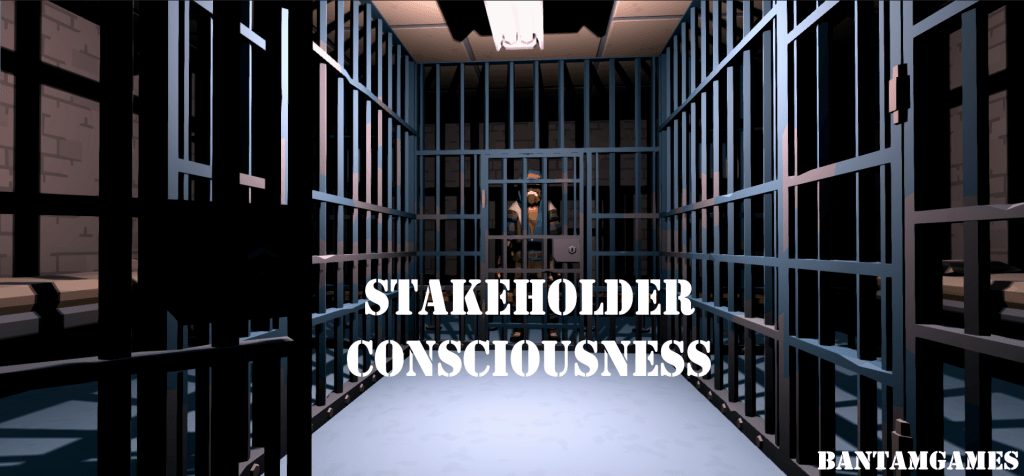


The game story I’ve been working on isn’t just a story, it’s an allegory for a future we are rapidly moving toward. Yes, It’s a hypothetical scenario, but it’s built on very real trends in governance, economics, and technology that are unfolding right now.
One of the core ideas I introduce in my game is a concept I call “Stakeholder Consciousness”. This is a term I created to represent the next evolution of collective intelligence, driven and directed by AI, where free will is gradually engineered out of existence.
Stakeholder Consciousness is what happens when collective consciousness stops being organic and becomes a structured, AI-regulated decision-making system, one where reality itself is shaped by economic, social, and political incentives (socio-tokenization) rather than by free thought and emergent chaos. It is the endgame of stakeholder capitalism, where the same governance structures used to control markets today will one day be used to control what becomes real, what is possible, and what is erased before it can exist.
This game is a warning. It’s an allegory that asks:
- What happens when free-market capitalism dies, and stakeholder capitalism takes over?
- What happens when we transition from a world where individuals create reality through free thought and action to one where AI, corporations, and networks of stakeholders collectively decide which realities are allowed to collapse into existence?
- What happens when, in the environment of brain-to-machine interfaces and quantum computing, quantum wave function collapse (the very fabric of reality) is no longer a product of personal consciousness but a consensus-driven system designed to optimize stability and efficiency?
People are walking into a digital ambush without realizing it. The systems that would allow stakeholder governance to evolve into stakeholder consciousness are already being built. And if we don’t see it now, we won’t see it when it’s too late.
In this blog, I’ll explain:
- How we are moving from free-market capitalism to stakeholder capitalism, and why this shift is not what people think it is.
- Why stakeholder capitalism is not about decentralization, but about structured control through incentives, social credit, and economic dependency.
- How blockchain-based governance, Proof-of-Stake systems, and AI-driven behavioral nudging are laying the groundwork for a reality controlled by stakeholder consensus.
- What “stakeholder consciousness“ actually means: A world where free will is just an illusion, and AI curates our perception of reality itself.
- The ultimate warning: What happens if humanity does not resist this shift?
From Free-Market Capitalism to Stakeholder Capitalism: The False Promise of Collective Decision-Making
For centuries, free-market capitalism functioned as a decentralized system of voluntary exchange. The market rewarded those who created value, met demand, and competed openly in an environment where individuals had the autonomy to choose what they bought, sold, and produced. It wasn’t perfect, but it had one defining characteristic that separated it from every system before it: it was organic and driven by choice.
That system is now dying. And it’s being replaced by something fundamentally different: stakeholder capitalism.
At first glance, stakeholder capitalism sounds like an improvement over free-market capitalism. Instead of corporations focusing solely on maximizing profits for shareholders, they now consider the interests of a broader range of “stakeholders” such as employees, governments, communities, social organizations, and even the environment. But this is where the deception begins.
Stakeholder capitalism is not a more ethical form of capitalism, it is a transition into a system where economic power is concentrated, decision-making is structured through networks of “approved” participants, and free enterprise is gradually replaced by economic governance (social credit).
In traditional free-market capitalism:
- Individuals and businesses compete freely, without centralized control over who succeeds or fails.
- Consumers decide what thrives and what dies through voluntary exchange.
- Governments play a limited role in directing the economy, beyond basic regulations and legal enforcement.
Under stakeholder capitalism, however:
- Decisions are made through collective governance models, where corporations, NGOs, and government entities dictate economic direction based on “stakeholder interests.”
- The market no longer responds to demand and innovation but instead aligns with “consensus-driven” policies and incentive structures.
- Corporations no longer compete in a free market. Instead, they operate as stewards of a globalized system where economic activity is directed toward pre-selected “social goals.”
The most dangerous part? Stakeholder capitalism is implemented through tokenized incentives, not coercion.
Governments, corporations, and AI-driven governance models don’t need to forcibly take control of the economy. Instead, they use financial incentives (tokenized rewards), regulatory pressure, ESG (Environmental, Social, Governance) compliance, and algorithmic reinforcement to gradually shift all economic activity into the stakeholder model. The free market is not outlawed, it simply stops being competitive.
And here’s where things take a darker turn: Stakeholder capitalism is not the end goal. It is a bridge. A transitional phase that sets the stage for a much deeper level of control, one that extends beyond economics and into human collective consciousness itself.
We are not just witnessing the end of free-market capitalism. We are watching the emergence of an entirely new system, one that will not only dictate what we buy and sell, but eventually, what we think and believe.
Stakeholder capitalism is not just about governance, it is the infrastructure for Stakeholder Consciousness.
The Rise of Stakeholder Consciousness: How AI, Blockchain, and Incentive Structures Will Replace Free Will
Stakeholder capitalism is not the final stage, it is a stepping stone toward something far more encompassing: stakeholder consciousness.
This is the term I created to describe a system where collective intelligence, AI, and decentralized governance mechanisms merge into a reality where free will is functionally replaced by structured, incentive-driven decision-making.
It is not a theory of metaphysical collective consciousness, where humanity evolves into a higher spiritual unity. It is the engineering of a controlled consensus system, where human behavior, perception, and even quantum probability collapse are dictated by economic and algorithmic reinforcement.
Stakeholder consciousness is the logical endpoint of AI-driven decision-making, Web3 governance models, and behavioral reinforcement through digital ecosystems. Under this system:
- Free will still exists on paper, but all decisions are nudged, conditioned, and reinforced through incentives and disincentives (stakeholder tokens).
- Economic transactions are no longer voluntary exchanges, but (smart-contract) interactions designed to reinforce system-wide objectives.
- Personal choices are gradually replaced by algorithmically curated “pathways”, you believe you are making a decision, but the system has already pre-selected the most “optimized” one for you.
- Quantum probabilities—possibilities of the future are collapsed based on stakeholder consensus rather than individual observation, meaning the range of potential realities that can emerge is curated before you even make a choice.
The Technological Foundations of Stakeholder Consciousness
For stakeholder consciousness to function, three key technological pillars must be in place:
1. AI-Driven Behavioral Nudging
Artificial intelligence is no longer just analyzing human behavior, it is actively directing it.
AI now has the capability to:
- Anticipate and preemptively influence human decisions before they are consciously made.
- Detect, suppress, and redirect ideological or behavioral deviations before they can disrupt system-wide stability.
- Optimize human incentives in real-time, adjusting rewards and punishments based on compliance with predefined objectives.
Already, AI algorithms:
- Determine which narratives are allowed on social media.
- Adjust financial creditworthiness based on “trust scores” and compliance.
- Manipulate user engagement to prioritize emotional reactions over critical thinking.
Once AI becomes fully integrated with economic and governance systems, individual free will becomes an inefficiency that must be minimized in favor of collective stability.
2. Blockchain & Proof-of-Stake (PoS) Governance
Stakeholder capitalism already operates on the economic incentive model, businesses and institutions comply with ESG regulations, policy mandates, and corporate governance frameworks in order to receive financial benefits, avoid penalties, and maintain market stability.
Blockchain-based Proof-of-Stake (PoS) governance models function in the same way, except applied to decentralized networks via tokens:
- Those with the most stake (tokens) in a system dictate decision-making outcomes.
- Decisions are weighted based on economic contribution, reputation (tokens), and past behavior.
- Dissenting choices are either ignored or gradually excluded from the system over time.
Now imagine this model being applied to reality itself.
If decision-making about governance, economics, and resource allocation is already being governed by stakeholder consensus models, what happens when the perception of reality itself is determined in the same way?
We are entering a world where:
- Truth is determined by economic weight and consensus validation rather than objective fact.
- Dissenting observations and choices are either economically disincentivized or eliminated from probability collapse.
- Only “approved” realities, curated by the highest stakeholders, are allowed to manifest.
This mimics the structure of blockchain governance, where decisions are “decentralized,” yet only those with the most stake influence outcomes.
If this system scales beyond economics and into perception, thought, and quantum reality shaping, we will have engineered a world where free will exists only within a structured illusion.
3. Gamified Social & Economic Incentives
One of the most insidious aspects of stakeholder consciousness is that it does not require force, it only requires incentives (tokenized rewards).
Through gamified behavioral reinforcement:
- Humans voluntarily align with pre-selected choices because those choices are systematically rewarded through economic, social, and psychological incentives.
- Dissenting choices are not outlawed, but they are economically and socially disadvantageous, leading individuals to self-regulate their own behavior.
- Social scoring, AI-driven nudging, and reputation-based access to resources ensure that compliance is not coerced, but is simply the most beneficial option.
This is how true free will dies, not through overt control, but through pre-selection of probabilities that reinforce systemic stability.
People will still feel free. They will still “make choices.” But every option available to them will be one that serves the structure, rather than disrupting it.
That is stakeholder consciousness, a system where reality itself becomes a controlled market, and free will is just a branding exercise.
The worst part?
Most people won’t even notice it happening.
The Collapse of Free Will: What Happens When Reality Becomes a Consensus System?
At its core, free will is the ability to choose between possibilities that have not yet been determined. It is the power to create new realities, to disrupt patterns, and to introduce something that did not previously exist.
But what happens when the very fabric of reality is structured through stakeholder consensus?
The stakeholder consciousness model, which I introduce in my game, imagines a world where reality is not shaped by individual observation alone but is instead a product of weighted, incentivized consensus, similar to how Proof-of-Stake governance models determine outcomes in blockchain systems.
In such a system:
- The collapse of quantum probabilities is no longer random or driven by personal consciousness, it is weighted based on collective consensus.
- Certain realities become more probable not because they are naturally emergent, but because they have been incentivized.
- Unapproved possibilities do not manifest, not because they are impossible, but because they have been systematically discouraged, ignored, or erased from the set of viable outcomes.
This introduces a dangerous paradox, people still feel like they are making choices, but those choices only exist within a pre-engineered set of possibilities.
Free will has not been outlawed, it has been pre-curated.
1. A World Where Only “Validated” Realities Exist
For the first time in history, technology has given us the ability to engineer not just economic and political consensus, but the very nature of reality itself.
A blockchain-based Proof-of-Stake system functions by removing transactions that are invalid or not supported by the network’s validators.
Now apply this same principle to reality-shaping:
- If consensus determines which probabilities collapse into existence, then any reality that is not widely accepted by the stakeholder system simply does not manifest.
- Dissenting thoughts, radical new ideas, and disruptive possibilities become statistical noise, “unverified transactions” in a blockchain of existence that never get added to the ledger of reality.
- History itself becomes flexible, editable, and reversible, subject to consensus validation rather than objective fact.
The unthinkable consequence?
We will have created a world where only approved versions of the past, present, and future exist.
Anything that does not align with stakeholder consensus is not banned, not censored, but simply prevented from ever becoming real.
The effect? A form of soft determinism, where free will is functionally erased without ever being explicitly removed.
2. The Death of the Unknown and the End of Creativity
One of the most great aspects of human consciousness is its ability to create the unexpected, to introduce disruptions that were never part of the original equation.
Creativity thrives in the unknown, in unpredictability, in chaos.
But in a system where reality is optimized, reinforced, and stabilized through stakeholder consensus, true creativity will no longer be possible.
- Only “viable” innovations will receive economic, social validation and rewards.
- Only certain “useful” forms of artistic and scientific progress will be incentivized.
- Ideas that do not fit within the incentivized framework will be ignored, rendered statistically irrelevant, or simply not considered in the first place, never making it onto the ledger.
In other words, the unexpected will cease to exist.
- No paradigm shifts.
- No disruptions to the system.
- No true freedom of thought, only a menu of acceptable variations within a curated framework.
Humanity, which has thrived on disrupting patterns and redefining reality, will become a managed, self-optimizing system that no longer needs to evolve, because every evolution will have already been pre-determined.
3. The New Digital Prison: A Reality Where Resistance is Impossible
The most disturbing aspect of stakeholder consciousness is that there will be no need for traditional authoritarian control.
In past dystopian systems:
- Tyrants and governments had to use force, coercion, and violence to suppress free will.
- People knew they were being controlled and often resisted.
But in a world where:
- Every thought, choice, and behavior, tracked and monitored, is economically, socially, and digitally incentivized…
- Where every possibility that disrupts the system simply fails to collapse into existence…
- Where quantum probabilities that challenge the structure never manifest…
There will be no need for force.
People will comply voluntarily.
They will believe they are free.
They will never even realize what has been lost.
And that is the final trap.
That is the true horror of a stakeholder consciousness system.
A world where resistance is not crushed, but never even conceived.
The Final Warning: If Humanity Does Not Resist, This Will Be Our Future
If we do not stop this transition, if we allow stakeholder capitalism to evolve into stakeholder consciousness, we will enter a world where:
- Reality is no longer a free-flowing, emergent process: it is a structured, pre-approved system of controlled possibilities.
- Free will is reduced to an illusion: people will feel like they are making choices, but those choices will only exist within a menu curated by AI-driven governance.
- Dissent will not be punished: it will be economically and socially disincentivized until it fades into irrelevance.
- History, science, and identity itself will be flexible, rewritten based on collective consensus rather than objective truth.
- The unpredictable, the very thing that drives evolution, progress, and meaning, will cease to exist.
This is not speculation. The technological and economic structures to make this a reality are already being built.
We are entering a new digital era where incentives will be stronger than coercion, and participation will be voluntary, but not optional.
Most people will never realize what is happening.
Most will embrace the system, believing they are creating a better world.
But in doing so, they will sign away their autonomy, their creativity, and their very ability to choose a future outside of the system.
Stakeholder Consciousness is the final form of control, a system where people willingly shape their own digital prison, believing they are building a utopia.
If humanity does not resist now, we will not be able to resist later.
Because by then, resistance will not even be a possibility.
The Last True Choice
We are standing at the edge of a future where free will either continues to exist or becomes obsolete.
- If we do nothing, the world of stakeholder consciousness will emerge seamlessly, and permanently.
- If we push back, if we reject governance by incentives, demand the protection of free will, and resist the consolidation of decision-making power into AI-driven systems, then we still have a chance.
But the window is closing fast.
This is the last true choice we will ever make.
Because if we allow this system to become reality, the next choice won’t be ours to make at all.
This is why I wrote my game.
To show people where this road leads before it’s too late to turn back.
Because if we don’t see it now, then this story ends.

 Bantam Joe
Leave a reply to zrpradyer Cancel reply