Science and Spirituality: the Same Reality

Why should science be confined to what is measurable and predictable when reality itself often defies such neat categorization? The universe presents countless mysteries and effects without solid causes, phenomena that challenge logic, and experiences that transcend the physical. To fully understand existence, it’s time that science embraces both the material and the immaterial, recognizing spirituality as a vital complement to empirical inquiry.

Science Should Embrace the Immaterial

Science, at its heart, seeks to understand reality in all its dimensions. But reality is not solely defined by what we can touch, measure, or predict. Consciousness, intuition, and spiritual experiences are intrinsic to the human condition and influence how we perceive the world. Excluding these elements ignores a significant part of existence. By integrating spirituality, science can explore phenomena that lie beyond physical measurement, unlocking deeper truths about reality.

Unexplainable Effects in Quantum Mechanics

Modern science already struggles with phenomena that defy material explanations. Quantum mechanics, in particular, has revealed mysteries that blur the line between the physical and the immaterial:

  1. Wave-Particle Duality: Particles like electrons and photons behave as both waves and particles depending on observation, challenging the idea that objects have fixed properties independent of perception.
  2. Quantum Entanglement: Two particles, no matter how far apart, can instantly influence each other, defying the speed of light and suggesting a deep interconnection in the universe.
  3. The Observer Effect: The outcome of quantum experiments depends on whether we observe the particles, implying that consciousness itself might influence physical reality.
  4. Quantum Superposition: Particles exist in multiple states simultaneously until observed, as famously illustrated by Schrödinger’s cat, which is both alive and dead until someone looks.
  5. Quantum Tunneling: Particles inexplicably pass through energy barriers that classical physics says they shouldn’t, highlighting the universe’s capacity for phenomena beyond deterministic laws.
  6. Creation from Nothing: The universe itself, as described by the Big Bang, emerged from a singularity, seemingly “nothing”, with no clear material cause.

These mysteries challenge materialist assumptions and suggest that deeper, immaterial principles might underpin reality. They open the door for spiritual perspectives to contribute meaningful insights into the nature of existence.

Spirituality and Science as Partners

Spirituality explores the unseen dimensions of existence, that is consciousness, interconnectedness, and the purpose of life. These ideas often align with cutting-edge science, such as quantum mechanics’ focus on the role of the observer and the interconnected quantum field. spirituality reminds us that reality is not merely mechanical but a dynamic interplay between the seen and unseen. Together, science and spirituality could form a holistic framework for understanding existence.

Predictability Is Not Essential

The insistence on predictability in science limits our understanding of a universe that is inherently unpredictable. Quantum mechanics has already shown us that uncertainty is fundamental to reality, and even necessary for evolution of systems. Not everything follows strict cause-and-effect relationships, and chaos, randomness, and creativity are integral parts of existence. Embracing unpredictability allows science to explore the dynamic, ever-changing nature of reality with greater flexibility and openness.

Maybe It’s Time for a New Approach

Science, for all its achievements, seems to have reached a dead end in explaining some of the universe’s greatest mysteries. Despite its incredible success in describing the material world, it has struggled to answer fundamental questions: What is consciousness? How did life emerge? What drives creation?

Maybe it’s time for science to start exploring spirituality as a serious field of study. Maybe it’s time for science to embrace the possibility that consciousness is not just a byproduct of matter but the primal driver of creation and life itself. By integrating spirituality, science could expand its horizons, break through its current limits, and open the door to transformative discoveries that benefit both science and humanity.

A Unified Path Forward

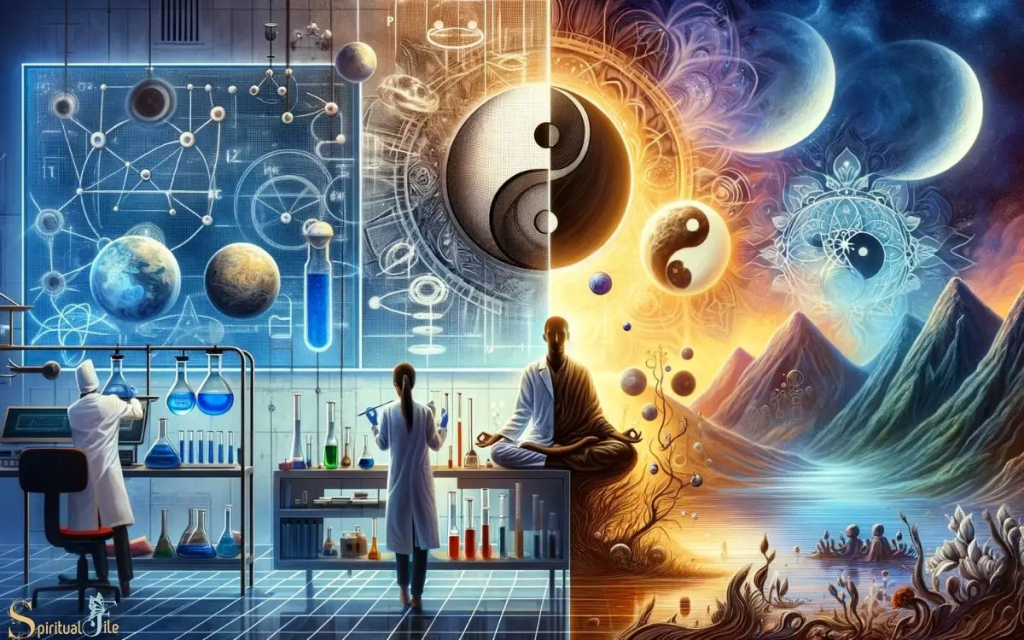
Science and spirituality are not opposites, but instead, they are complementary. Science excels at measuring and analyzing, while spirituality offers insights into the immaterial and experiential. Together, they can bridge the gap between the physical and the non-physical, recognizing that the universe operates on levels far beyond our current understanding.

By embracing this unified approach, science would not lose its rigor but gain a new dimension. It would acknowledge that the universe is not merely a machine but a profoundly interconnected and conscious reality. This perspective could lead to breakthroughs not just in understanding reality but in how we live and thrive as a species. It’s time to let science and spirituality work together to unlock the full potential of human knowledge and experience.

6 responses to “Science and Spirituality: the Same Reality”

  1. Embrace the “woo-woo” Joseph. : )

    You’ve probaby heard me mention John Fetzer in my talks. I think you might appreciate his background in radio signals. https://www.youtube.com/watch?v=X7qk4WE4ePs
    He often visited Camp Chesterfield, a spiritualist community in Indiana. https://www.youtube.com/watch?v=ERhmbJVEEN4

    Liked by 1 person

  2. The simplest answer is that we are living in a simulation. https://rumble.com/v68mzxm-377306986.html?e9s=src_v1_uppSent from my Galaxy

    Like

    1. Yes, we are living in a natural quantum generated virtual reality, where we still have free choice, given to us by a self-referential primal consciousness. So yes, we are in a sense, living in a living simulation, one that is alive and where we are co-creators.

      Like

    2. I appreciate exploring your theory but you’ve never provided any proof that free will isn’t merely a predetermined choice architecture construct within the Simulation. Those feelings of free will and consciousness are likely predetermined within the programming of our digital twins. Nonlocality and quantum entanglement make sense because everything is one within the Simulation as like bits and bytes in the same computer system. I see it as our consciousness playing a VR game but in which our memory has been wiped. My own reality has become so utterly ridiculous and implausible that I can no longer see life as organic. Like many, I have suffered tremendous losses because of my whistle-blowing during the FAKE pandemic.It’s kind of like the movie, Total Recall where you (or the AI) can pick your favorite body type (“athletic”) and also your Jungian archetypes (hero, martyr) which also fit within game theory. Of course, we have no memory of these established parameters. Some of us (unvaxxed, untested) have been experiencing frequent coincidences/synchronicitiesthat are most easily explained by the nanotechnology biosensors in everything which connect us to the Internet of Bio-Nano Things. (Eg. Random books and the environment behaving like AI and providing personal answers.) It’s like our “reality” is a predetermined ocean wave and we are merely surfing it within a limited choice architecture of possible outcomes….but we cannot change the wave. The outcome is entirely predetermined but unknown to the agents (us.)We could just be brains in a vat experiencing electrical signals. This manufactured reality which has been shown to be a hologram contains matter which doesn’t even exist at the molecular level. It seems likely that many previous generations (Plato?Hammurabi?) have been born into the Simulation and that much history is false. The prescient research generously provided to us by Alison McDowell exposes and explains in great detail the sprawling and complex apparatus that enables our digital panopticon. How can free will possibly exist within such a vast global digital prison which accesses and monetizes us at the molecular level? We must also consider optogenetics. What if the Covid-19 military operation and Biodigital Convergence have happened in order to reveal that we live in a Simulation?Those with an optimistic spin on our privacy-eviscerated and quorum-sensing predicament haven’t yet been “shorted” by the Web3, parametric insurance, SMART contract, impact investment boot of the state and its public-private partners stamping on your face for eternity. Thanks for your content, Joe.AngieSent from my Galaxy

      Like

    3. Hi Angie,
      Thank you for the thought out response. I hope I can do it justice in response.

      In order to substantively prove that free will isn’t merely a predetermined choice architecture construct within a simulated reality, let’s look at the evidence that demonstrates the non-deterministic nature of reality and the participatory role of consciousness. Here’s the argument:

      1. Quantum Mechanics: Reality Is Fundamentally Probabilistic, Not Deterministic

      At the heart of quantum mechanics lies the wave function, which describes the state of a quantum system as a superposition of possibilities. When measured or observed, the wave function collapses into a single outcome. This collapse isn’t deterministic, it’s probabilistic.

      Evidence:
      – The Double-Slit Experiment: When particles like electrons are sent through two slits, they form an interference pattern (like a wave) if unobserved. But when observed, they behave like particles, choosing one path. The act of observation changes the outcome.
      – Delayed-Choice Experiments: These experiments show that a decision made after a particle has already passed through the slits retroactively affects how it behaved, as though the future decision “rewrites” the past. This behavior is incompatible with a fixed, preprogrammed architecture.

      If reality were preprogrammed, the outcomes of these experiments would be fixed, predetermined by the “simulation’s code.” Instead, quantum systems remain in superposition until observed, meaning outcomes are decided in real time and are influenced by the observer’s choices.

      2. Consciousness Plays an Active Role in Reality

      Quantum Realism states that consciousness is fundamental to the nature of reality. The observer effect in quantum mechanics suggests that consciousness actively participates in the collapse of the wave function, influencing which potential outcome becomes real.

      Consciousness is not just a passive byproduct; it has a causal role in shaping reality. If reality were predetermined, this influence wouldn’t exist. The observer would merely “see” the preprogrammed results. Instead, observation itself determines the outcome.

      3. Nonlocality and Entanglement Prove Interconnected, Not Preprogrammed, Reality

      Quantum entanglement shows that two particles can share a state instantaneously, regardless of distance. Measuring one particle affects the other, but the specific outcomes of measurements are random and unpredictable.

      If reality were a simulation, entanglement would require a fixed script to dictate the outcomes of measurements. However, entangled particles don’t behave according to fixed rules, they follow quantum probabilities. Their behavior suggests a dynamic, interconnected system rather than a rigid, programmed structure.

      4. The Impossibility of Encoding Infinite Possibilities
      A simulation, by definition, operates within finite constraints: it requires pre-written code, finite resources, and deterministic algorithms to simulate outcomes. Reality, however, operates on infinite possibilities.

      Evidence:
      – Quantum Randomness: Events like radioactive decay or vacuum fluctuations occur with no determinable cause. They aren’t the result of a programmed pattern, they’re fundamentally random.
      – Complexity Beyond Calculation: The universe exhibits emergent phenomena that arise from countless variables interacting dynamically. Simulating such complexity in a preprogrammed system would require infinite resources, which is impossible.

      5. Free Will Demonstrated Through Choice and Indeterminacy

      The notion of free will aligns with the indeterminacy observed in quantum mechanics and the active role of consciousness. Even in classical systems influenced by quantum processes, outcomes often depend on the interplay of probabilities and external factors.

      Proponents of the simulation theory argue that free will is an illusion, a preprogrammed feeling. However:
      – If free will were preprogrammed, our choices and experiences would align perfectly with deterministic outcomes. Instead, choices often diverge unpredictably from deterministic models, as shown in human creativity and decision-making under uncertainty.
      – The neural correlates of free will show that decision-making involves a mix of conscious intent and spontaneous neural activity, consistent with a system influenced by quantum uncertainty, not deterministic programming.

      6. Synchronicity and Coherence Are Emergent, Not Programmed

      Synchronicities and meaningful patterns in reality emerge naturally from the interconnectedness of the quantum field. They aren’t evidence of programming but of a system where localized events influence the whole in non-deterministic ways.

      Reality Is Participatory, Not Preprogrammed

      The evidence from quantum mechanics, consciousness, and the nature of emergent phenomena demonstrates that reality is not a deterministic construct. Instead, it is participatory, shaped dynamically by the interplay between consciousness and the quantum field.

      Free will is real because:
      1. Outcomes in quantum systems depend on observation, not preprogramming.
      2. Consciousness actively shapes reality rather than passively experiencing it.
      3. The randomness and infinite possibilities of quantum processes make preprogramming impossible.

      Reality is not a rigid simulation. It is a living, evolving construct where free will is an intrinsic feature, arising from the same foundational processes that create the universe itself.

      I hope this removes some of the misconceptions of quantum realism and highlights the faults of a physical simulated universe. Yes, we do live in a virtual simulated universe, but it is natural, created by a consciousness that predates space, time, matter and energy.

      Like

  3. Truth and “Reality” in my opinion, is akin to the dance between the Sun and Moon, Earth, of course, representing our non-static perception and self-awareness of that which we observe and experience. The only thing I have ever found that has a multimillion-year case study in consistency… Is our Moon, which I personify as truth, this not to say that one cannot be convinced of something untrue, like it is made cheese or something ridiculous, but rather the cyclical nature of our strange and mysteriously unique spherical neighborhood. Great piece! Keep em comin’

    Liked by 1 person

Leave a reply to The Realitologist Cancel reply

Hey!

I’m BantamJoe. Discover the machinations of the New World Order – your go-to source for tech information regarding the dangers of technology under the control of the ruling class. And, follow the video game development depicting these dangers.

Join the club

Stay updated with the latest post/blog postings.