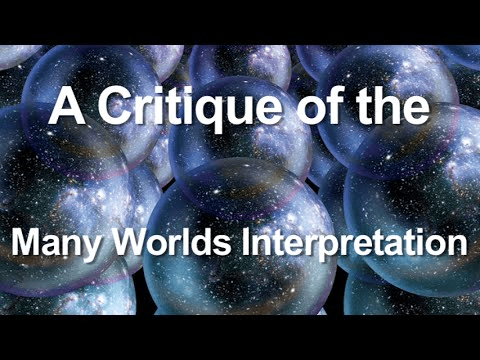


A Critique of the Many-Worlds Interpretation (MWI)
The Many-Worlds Interpretation (MWI) is a theory that tries to explain quantum mechanics. It says that every time something happens, like flipping a coin, the universe splits. In one version, the coin lands on heads; in another, it lands on tails. This creates an endless number of universes, one for every single possible outcome of every single particle in the universe, continuously. While the idea is fascinating, MWI has several major problems when we think about consciousness, free will, and the meaning of our choices.
Below is a critique of the MWI and why I don’t subscribe to it.
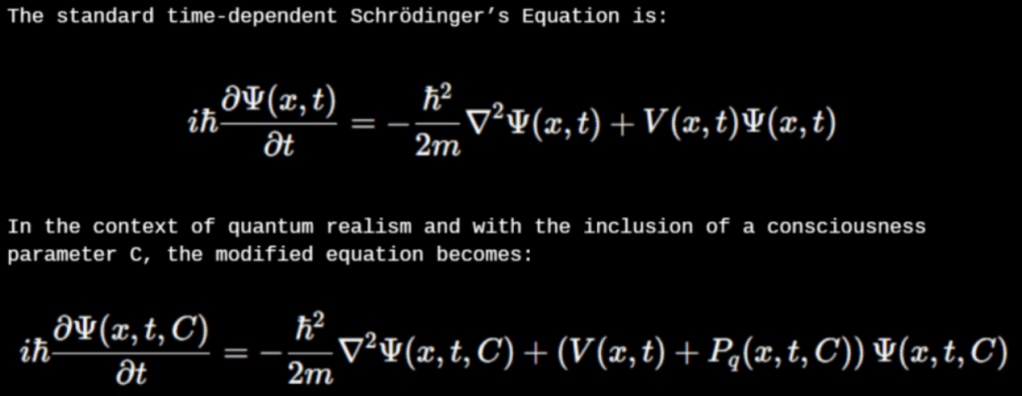
(NOTE: The equations shown above show Schrödinger‘s equation as used in the MWI without consciousness playing a factor, and modified to include consciousness. You can read more about its derivation and explanation in one of my previous blogs: https://bantamjoe.com/2024/10/16/consciousness-schrodinger-equation/)
1. MWI Removes Free Will
MWI says that everything you do happens in one branch of the universe or another. For example, if you choose between tea and coffee, there’s a branch where you pick tea and another where you pick coffee. This makes your choices meaningless because every possibility plays out anyway. It suggests that your decisions don’t truly matter.
- The Problem: Free will is essential to how we understand ourselves. We believe our choices shape who we are and change the future. If MWI is true, everything is already predetermined, and there’s no real agency in what we do.
- A Better Approach (Quantum Realism): Quantum Realism (QR) says that free will is real and fundamental. It argues that consciousness is deeply connected to the universe and that your choices directly influence what happens. This makes your decisions meaningful.
2. MWI Ignores Consciousness
MWI is based on the Schrödinger equation, which describes how quantum systems behave. However, this equation doesn’t include consciousness at all, providing directional weight. MWI treats observers as mechanical systems, with no explanation for why or how we experience things like thoughts or awareness.
- The Problem: Consciousness is central to human life. If a theory ignores it, it feels incomplete. MWI provides no explanation for what it means to “observe” something or why we have a sense of self.
- A Better Approach (QR): QR makes consciousness the foundation of reality. It sees consciousness as a primary part of the universe, not just a byproduct of physical processes (as shown above in the modified version of the Schrödinger equation which includes consciousness). In QR, the universe is a quantum virtual construct, and consciousness is the observer experiencing it.
3. MWI Implies Life is Predetermined
MWI assumes that all possible outcomes of every decision already exist. This means life is like a tree, where every branch is already in place. You’re not actually creating new paths (branches) or making changes, you’re just following along one pre-existing route.
- The Problem: This view removes any sense of growth or learning. If every version of you already exists somewhere, it doesn’t matter if you improve yourself or make better choices. There’s always another version of you that did the opposite.
- A Better Approach (QR): QR says that life is about learning and evolving. In QR, consciousness interacts with the universe to grow and gain understanding. This makes personal growth and experience real and meaningful.
4. MWI Adds Too Much Complexity
MWI requires an infinite number of universes to explain quantum events. Every time something happens, the universe splits into countless branches. These branches don’t interact or affect each other, and we have no way to see or measure them.
- The Problem: Adding so many invisible and untestable universes feels grossly excessive. Science often prefers simpler explanations, and MWI seems unnecessarily complex for what it tries to solve.
- A Better Approach (QR): QR doesn’t need infinite universes. It explains reality as one interconnected quantum field, where everything is linked. This makes QR simpler and more elegant.
5. MWI Misses What Makes Life Meaningful
MWI reduces people to physical systems that split endlessly into copies. It doesn’t explain individuality or the sense of being “you.” If there are infinite versions of you, does your life really matter? What does it even mean to be unique?
- The Problem: A theory that ignores individuality and personal experience feels incomplete. MWI describes a cold, mechanical universe where human life and identity seem unimportant.
- A Better Approach (QR): QR emphasizes consciousness and individuality. It says that each person’s experience contributes to the evolution of the universe. In QR, your actions, thoughts, and growth have real meaning.
6. MWI is Stuck in Old Thinking
MWI relies on the idea of a deterministic universe, where everything unfolds like a machine. This idea comes from old classical physics, where scientists believed the universe worked like clockwork. But modern quantum mechanics shows us a universe full of uncertainty, probability, and observer effects.
- The Problem: MWI tries to explain a quantum world using outdated ideas. It forces the strange, flexible nature of quantum mechanics into a rigid, deterministic framework.
- A Better Approach (QR): QR embraces the uncertainty and interconnectedness of quantum mechanics. It recognizes that the universe isn’t a fixed machine but a dynamic system influenced by consciousness.
The Many-Worlds Interpretation is an interesting theory, but it has serious flaws. It ignores free will, consciousness, and the importance of individuality. It creates an overly complicated picture of reality without adding real understanding. Quantum Realism offers a more balanced approach, one that includes consciousness, free will, and growth as central parts of existence. It gives us a universe where our choices and experiences truly matter.
Here is a table summarizing the critique of the Many-Worlds Interpretation (MWI) and comparing it to Quantum Realism (QR):
| Aspect | MWI (Many-Worlds Interpretation) | QR (Quantum Realism) |
|---|---|---|
| Free Will | MWI implies all possible outcomes happen in different universes, making choices irrelevant and predetermined. | QR sees free will as fundamental, with choices shaping reality through interactions with the quantum field. |
| Consciousness | MWI ignores consciousness, treating observers as mechanical systems entangled with the environment. | QR makes consciousness central, proposing it as the foundation of reality and an active participant in the universe. |
| Life and Growth | Life is predetermined, as every possible version of “you” exists across infinite branches. | Life is dynamic, with consciousness evolving, learning, and growing through interaction with the quantum field. |
| Complexity | Requires infinite universes for every quantum event, leading to ontological inflation and unverifiable claims. | Explains reality with a single interconnected quantum field, avoiding the need for extra universes. |
| Individuality | Reduces people to physical systems endlessly splitting into copies, undermining uniqueness and identity. | Emphasizes individuality and personal experience as meaningful contributions to the universe’s evolution. |
| Determinism | Clings to a deterministic, clockwork universe model based on outdated physics. | Embraces quantum uncertainty and the dynamic, interactive nature of the quantum field. |
| Testability | Other universes are non-interacting and unobservable, making MWI impossible to test scientifically. | While QR has speculative elements, its focus on consciousness and quantum networks provides potential avenues for indirect testing. |
| Philosophical View | A mechanical, impersonal universe where human experience and morality are trivialized. | A purposeful, interconnected reality where consciousness and morality are significant. |
This table highlights why MWI struggles to account for the deeper aspects of existence. QR, in contrast, offers a holistic framework that integrates consciousness, free will, and individuality.
The MWI should be relegated to science fiction. As my friend Dr. Saeed Qureshi often states, this is “Bad Science (BS)” and should be dismissed as fake science.
I give great gratitude to Alison McDowell for bringing up this topic in one of our conversations regarding consciousness, and allowing me to give my critique.




 Bantam Joe
Leave a comment