

A Brain Tutorial: Quantum Realism and Consciousness
This tutorial will explore the human brain, consciousness, and how these are understood within the framework of Quantum Realism (QR). We’ll start from the micro-level (microtubules) and work up to neurons, brain regions, collective brain activity and brainwaves. We’ll conclude with experimental possibilities and organizations researching consciousness.
LET’S BEGIN!
Chapter 1: Microtubules and Quantum Coherence
In this chapter, we will explore microtubules, which play a fundamental role in neuron function and have been proposed as candidates for quantum processing in consciousness. We’ll connect this to quantum coherence, a key concept in Quantum Realism (QR). Mathematics will be used to illustrate how quantum effects might arise within microtubules and contribute to consciousness.
1.1. Microtubules: Structure and Function


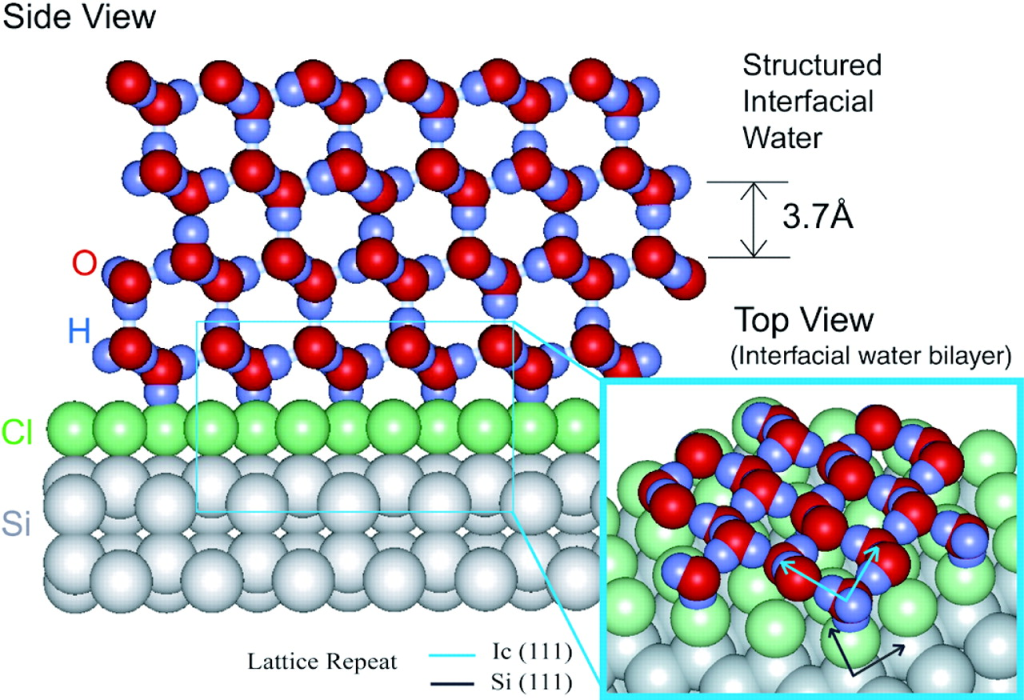
Microtubules are cylindrical protein polymers made from tubulin dimers, which assemble into hollow tubes about 25 nm in diameter. They form part of the cytoskeleton of neurons, giving structure to cells and serving as tracks for intracellular transport.
- Tubulin Dimers: Each tubulin dimer can exist in two conformations: an active and inactive state. These states can be thought of as classical bits (0 and 1), but within the framework of QR, these states may represent quantum bits (qubits), capable of existing in superpositions.
Mathematically, a single tubulin dimer might be described by a quantum state ψ, which can be a superposition of two possible states:

where α and β are complex probability amplitudes, with |α|2 and |β|2 representing the probabilities of the dimer being in states ∣0⟩ (inactive) or ∣1⟩ (active). The normalization condition is:
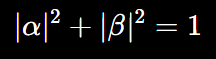
This equation forms the foundation of how microtubules in neurons might participate in quantum processing.
1.2. Quantum Coherence in Microtubules
Quantum coherence refers to the maintenance of superposition states across different quantum systems. For microtubules to participate in consciousness, as proposed by Penrose and Hameroff’s Orch OR theory, they must maintain quantum coherence for a significant period.
Microtubules can exhibit coherence due to their highly ordered structure and the potential for quantum interactions between tubulin dimers. Coherence ensures that the states of different tubulin dimers become entangled, allowing them to function as a collective quantum computer system rather than independent classical elements.
- Quantum Entanglement: If two tubulin dimers are entangled, their combined quantum state cannot be written as a product of their individual states. Instead, we have an entangled state:

Here, the states of the two dimers are correlated: if one is found in the state ∣0⟩, the other must also be in ∣0⟩, and the same for ∣1⟩. This entanglement may extend over large networks of microtubules within neurons, allowing for quantum computations to occur at a macroscopic level.
In the Quantum Realism framework, the coherence and entanglement between microtubules would be part of a broader quantum network that integrates information across the brain. Each microtubule can act as a node in this network, where quantum information is processed.
1.3. Quantum States in Microtubules: Schrödinger’s Equation
The evolution of quantum states in microtubules can be modeled by Schrödinger’s equation, a fundamental equation in quantum mechanics that governs how quantum systems evolve over time:

Here, i is the imaginary unit, ℏ is the reduced Planck constant, ψ(t) is the wave function describing the state of the microtubule over time, and H is the Hamiltonian, which represents the total energy of the system.
In the case of microtubules, the Hamiltonian could include terms related to:
- The internal energy of the tubulin dimers,
- The interaction energy between neighboring dimers, which promotes entanglement,
- The external environment, which might cause decoherence (loss of quantum coherence).
The ability of microtubules to maintain coherence is crucial for their role in QR’s interpretation of consciousness. If the coherence time is long enough, quantum information can be processed, contributing to conscious experience.
1.4. Microtubules as Quantum Processors
Within the Quantum Realism framework, microtubules are not just passive elements but quantum processors. The state of the brain can be seen as a superposition of quantum states across the entire network of microtubules. Each microtubule may perform quantum computations on the information it receives, leading to an emergent conscious experience.
- Quantum Computation: The combined quantum state of all microtubules in a neuron can be described as:

where N is the number of tubulin dimers, and αi, βi are the complex amplitudes for each dimer. The superposition of these states allows for parallel processing of information, where multiple possibilities can be explored simultaneously.
Mathematically, the state function for consciousness C in the context of microtubules might take the form of a coherence function:

where g(αi,βi) is a coherence function that becomes nonzero only when certain threshold conditions for coherence and entanglement are met.
1.5. Quantum Decoherence: The Challenge of Maintaining Consciousness
One of the main challenges for QR’s model of consciousness is quantum decoherence. In the brain’s warm, noisy environment, it’s challenging for quantum systems to maintain coherence over time.
- Decoherence: This occurs when the quantum system (microtubules) interacts with the environment (thermal vibrations, electromagnetic fields, etc.), causing it to lose its quantum properties and behave classically. The rate of decoherence Γ depends on the strength of the environmental interaction:
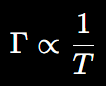
where T is the coherence time. Reducing environmental noise or shielding the brain’s quantum systems could enhance the ability of microtubules to maintain coherence.

Chapter 2: Neurons as Quantum Nodes in Consciousness
Building on the quantum processes occurring in microtubules, we now shift our focus to neurons—the fundamental units of the brain’s structure and function. In this chapter, we will explore how neurons act as quantum nodes within the brain’s quantum network. We’ll also delve into the mathematical description of neuron firing as a quantum process, connecting this to the broader framework of Quantum Realism (QR).
2.1. Neurons: Basic Structure and Function
Neurons are specialized cells responsible for transmitting information throughout the nervous system. Each neuron consists of three main components:
- Dendrites: Branch-like extensions that receive signals from other neurons.
- Cell Body (Soma): The core region containing the nucleus, responsible for integrating incoming signals.
- Axon: A long projection that sends signals to other neurons, muscles, or glands.
The transmission of signals between neurons occurs through action potentials—rapid electrical impulses that travel along the axon.
Classical View of Neuron Function
Traditionally, neurons are thought to function like electrical circuits. An action potential is generated when the neuron reaches a certain threshold potential (typically around -55 mV), causing ion channels to open and allowing positive ions (Na+) to rush into the cell. This depolarizes the neuron, sending the electrical impulse down the axon.
However, Quantum Realism proposes a deeper layer of explanation, where neurons aren’t just classical electrical circuits, but quantum nodes in a larger quantum information network.
2.2. Neurons as Quantum Nodes
Within the framework of QR, each neuron functions as a node that processes quantum information. Just as classical neurons fire when a threshold is reached, quantum neurons might operate on similar principles, but based on quantum state functions.
Quantum Superposition in Neurons
A single neuron can be thought of as existing in a superposition of firing and non-firing states until a measurement (or observation) is made. Mathematically, this can be expressed as:

where:
- ∣0⟩ represents the state where the neuron does not fire,
- ∣1⟩ represents the state where the neuron fires,
- α and β are probability amplitudes that describe the likelihood of each state.
The superposition of these states collapses into one observable outcome (either firing or not firing) when a measurement is made, analogous to how neurons are classically modeled to fire when certain conditions are met.
Quantum Tunneling in Neurons
Quantum tunneling could play a role in neuron firing. Under certain conditions, quantum effects may allow neurons to fire even if they have not reached the classical threshold. This could provide a mechanism for spontaneous or unexpected firing, which has been observed in some neurons.
The probability of quantum tunneling can be modeled by the tunneling probability formula:

where:
- Ptunnel is the probability of the neuron firing via quantum tunneling,
- V(x) is the potential energy barrier, and
- E is the energy of the neuron.
This equation suggests that even neurons with sub-threshold depolarization might still fire, adding a layer of quantum unpredictability to neuron behavior.
2.3. Quantum Network of Neurons
In QR, neurons are not isolated but form part of a quantum network. This network allows quantum information to be shared between neurons through entanglement. When two or more neurons become entangled, their quantum states are correlated, allowing for instantaneous communication of information across different regions of the brain.
Mathematics of Entangled Neurons
Consider two entangled neurons. Their joint quantum state can be represented as:

where:
- ∣00⟩ represents the state where both neurons do not fire,
- ∣11⟩ represents the state where both neurons fire,
- α and β describe the probability amplitudes of these states.
If one neuron fires ∣1⟩, the other will fire as well, even if there is no direct synaptic connection. This could explain phenomena such as synchronized firing in distant regions of the brain, where neurons fire together without direct communication.
The Brain as a Quantum Network
Neurons connected by quantum entanglement may form a quantum network, allowing for the non-local processing of information. This is in contrast to classical neuroscience, where information is processed locally by synaptic connections.
In this quantum network, each neuron (or group of neurons) functions as a node, sharing quantum information with other nodes across the brain. This might account for the holistic nature of consciousness, where experiences are not localized to specific brain regions but are the result of distributed processing.
2.4. Schrödinger’s Equation and Neuron Activity
As with microtubules, the quantum state of neurons evolves according to Schrödinger’s equation:

where ∣Ψ(t)⟩ is the wavefunction representing the neuron’s quantum state, and H is the Hamiltonian, representing the energy of the neuron.
In the case of neurons, the Hamiltonian can include:
- The membrane potential energy, representing the difference in electrical charge across the neuron’s membrane,
- The synaptic interaction energy, representing the quantum interaction between neurons connected by synapses,
- The environmental interaction, which could include external stimuli, noise, and other factors affecting the neuron’s quantum state.
This equation describes how the neuron’s quantum state evolves over time, possibly leading to the collapse of the wavefunction (the neuron firing).
2.5. Coherence and Decoherence in Neurons
As with microtubules, maintaining quantum coherence in neurons is crucial for them to participate in conscious experience. If coherence is lost, the quantum system decoheres, leading to classical behavior.
- Coherence: When neurons maintain coherence, their quantum states remain in superposition and can engage in quantum processing.
- Decoherence: When neurons interact with the external environment (thermal noise), they lose their quantum coherence and behave classically. The decoherence time TD is a critical parameter, determining how long the neuron can remain in a coherent state:

where γ is the rate of environmental interaction.
Maintaining coherence is challenging in the brain’s warm and noisy environment, but QR proposes that quantum shielding mechanisms (possibly involving specific brain structures or biological processes) might help preserve coherence long enough for quantum processing to contribute to conscious experience.
2.6. Quantum Collapse and Consciousness
In QR, neurons contribute to conscious experience through the process of quantum collapse. When neurons are in superposition, multiple possibilities (firing or not firing) are explored simultaneously. However, when a measurement (observation) is made, the wavefunction collapses, and one possibility is realized.
This quantum collapse could be tied to decision-making or conscious awareness, where the act of observing a choice (or thought) collapses the quantum possibilities into a single outcome. Mathematically, the probability of a neuron firing, given a conscious decision, might be represented by:

where ⟨Ψ∣C⟩ is the inner product between the quantum state of the neuron Ψ and the conscious state C.

Chapter 3: Brain Sections as Quantum Processing Hubs
In this chapter, we will explore how different sections of the brain function as quantum processing hubs in the framework of Quantum Realism (QR). Building on the quantum behavior of microtubules and neurons, we’ll discuss how entire brain regions integrate quantum information. These sections might perform specialized quantum computations, contributing to various aspects of conscious experience. We will also introduce relevant mathematics to describe quantum interactions across brain regions.
3.1. Major Brain Sections and Their Functions
The brain consists of several distinct regions, each responsible for specific cognitive functions. These regions can be thought of as hubs in a larger quantum network, where they process and share quantum information.
- Cerebral Cortex: Responsible for higher-order cognitive functions, including decision-making, reasoning, and perception.
- Hippocampus: Involved in memory formation and spatial navigation.
- Cerebellum: Coordinates motor control and balance.
- Thalamus: Acts as a relay station for sensory information.
- Amygdala: Associated with emotions, especially fear and pleasure.
Each of these regions could be viewed as quantum processing centers, where complex quantum states interact and evolve to produce the cognitive phenomena we associate with these functions.
3.2. Quantum Processing in the Cerebral Cortex
The cerebral cortex is the outer layer of the brain, responsible for many of the cognitive abilities that define consciousness. In QR, the cortex may act as a quantum processor, where superpositions of thoughts, decisions, and sensory inputs are computed.
Quantum Superposition of Thoughts
In QR, the brain does not merely process individual bits of information but entire superpositions of possible thoughts. Consider the cortex evaluating a decision between two choices. Before making a decision, the quantum state of the brain might be described by a superposition:

where:
- ∣A⟩ represents the state where the decision favors option A,
- ∣B⟩ represents the state where the decision favors option B,
- α and β are the probability amplitudes that describe the likelihood of each outcome.
In this view, decision-making in the cortex may involve quantum parallel processing, where multiple potential decisions are considered simultaneously until one is chosen through the collapse of the quantum state.
Quantum Coherence in the Cortex
To sustain quantum processing, the neurons in the cortex must maintain quantum coherence, allowing them to function as a collective quantum system. This coherence enables multiple neurons to work together on the same quantum state, amplifying their computational power.
The coherence time TC in the cortex depends on how well the neurons are shielded from environmental noise, which could cause decoherence. Mathematically, the coherence of the cortical network can be described by a coherence function g(t), which decays exponentially over time:

where γ is the decoherence rate, determined by factors such as temperature and noise.
The longer TC is, the more time the cortex has to perform quantum computations before environmental interactions cause the system to decohere, resulting in classical behavior. Which is why exposure to EM radiation is detrimental.
3.3. Memory and Quantum States in the Hippocampus
The hippocampus is critical for memory formation. In QR, memory might not just be a classical storage of information, but rather the storage of quantum states representing past experiences.
Quantum Superposition of Memories
Memories might be stored as quantum states that encode different experiences in a superposition. When recalling a memory, the brain collapses the quantum state to retrieve a specific experience. Mathematically, we can represent the state of memory as:

where ∣Mi⟩ represents the quantum state associated with memory Mi, and αi are probability amplitudes.
When you actively recall a memory, you are collapsing the superposition into a specific memory state, similar to the collapse of a quantum wavefunction in quantum mechanics.
Quantum Entanglement of Memories
Another possible mechanism in the hippocampus is the entanglement of memories. Two memories can become entangled, meaning that recalling one memory might influence the recall of another. This might explain why one memory often triggers a cascade of related memories.
For two entangled memories, their joint quantum state can be described as:

This entangled state reflects the idea that the two memories are linked, and recalling one will automatically influence the other.
3.4. Emotion and Quantum Interactions in the Amygdala
The amygdala plays a central role in processing emotions, particularly fear and pleasure. In the QR framework, the emotional states in the amygdala might be influenced by quantum fluctuations in the quantum network.
Quantum Fluctuations and Emotional States
Emotional states might correspond to the quantum fluctuations of the brain’s quantum field, where different emotional intensities can be represented by fluctuations in the probability amplitudes of specific quantum states.
For example, a quantum state representing fear might be described as:

where ∣0⟩ represents a calm state, and ∣1⟩ represents a high-fear state. The probability of experiencing fear can change based on the quantum fluctuations in α and β, which are constantly in flux due to quantum effects.
3.5. Sensory Integration in the Thalamus
The thalamus acts as a relay station for sensory information, sending data from sensory organs to the appropriate parts of the brain. In QR, the thalamus might act as a quantum router, directing quantum information to the correct processing hubs in the brain.
Quantum Information Routing
When sensory input is received (such as visual information), it enters a superposition of all possible sensory states:

where ∣Si⟩ represents a specific sensory experience (sight, sound, touch).
The thalamus then directs this quantum information to the appropriate part of the brain for further processing. This routing might involve the collapse of the superposition into a specific sensory experience, such as sight being processed by the visual cortex.
3.6. The Cerebellum: Quantum Control of Motor Functions
The cerebellum is responsible for coordinating motor control and balance. In QR, motor control may involve the quantum processing of spatial and movement information, allowing the cerebellum to execute complex tasks with precision.
Quantum Superpositions of Motor Commands
Motor commands can be thought of as quantum superpositions of possible movements. Before a specific movement is executed, the cerebellum may process all possible motor commands in parallel:

where ∣Mj⟩ represents a specific motor command, and αj are probability amplitudes.
Once the brain selects a particular motor command, the superposition collapses into a single action, such as lifting an arm or walking. This quantum processing allows for precise motor coordination.
3.7. Quantum Interactions Across Brain Regions
The brain regions discussed above are not isolated but work together as part of a global quantum network. Quantum entanglement between different brain regions allows for seamless integration of information, ensuring that sensory input, emotions, thoughts, and motor control all contribute to the overall conscious experience.
Mathematics of the Global Brain State
The global quantum state of the brain might be described as a superposition of the quantum states of each individual region:
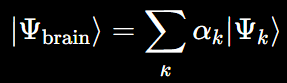
where ∣Ψk⟩ represents the quantum state of the k-th brain region, and αk are probability amplitudes. These regions communicate through quantum entanglement, ensuring that the brain processes information holistically, rather than in isolated parts.
This global entanglement could account for the unified nature of conscious experience, where emotions, memories, thoughts, and actions are experienced as part of a cohesive whole.

Chapter 4: The Brain as a Unified Quantum System and Brainwaves
In this chapter, we will discuss how the entire brain functions as a unified quantum system within the framework of Quantum Realism (QR). We’ll explore how brainwaves represent quantum oscillations in the brain’s quantum field and how these oscillations correlate with different states of consciousness. Mathematical models will help us understand the dynamic processes underlying brainwaves and the unified brain’s quantum behavior.
4.1. The Brain as a Unified Quantum System
The human brain operates as a highly interconnected network of billions of neurons. In the QR framework, this network behaves not just classically but also quantum mechanically, with the brain functioning as a quantum system that processes information at both local (neuronal) and global (brain-wide) levels.
Quantum Superposition Across the Brain
When the brain processes information, such as thinking about a problem or making a decision, it explores a superposition of possibilities before collapsing into a single outcome. This superposition can occur over large networks of neurons, leading to a distributed quantum state across different brain regions.
The global quantum state of the brain can be described as:
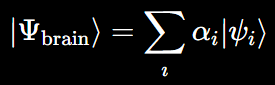
where ∣ψi⟩ represents the quantum state of different brain subsystems (cortex, hippocampus, amygdala), and αi are the probability amplitudes of these states.
The brain integrates these superpositions into a coherent whole, ensuring that different cognitive functions (memory, decision-making, emotion) are processed simultaneously and contribute to a unified conscious experience.
Quantum Entanglement in the Brain
Entanglement is a key feature of quantum systems, where the state of one part of the system is correlated with the state of another, regardless of physical distance. In the brain, neuronal networks can become entangled, meaning that their quantum states are linked, allowing them to share information instantaneously.
Entangled states in the brain might take the form:

where neurons or brain regions i and j are entangled, and αij represents the strength of the entanglement.
Entanglement allows for non-local processing, meaning that distant parts of the brain can interact and synchronize without direct synaptic connections, potentially accounting for the rapid integration of information across the brain.
4.2. Brainwaves as Quantum Oscillations
Brainwaves are electrical oscillations produced by synchronized activity of neurons. In QR, brainwaves may represent quantum oscillations within the brain’s quantum network, where they reflect the dynamics of the brain’s quantum state. Different types of brainwaves are associated with different levels of consciousness, from deep sleep to heightened awareness.
Types of Brainwaves
Brainwaves are generally classified into five main categories, each corresponding to different states of consciousness:
- Delta Waves (1-4 Hz): Associated with deep, dreamless sleep and unconsciousness.
- Theta Waves (4-8 Hz): Linked to light sleep and deep relaxation, often seen during meditation.
- Alpha Waves (8-12 Hz): Observed during relaxed wakefulness, often when eyes are closed.
- Beta Waves (12-30 Hz): Present during active thinking and problem-solving.
- Gamma Waves (30-100 Hz): Associated with higher cognitive functions, such as learning and memory consolidation.
In the QR framework, each brainwave frequency could represent different levels of quantum coherence in the brain’s quantum field. Higher frequencies (gamma waves) might correspond to states of greater quantum coherence and more complex quantum processing, while lower frequencies (delta waves) might indicate lower coherence or simpler processing states.
4.3. Mathematical Model of Brainwaves
Brainwaves can be described mathematically using wave equations, which capture their oscillatory nature. In QR, these waves might represent quantum oscillations in the brain’s quantum field.
Quantum Wave Function and Brainwaves
We can represent brainwaves using a wave function Ψ(t) that evolves over time. The general form of a quantum wave function can be written as:

where:
- A is the amplitude of the wave,
- ω is the angular frequency (related to the frequency of the brainwave),
- ϕ is the phase of the wave.
The wave function describes the oscillatory behavior of brainwaves. Different brainwave frequencies correspond to different values of ω, with higher frequencies (gamma waves) having larger values of ω.
Superposition of Brainwaves
Just as quantum systems can exist in a superposition of states, brainwaves can be seen as a superposition of multiple oscillatory frequencies. The overall brainwave state can be described by a sum of different frequency components:
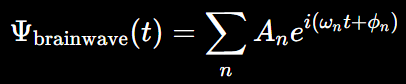
where An and ωn represent the amplitude and frequency of the n-th brainwave component.
This superposition allows the brain to process different types of information simultaneously. For example, the brain might engage in both low-frequency delta waves (for maintaining unconscious bodily functions) and high-frequency gamma waves (for conscious thought) at the same time, representing the parallel processing capabilities of the quantum brain.
4.4. Brainwaves and Quantum Coherence
In QR, the coherence of brainwaves is closely tied to the quantum coherence of the brain’s quantum state. When neurons across the brain are in quantum coherence, their brainwaves are synchronized, leading to a stable and harmonious state of consciousness.
Phase Synchronization
The synchronization of brainwaves across different regions of the brain can be described by phase coherence. If the brain regions are coherent, their brainwaves maintain a constant phase difference:

where ϕ1 and ϕ2 are the phases of brainwaves in two different regions.
When brain regions are quantum-coherent, their brainwaves are phase-synchronized, leading to a unified state of consciousness. This might explain moments of flow or intense focus, where the brain operates as a highly coherent quantum system.
Decoherence and Brainwaves
When the brain loses quantum coherence, decoherence occurs, leading to a breakdown in brainwave synchronization. This can result in disorganized brain activity, which may manifest as cognitive difficulties, confusion, or loss of consciousness.
The decoherence time TD of the brain determines how long brain regions can remain synchronized. This decoherence time is inversely related to environmental noise and other external factors:

where γ is the rate of interaction with the environment. The longer the brain maintains coherence, the more effectively it can process information quantum-mechanically.
4.5. Quantum Collapse and Brainwaves
As discussed in earlier chapters, quantum collapse occurs when a quantum superposition is reduced to a single outcome. In the brain, quantum collapse might correspond to moments of conscious decision-making, where multiple possibilities are evaluated and one is selected.
Collapse of Brainwave Superpositions
When the brain is in a superposition of different brainwave states, the collapse of this superposition might occur when a decision is made, leading to the brain settling into a specific brainwave pattern. Mathematically, this can be described by the collapse of the wavefunction:

where P(Ψ|C) is the probability of collapsing into a specific brainwave state given a particular conscious decision.
This collapse might correspond to the shift from one brainwave frequency to another, such as when the brain transitions from relaxed alpha waves to high-focus beta waves during problem-solving.
4.6. Global Brainwaves and Collective Consciousness
In QR, brainwaves may not be confined to individual brains. Collective consciousness could emerge from the entanglement of brainwaves across multiple individuals, leading to a global quantum network of consciousness.
Mathematics of Collective Brainwaves
The collective brainwave state of a group of individuals might be described as a global superposition:

where ∣Ψi⟩ and ∣Ψj⟩ represents the brainwave state of individuals i and j, and αij represents the quantum correlation (entanglement) between i and j.
This global brainwave state could reflect collective experiences, such as during group meditations, synchronized activities, or collective emotional responses. Quantum coherence across individuals might lead to shared conscious states, explaining phenomena like group intuition or hive-mind behavior in certain social or cultural contexts.

Chapter 5: Experiments to Test Quantum Realism and Consciousness
In this chapter, we will explore experimental approaches to test the predictions of Quantum Realism (QR) in relation to brain function and consciousness. These experiments will aim to detect quantum coherence, entanglement, and superposition within the brain, as well as examine the potential for quantum collapse during conscious decision-making. We will also discuss organizations that are currently researching the intersection of quantum mechanics and consciousness.
5.1. Testing Quantum Coherence in the Brain
Quantum coherence is a key feature of quantum systems, where parts of the system (such as neurons or microtubules) maintain a superposition and interact in phase with one another. In the context of the brain, testing for coherence could provide evidence for quantum processing underlying consciousness.
5.1.1. Coherence Detection in Microtubules
One of the most direct ways to test the QR hypothesis is to detect quantum coherence within microtubules, the tiny structures within neurons. As proposed in the Orch OR theory (Penrose and Hameroff), microtubules could serve as sites for quantum computation, but this requires that they maintain quantum coherence for extended periods.
- Experiment: Researchers could use advanced quantum detectors, such as superconducting quantum interference devices (SQUIDs), to measure the quantum states of microtubules in living cells. These devices are sensitive to minute quantum fluctuations and could reveal whether microtubules are in a coherent quantum state.
- Goal: Detect sustained coherence within microtubules that could correspond to quantum information processing associated with conscious thought.
Mathematical framework:

This equation describes the coherence function g(t), where γ is the decoherence rate. Longer coherence times would support the idea that microtubules could contribute to quantum information processing relevant to consciousness.
5.1.2. Coherence in Neurons
Quantum coherence in entire neurons could also be measured. Since neurons function as part of a larger quantum network, their ability to maintain quantum coherence would be crucial for brain-wide quantum processing.
- Experiment: Quantum brain imaging techniques, such as magnetoencephalography (MEG), could be modified to detect signatures of quantum coherence at the neuronal level. Researchers might search for phase coherence between neurons in different brain regions, which would indicate synchronized quantum states across the brain.
- Goal: Detect quantum coherence across neuronal networks, especially during cognitive tasks that require high levels of focus, such as problem-solving or meditation.
5.2. Measuring Quantum Entanglement in the Brain
Quantum entanglement is a phenomenon where two or more quantum systems become correlated such that the state of one directly affects the state of the other, even across long distances. In QR, neurons or brain regions may become entangled, allowing for instantaneous communication of quantum information.
5.2.1. Entanglement Between Brain Regions
If different regions of the brain are entangled, we might observe correlations in their activity that cannot be explained by classical signals. For instance, brain regions involved in memory and emotion could be entangled, explaining the rapid recall of emotionally charged memories.
- Experiment: Functional MRI (fMRI) could be used to monitor the activity of entangled brain regions. By looking for non-local correlations—patterns of brain activity that arise simultaneously but are not directly linked by neural pathways—researchers could identify entanglement.
- Goal: Detect quantum entanglement between distant brain regions, providing evidence for non-local quantum information processing.
Mathematical representation of entanglement:

This describes the entangled state of two neurons or brain regions, where the states are correlated even though they are physically distant.
5.2.2. Global Brain Entanglement and Collective Consciousness
Beyond individual brains, collective consciousness might involve the entanglement of brainwaves between different individuals. Testing for quantum entanglement in group settings could help investigate this possibility.
- Experiment: In group meditations or rituals, EEG or MEG could be used to monitor the brainwaves of participants. Researchers would look for synchronization and entanglement of brainwave patterns across individuals, especially during moments of collective focus or shared emotion.
- Goal: Detect quantum entanglement between the brainwaves of different individuals, suggesting the possibility of a global consciousness network.
5.3. Quantum Collapse and Conscious Decision-Making
In QR, quantum collapse occurs when a quantum system in superposition collapses into a definite state. In the brain, this might correspond to moments of conscious decision-making, where multiple possibilities are evaluated and one is selected.
5.3.1. Detecting Quantum Collapse in Cognitive Tasks
To test for quantum collapse during decision-making, researchers could design experiments where subjects are faced with complex choices. If quantum collapse is involved, we might observe sudden shifts in brain activity as the wavefunction collapses into a specific outcome.
- Experiment: Using real-time EEG or fMRI, researchers could monitor brain activity during decision-making tasks. By analyzing the timing and nature of brainwave shifts, they might identify the moment of quantum collapse, where the brain transitions from a superposition of possible choices to a single decision.
- Goal: Detect sudden, non-linear shifts in brain activity during decision-making that correspond to quantum collapse.
Mathematical representation:

This equation describes the probability of a specific conscious state C collapsing from the superposition of quantum possibilities Ψ.
5.4. Brainwaves and Quantum Oscillations
Brainwaves are measurable oscillations of electrical activity in the brain, and in QR, they could represent quantum oscillations of the brain’s quantum field. Measuring brainwaves in different states of consciousness can provide insight into the underlying quantum processes.
5.4.1. Measuring Brainwave Coherence
Researchers can explore the coherence of brainwaves during various cognitive states, such as meditation, problem-solving, or dreaming. High levels of brainwave coherence might indicate quantum coherence within the brain’s quantum field.
- Experiment: EEG or MEG can measure brainwave coherence. By correlating high-frequency brainwaves (gamma waves, associated with heightened awareness) with states of focused attention, we might find evidence of underlying quantum coherence.
- Goal: Detect sustained brainwave coherence during states of intense focus or meditation, which could be linked to quantum coherence in the brain.
Mathematical description:
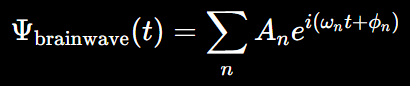
This superposition of brainwave frequencies describes the quantum oscillations of the brain’s quantum state, where coherence across frequencies might correlate with heightened consciousness.
5.5. Research Organizations Investigating Quantum Consciousness
Several research organizations are currently exploring the intersection of quantum mechanics and consciousness. These organizations focus on understanding how quantum processes might underlie cognitive functions such as decision-making, perception, and memory.
5.5.1. The Penrose-Hameroff Consciousness Research Group
This group focuses on the Orch OR theory, which proposes that microtubules within neurons are involved in quantum computations that contribute to consciousness. Their research aims to validate the theory by detecting quantum coherence in microtubules.
5.5.2. The Global Consciousness Project (GCP)
The GCP explores the possibility of global consciousness, where human minds might be connected through quantum entanglement. Using random number generators (RNGs), they measure correlations in random data during global events, suggesting a potential link between human consciousness and quantum phenomena.
5.5.3. CERN and Quantum Biology Initiatives
While CERN primarily focuses on particle physics, some researchers are investigating the implications of quantum mechanics for biological systems, including the brain. Quantum biology initiatives seek to understand how quantum effects might influence cognitive processes.
5.5.4. MIT Media Lab and Quantum Computation in the Brain
MIT’s Media Lab is exploring the potential for quantum computing within biological systems, including the brain. Their research focuses on identifying how quantum processes, such as quantum tunneling and superposition, might contribute to brain function.


 Bantam Joe
Leave a comment