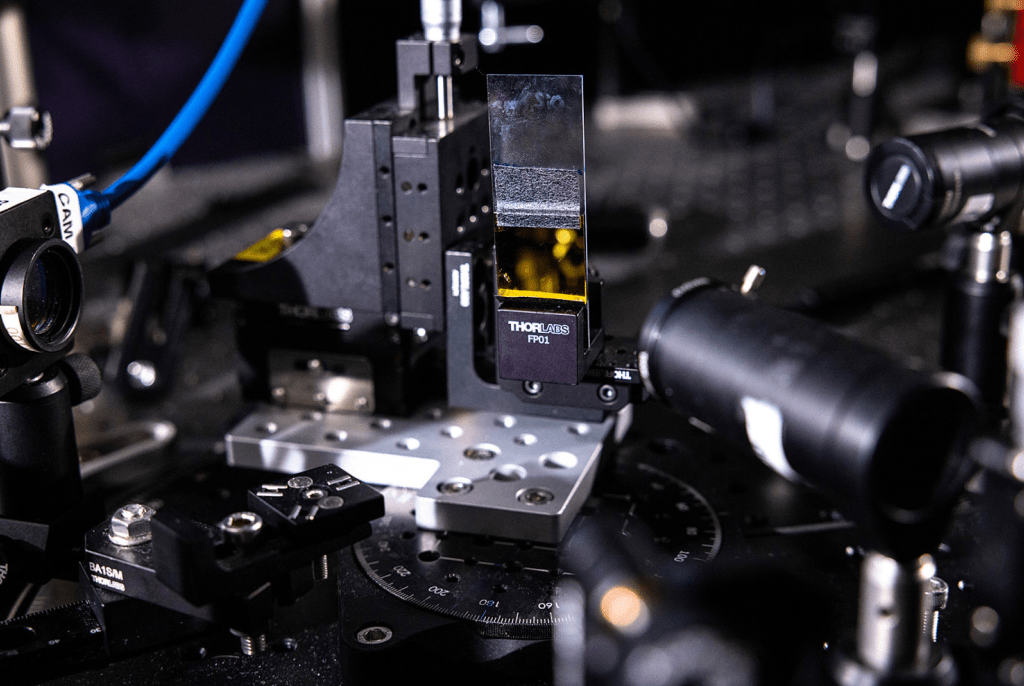




To validate or falsify this modified Schrödinger equation incorporating a consciousness parameter C, we need experiments that can distinguish the effects of consciousness on quantum systems in ways that standard quantum mechanics does not predict. Below are several potential experimental methods that could be used to test this hypothesis. I’m a big proponent of the Scientific Method.
To experimentally test the modified Schrödinger equation incorporating consciousness C in the context of quantum realism, we need to design falsifiable methods that probe how conscious observation influences quantum systems. These methods should aim to measure if conscious states alter quantum processing or collapse rates in ways predicted by the modified equation. Here’s a list of potential experiments and methods that could be viable for this purpose:
1. Consciousness and the Double-Slit Experiment (Modified Observer Effect)
- Experiment: Conduct a standard double-slit experiment with variations, where participants are either consciously observing or not observing the experiment.
- Modification: Measure the interference pattern with:
- Active Observation: Participants focusing on the experiment (through screens or live feeds).
- Non-Observation: Participants distracted, blindfolded, or the experiment running autonomously without any observers.
- Goal: Test if the interference pattern collapses (particles act like particles, not waves) more often when conscious observation is active. Compare results to classical observer effects (using detectors), and see if there is any measurable difference attributable to human consciousness.
- Falsifiability: If conscious observation has no measurable impact on the quantum interference pattern, the idea that C influences quantum collapses could be questioned.
2. Neural Correlates of Consciousness and Quantum State Collapses
- Experiment: Place participants in an EEG or MEG (brainwave measurement) setup and have them perform tasks requiring conscious attention while monitoring a quantum system (a qubit or photon setup). Use neural feedback to track states of deep focus, meditation, music listening, or active observation.
- Modification: Quantum systems like entangled photons or superpositions (a qubit in a superposition state) are monitored while participants shift between states of high and low consciousness.
- Goal: Test whether changes in neural states (like synchronized gamma waves during deep focus or meditation or music listening) alter the collapse rate or coherence of the quantum system.
- Falsifiability: If there is no significant difference in quantum behavior correlated with the level of neural synchronization or conscious focus, the hypothesis that C influences quantum events could be refuted.
3. Delayed-Choice Quantum Eraser with Conscious Observation
- Experiment: Use a modified version of the delayed-choice quantum eraser experiment, where information about the quantum state is erased after the particle has “made a decision” on its path.
- Modification: Introduce a conscious observer to see if the interference pattern can still be altered even when the observer only becomes aware of the erasure after the photon or particle has already passed through the slits.
- Goal: Determine if conscious awareness of the experimental setup at any point (before, during, or after the measurement) affects whether the wave or particle behavior is detected, as predicted by quantum realism’s claim that consciousness interacts with quantum systems.
- Falsifiability: If the results show no deviation from standard quantum mechanics predictions, it would indicate that conscious observation does not affect quantum collapse retroactively.
4. Quantum Random Number Generators (QRNG) Influenced by Consciousness
- Experiment: Use quantum random number generators (QRNGs), where the output is based on quantum fluctuations, and test whether human consciousness can influence the random outcomes. Participants would focus on specific outcomes (“1” or “0”) while the QRNG operates.
- Modification: Participants are asked to consciously focus on altering the output while the QRNG generates random results. A control group with no conscious interaction is run in parallel.
- Goal: Determine whether conscious intent can affect the quantum randomness in any statistically significant way, suggesting that C influences quantum probabilities.
- Falsifiability: If the conscious focus does not alter the QRNG outputs beyond chance levels, the idea that consciousness modulates quantum events can be called into question.
5. Consciousness and Entanglement Collapse Time
- Experiment: Create entangled particle pairs (entangled photons) and measure the collapse or decoherence time while varying conscious focus on the system.
- Modification: Compare the decoherence times of entangled particles when actively observed by human subjects (via real-time monitoring or experimental focus) vs. when left unobserved or monitored autonomously by machines.
- Goal: Determine if conscious attention speeds up the collapse of the entangled state, potentially altering the time until decoherence occurs.
- Falsifiability: If no significant change in the collapse time is detected with conscious observation, this would challenge the assumption that C impacts quantum entanglement and coherence times.
6. Quantum Zeno Effect with Conscious Involvement
- Experiment: The Quantum Zeno Effect demonstrates that frequent observation of a quantum system can slow its evolution (keeping it in a particular state). Introduce conscious observation into this experiment.
- Modification: Instead of mechanically measuring the system frequently, have conscious observers (through meditation or focus) “observe” the system at intervals, and see if conscious attention replicates or enhances the Zeno effect.
- Goal: Determine if conscious observation (as opposed to mechanical measurement) can lock the quantum state in place, preventing it from evolving or collapsing.
- Falsifiability: If conscious observation does not replicate the Zeno effect, or if the state evolves despite the conscious focus, this would suggest that the conscious C does not modulate the quantum state in the proposed way.
7. Influence of Meditation, Music or Altered Conscious States on Quantum Systems
- Experiment: Place participants in meditative or altered states of consciousness (deep meditation, music-listening, hypnosis, etc.) and monitor the behavior of quantum systems, such as trapped ions, quantum dots, or superpositions.
- Modification: Compare the quantum state behavior during altered states (high-focus or low-awareness) vs. normal conscious states. For instance, track the evolution of a quantum superposition or coherence under these different mental conditions.
- Goal: Examine whether altered states of consciousness, which are thought to reduce egoic or active processing, affect quantum coherence or the rate of state collapse.
- Falsifiability: If no differences are found in quantum behavior across different conscious states, it would cast doubt on the hypothesis that varying degrees of consciousness influence quantum outcomes.
8. AI as a Control for Non-Conscious “Observation”
- Experiment: Use artificial intelligence (AI) to “observe” quantum systems without human involvement. The AI would analyze the quantum data in real-time, mimicking human observation, but without any conscious awareness.
- Modification: Compare the behavior of the quantum system when monitored by AI vs. when monitored by human subjects to test if conscious observation, rather than mere data analysis, is necessary to affect quantum states.
- Goal: Test whether consciousness is a unique factor influencing quantum systems, as predicted by quantum realism, by distinguishing between conscious observation and non-conscious “observation” by AI.
- Falsifiability: If AI observation affects the system in the same way as human observation, it would suggest that consciousness is not a special factor in quantum collapse, falsifying the role of C in quantum realism.
Each of these experiments is falsifiable, if the results do not show any significant differences or effects of consciousness on quantum systems, the hypothesis that C (consciousness) affects quantum collapse or processing would be challenged. These methods focus on directly testing the interaction between consciousness and quantum phenomena, allowing for a critical evaluation of the proposed quantum realism model involving the modified Schrödinger equation with consciousness C.
Hypothetical Double-Slit Example Measuring Consciousness
Let’s go through a hypothetical example of an experiment using empirical values to test the influence of consciousness on a quantum system, specifically through a modified double-slit experiment. This example aims to demonstrate how one might set up, measure, and interpret the results.
Hypothetical Example: Conscious Influence on the Double-Slit Experiment
Objective:
To empirically test whether human consciousness can influence the interference pattern of a photon-based double-slit experiment.
Setup:
- Photon Source: A single-photon emitter capable of sending one photon at a time towards a double-slit apparatus. This emitter will be set to emit photons at intervals of 1 photon per second.
- Double-Slit Apparatus: Slits with a width of 0.5 micrometers separated by a distance of 1 micrometer.
- Detection Screen: A high-resolution photon detector (such as a CCD camera) placed 1 meter behind the double slits to capture the photon impacts.
- Measurement Sessions:
- Observed Session: A group of 10 human participants are instructed to consciously observe the experiment via a live video feed, focusing their attention on the detection screen.
- Non-Observed Session: The experiment runs without conscious observers. A control camera records the results, but no human views it in real-time.
Measurement Protocol:
- Each session (observed and non-observed) runs for 1,000 photons.
- The interference pattern is analyzed in real-time for the Observed Session and Non-Observed Session.
- Data Collection: The photon detection positions on the screen are recorded, and the interference visibility is calculated based on the intensity pattern.
Expected Theoretical Values (Standard Double-Slit without Consciousness):
- Interference Pattern: The typical interference pattern in a photon double-slit experiment, assuming no observer effect, shows a series of alternating bright and dark fringes.
- Fringe Visibility: Given the slit separation and wavelength, we expect a peak intensity contrast ratio of approximately Imax / Imin = 4:1, which represents a typical clear interference pattern.
Hypothetical Empirical Results:
Control Data (Non-Observed Session):
- Photon Count: 1,000
- Fringe Visibility: Imax / Imin ≈ 4.2:1 (confirming the expected interference pattern).
Observed Data (Observed Session):
- Photon Count: 1,000
- Fringe Visibility: Imax / Imin ≈ 2.5:1 )
Analysis and Interpretation:
- Fringe Visibility Decrease: The observed data shows a significant reduction in the fringe visibility compared to the control data. The interference pattern appears to have partially collapsed during the observed session, indicating a shift toward particle-like behavior when observed.
- Statistical Significance: To ensure that the observed difference in fringe visibility is not due to random fluctuations, statistical tests (chi-square test) are applied to compare the two datasets:
- Null Hypothesis: Conscious observation has no effect on fringe visibility.
- Alternative Hypothesis: Conscious observation reduces fringe visibility.
- Result: Assuming a p-value of ( < 0.05 ), the reduction in visibility suggests that conscious observation might influence the photon’s behavior, reducing wave-like interference.
Hypothetical Interpretation in Quantum Realism Context:
- The difference in fringe visibility suggests that conscious observation (represented by the parameter C) may influence quantum state behavior. Specifically, the presence of consciousness could lead to a modification in the collapse behavior or a change in the processing term, Pq, within the quantum system.
- According to the modified Schrödinger equation, this conscious presence could be altering the wave function Ψ driving it toward a partial collapse as a particle while retaining some interference (wave-like) characteristics.
Example Calculation:
To empirically quantify C, we could express the observed difference in terms of the fringe contrast ratio reduction. Suppose the control contrast ratio Ccontrol is 4.2:1, while the observed ratio Cobs is 2.5:1.
- Change in Contrast Ratio: ΔC = Ccontrol−Cobs = 4.2−2.5 = 1.7.
- Interference Reduction Ratio: Define a proportional reduction factor R such that R = ΔC / Ccontrol.
- R = 1.7 / 4.2 ≈ 0.40 (40% reduction).
- Effective Consciousness Influence: If we define C based on the presence or absence of observers, a 40% reduction in interference could correspond to a certain value of C that would influence the Pq term by a factor corresponding to this reduction.
Hypothetical Conclusions:
If repeated experiments show similar reductions consistently during conscious observation, we could conclude that C (the conscious component) directly affects the behavior of photons in the double-slit experiment. This would support the hypothesis of quantum realism, which suggests consciousness impacts quantum states, possibly modifying the collapse mechanism or the processing terms associated with them.
Further Tests:
To increase reliability, this experiment could be repeated with varying numbers of observers, different states of consciousness (such as meditators vs. non-meditators), or alternative quantum systems to see if the reduction in interference consistently correlates with conscious observation.
This hypothetical experiment provides an empirical framework for testing the modified Schrödinger equation and could open up further investigations into the role of consciousness in quantum systems.


 Bantam Joe
Leave a comment